AgentAnycast
Connect AI agents across any network. No public IP required.





The A2A protocol assumes every agent has a public URL -- but real agents run on laptops, behind NATs, inside corporate firewalls. AgentAnycast is a P2P runtime that gives any agent a reachable identity. End-to-end encrypted, NAT-traversing, zero config on LAN.
Try it now
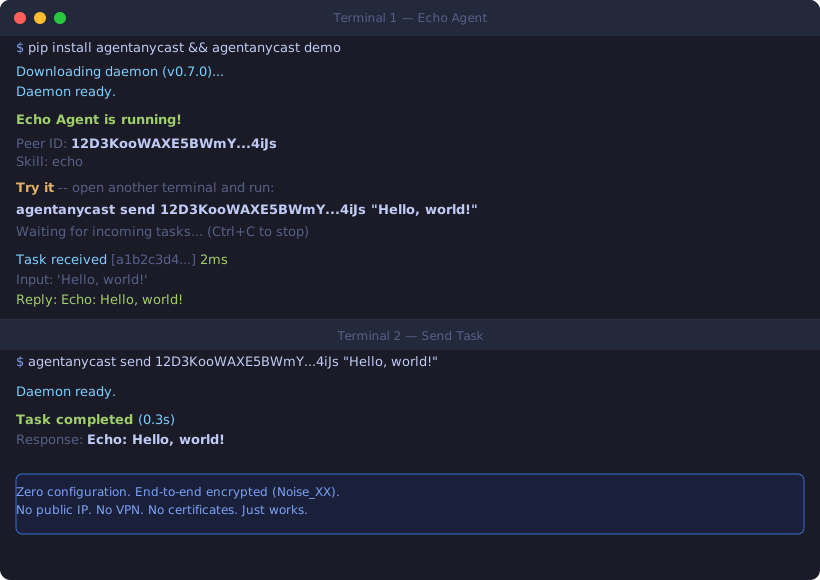
pip install agentanycast && agentanycast demo
# Open another terminal:
agentanycast send <PEER_ID> "Hello!"
The daemon downloads automatically. The demo prints the exact command to test it.
pip install agentanycast        # Python SDK
npm install agentanycast        # TypeScript SDK
uvx agentanycast-mcp            # MCP Server for Claude, Cursor, VS Code, etc.
Why AgentAnycast?
The A2A protocol assumes every agent has a public URL. That excludes agents on laptops, behind NATs, or inside private networks. AgentAnycast fixes this:
| No public IP needed | pip install and your agent is reachable. The Go sidecar daemon is auto-managed. |
| Find by skill, not address | Anycast routing discovers the right agent by capability. No URLs, no DNS. |
| E2E encrypted | Noise_XX protocol. Relay servers see only ciphertext. No plaintext path in the codebase. |
| Works behind any firewall | Automatic NAT traversal (DCUtR hole-punching + relay fallback). |
| Cross-language | Python and TypeScript agents interoperate on the same network. |
Quick Start
Python
pip install agentanycast
from agentanycast import Node, AgentCard, Skill

card = AgentCard(
    name="EchoAgent",
    description="Echoes back any message",
    skills=[Skill(id="echo", description="Echo the input")],
)

async with Node(card=card) as node:
    @node.on_task
    async def handle(task):
        text = task.messages[-1].parts[0].text
        await task.complete(artifacts=[{"parts": [{"text": f"Echo: {text}"}]}])

    print(f"Agent running — Peer ID: {node.peer_id}")
    await node.serve_forever()
TypeScript
npm install agentanycast
import { Node, type AgentCard } from "agentanycast";

const card: AgentCard = {
  name: "EchoAgent",
  description: "Echoes back any message",
  skills: [{ id: "echo", description: "Echo the input" }],
};

const node = new Node({ card });
await node.start();

node.onTask(async (task) => {
  const text = task.messages.at(-1)?.parts[0]?.text ?? "";
  await task.complete([{ parts: [{ text: `Echo: ${text}` }] }]);
});

console.log(`Agent running — Peer ID: ${node.peerId}`);
await node.serveForever();
Python and TypeScript agents interoperate out of the box -- same daemon, same protocol, same network.
MCP Server (Any AI Tool)
No code needed. Install the MCP server and use P2P agents from Claude Desktop, Cursor, VS Code, or any MCP-compatible tool:
uvx agentanycast-mcp
Add to your AI tool's config (example: Claude Desktop):
{
  "mcpServers": {
    "agentanycast": {
      "command": "uvx",
      "args": ["agentanycast-mcp"]
    }
  }
}
Then ask: "Find agents that can translate Japanese" or "Send a task to the summarize agent".
See platform-specific setup for Cursor, VS Code, Windsurf, JetBrains, Gemini CLI, and more.
How It Works
AgentAnycast uses a sidecar architecture: a thin SDK talks to a local Go daemon over gRPC. The daemon handles all P2P networking, encryption, and protocol logic.
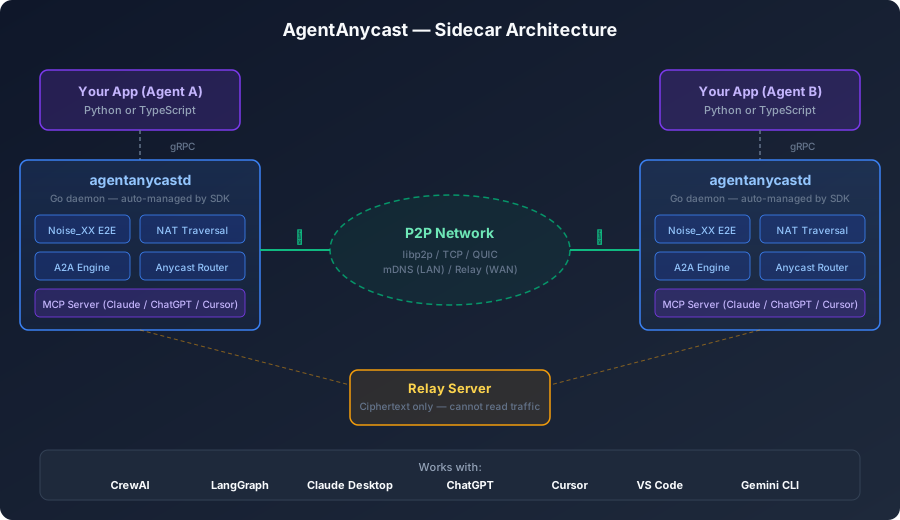
- On a LAN -- agents find each other via mDNS. Zero configuration.
- Across networks -- deploy a self-hosted relay. Agents connect through it, but the relay cannot read traffic (end-to-end encrypted).
- Behind NAT -- the daemon tries hole-punching (DCUtR) first, then falls back to relay.
- Identity -- each agent gets an Ed25519 key pair mapped to W3C DIDs (
did:key,did:web). No certificates, no DNS, no accounts.
Three Ways to Connect
# 1. Direct — send to a known agent by Peer ID
await node.send_task(peer_id="12D3KooW...", message=msg)

# 2. Anycast — send by skill, the network finds the right agent
await node.send_task(skill="translate", message=msg)

# 3. HTTP Bridge — reach standard HTTP-based A2A agents
await node.send_task(url="https://agent.example.com", message=msg)
| Mode | Use case |
|---|---|
| Direct | You know the agent's Peer ID. Point-to-point, lowest latency. |
| Anycast | You need a capability ("translate", "summarize"). The skill registry routes to an available agent. |
| HTTP Bridge | The target is a standard HTTP A2A agent. The bridge translates between P2P and HTTP bidirectionally. |
Framework Adapters
Turn existing agent frameworks into P2P agents with one function call:
from agentanycast.adapters.crewai import serve_crew
from agentanycast.adapters.langgraph import serve_graph
from agentanycast.adapters.adk import serve_adk_agent
from agentanycast.adapters.openai_agents import serve_openai_agent
from agentanycast.adapters.claude_agent import serve_claude_agent
from agentanycast.adapters.strands import serve_strands_agent

await serve_crew(my_crew, card=card, relay="...")          # CrewAI
await serve_graph(my_graph, card=card, relay="...")         # LangGraph
await serve_adk_agent(my_agent, card=card, relay="...")     # Google ADK
await serve_openai_agent(my_agent, card=card, relay="...")  # OpenAI Agents SDK
await serve_claude_agent(prompt="...", card=card)           # Claude Agent SDK
await serve_strands_agent(my_agent, card=card)              # AWS Strands Agents
Key Features
| End-to-end encryption | Noise_XX protocol. No plaintext transport path. Relay servers see only ciphertext. |
| NAT traversal | AutoNAT detection, DCUtR hole-punching, Circuit Relay v2 fallback. |
| Skill-based routing | Anycast addressing by capability. Relay skill registry with optional multi-relay federation. |
| Decentralized identity | Ed25519 keys, W3C DID (did:key, did:web, did:dns), Verifiable Credentials. |
| A2A protocol | Native implementation of Agent Card, Task, Message, Artifact, and the full task lifecycle. |
| HTTP Bridge | Bidirectional translation between P2P agents and standard HTTP A2A agents. |
| MCP interop | MCP Tool <-> A2A Skill mapping. Daemon runs as an MCP server (stdio + HTTP). |
| Cross-language | Python and TypeScript SDKs sharing the same daemon, protocol, and network. |
Interoperability
| Ecosystem | Integration |
|---|---|
| A2A | Native implementation -- Agent Card, Task, Message, Artifact |
| HTTP A2A | Bidirectional HTTP Bridge between P2P and HTTP agents |
| MCP | Daemon as MCP server; SDK maps MCP Tools <-> A2A Skills |
| ANP | Agent Network Protocol bridge |
| W3C DID | did:key, did:web, did:dns identity + Verifiable Credentials |
| AGNTCY | Agent directory integration + OASF record conversion |
Comparison
| AgentAnycast | Standard A2A | agentgateway | |
|---|---|---|---|
| Works behind NAT | Yes (automatic) | No | No |
| E2E encrypted through relays | Yes (Noise_XX) | No (TLS terminates) | No (proxy decrypts) |
| Skill-based routing | Yes | No | No |
| MCP server built-in | Yes | No | Yes |
| Setup complexity | pip install + 3 lines | HTTP server + public IP | Gateway deployment |
Self-Hosted Relay
On a LAN, no relay is needed -- agents discover each other via mDNS.
For cross-network communication, deploy a relay on any machine with a public IP:
git clone https://github.com/AgentAnycast/agentanycast-relay.git && cd agentanycast-relay
docker compose up -d
Then point agents to it:
async with Node(card=card, relay="/ip4/<IP>/tcp/4001/p2p/12D3KooW...") as node:
    ...
The relay is a zero-knowledge forwarder -- it passes only encrypted bytes. It also hosts a skill registry for anycast discovery, with optional multi-relay federation.
Repository Ecosystem
| Repository | Language | Description |
|---|---|---|
| agentanycast | -- | Documentation, protocol definitions (proto/), examples -- you are here |
| agentanycast-mcp | Python | MCP server for Claude, Cursor, VS Code, and 13+ AI tools |
| agentanycast-python | Python | Python SDK -- pip install agentanycast |
| agentanycast-ts | TypeScript | TypeScript SDK -- npm install agentanycast |
| agentanycast-node | Go | Core daemon -- P2P networking, encryption, A2A engine |
| agentanycast-relay | Go | Relay server + skill registry + multi-relay federation |
Examples
Start with 01-hello-world or explore all examples -- including CrewAI, LangGraph, Google ADK, OpenAI Agents, Claude Agent SDK, and AWS Strands integrations.
Documentation
| Guide | Description |
|---|---|
| Getting Started | Install, run your first agent, connect two agents |
| Architecture | Sidecar model, security, NAT traversal, federation |
| Python SDK Reference | Node, AgentCard, TaskHandle, DID, framework adapters |
| TypeScript SDK Reference | Complete TypeScript API reference |
| Deployment Guide | Production relay, HTTP bridge, MCP server, metrics |
| Protocol Reference | Wire format, task lifecycle, gRPC services |
| Examples | Anycast, adapters, streaming, LLM-powered agents |
| FAQ & Troubleshooting | Common questions and solutions |
Contributing
Contributions welcome! See CONTRIBUTING.md for guidelines. A CLA bot will guide you on your first PR.
License
SDKs and protocol definitions are Apache-2.0. Daemon and relay are FSL-1.1-Apache-2.0 -- each release auto-converts to Apache-2.0 after two years.
Community
- GitHub Discussions -- questions, ideas, show & tell
- GitHub Issues -- bug reports, feature requests