










Immortal cognitive memory for AI agents.
Every letter captured. Every context preserved. Nothing lost. Ever.
V3 Architecture · Quickstart · Problems Solved · How It Works · Why · MCP Tools · Benchmarks · Query Engine · Install · API · Papers
Every AI agent has amnesia.
Claude forgets your last conversation. GPT doesn't know what you decided last week. Your copilot can't recall the architecture discussions from three months ago. Every session starts from zero.
The current fixes don't work. Vector databases lose all structure -- you get "similar text," never "why did I decide this?". Markdown files are slow and break at scale. Key-value stores are flat -- no relationships, no reasoning chains. Provider memory is locked to one vendor.
AgenticMemory stores your agent's knowledge as a navigable graph in a single binary file. Not "search your old conversations." Your agent has a brain -- facts, decisions, reasoning chains, corrections, and skills -- all connected, all queryable in microseconds.
Problems Solved (Read This First)
- Problem: every chat starts over and previous decisions disappear.
Solved: persistent.amemmemory survives restarts, model switches, and long gaps between sessions. - Problem: vector search returns "similar text" but not true reasoning trails.
Solved: graph traversal, causal paths, and decision lineage are first-class queries. - Problem: corrections overwrite truth and erase history.
Solved: supersession chains preserve old and new beliefs with auditable change history. - Problem: memory quality degrades silently over time.
Solved: quality, drift, gap, and revision tooling keep memory reliable at runtime. - Problem: long-term memory becomes too heavy to keep portable.
Solved: compact single-file storage with practical multi-year lifespan and backup portability.
from agentic_memory import Brain

brain = Brain("my_agent.amem")

# Your agent learns
brain.add_fact("User is a senior Rust developer", session=1, confidence=0.95)
brain.add_decision("Recommended tokio for async -- team has no Go experience", session=1)

# Session 47 -- months later, different LLM, same brain:
results  = brain.search("async runtime")          # Hybrid BM25 + vector search
chain    = brain.traverse(decision_id)             # Why did I decide this?
current  = brain.resolve(old_fact_id)              # What's the latest version?
report   = brain.revise("Team now knows Go")       # If this is true, what breaks?
gaps     = brain.gaps()                            # Where am I guessing?
timeline = brain.drift("programming languages")    # How has this belief changed?
Operational reliability commands (CLI):
amem quality my_agent.amem
amem runtime-sync my_agent.amem --workspace . --write-episode
Six lines. Sixteen query types. One file holds everything. Works with Claude, GPT, Ollama, or any LLM you switch to next.
V3: Immortal Architecture
New in v0.4.1 -- Memory that never dies.
V3 adds a complete append-only, content-addressed storage layer with BLAKE3 integrity chains. Your agent's memory is now cryptographically tamper-proof, multi-client, and designed to last 20 years.
Core Capabilities
- Immortal Log -- Append-only storage with BLAKE3 integrity chains. Never deletes. Never modifies.
- Five Indexes -- Temporal, semantic, causal, entity, and procedural. Find anything instantly.
- Tiered Storage -- Hot -> Warm -> Cold -> Frozen. 20 years of memory in ~500MB.
- Ghost Writer -- Auto-syncs to Claude, Cursor, Windsurf, and Cody. Zero configuration.
- Smart Retrieval -- Multi-index fusion with token budgeting. Perfect context assembly.
- Crash Recovery -- WAL with CRC32 checksums. Survives anything.
- MCP Hardening -- Content-Length framing with 8 MiB limit, JSON-RPC 2.0 validation, no silent fallbacks.
Multi-Client Support
| Client | Auto-Sync Location | Status |
|---|---|---|
| Claude Code | ~/.claude/memory/V3_CONTEXT.md | Full support |
| Cursor | ~/.cursor/memory/agentic-memory.md | Full support |
| Windsurf | ~/.windsurf/memory/agentic-memory.md | Full support |
| Cody | ~/.sourcegraph/cody/memory/agentic-memory.md | Full support |
V3 Architecture
+-------------------------------------------------------------+
|                     YOUR AI AGENT                           |
|           (Claude, Cursor, Windsurf, Cody)                  |
+----------------------------+--------------------------------+
                             |
                  +----------v----------+
                  |      MCP LAYER      |
                  |   Tools + Resources |
                  +----------+----------+
                             |
+----------------------------v--------------------------------+
|                        V3 ENGINE                            |
+--------------+--------------+--------------+----------------+
| Immortal Log | 5 Indexes    |Tiered Storage| Ghost Writer   |
| (append-only)| (T/S/C/E/P)  | (H/W/C/F)   | (multi-client) |
+--------------+--------------+--------------+----------------+
                             |
                  +----------v----------+
                  |     .amem FILE      |
                  |    (your memory)    |
                  +---------------------+
The Five Indexes
| Index | Purpose | Query Type |
|---|---|---|
| Temporal | Find by time | "What happened yesterday?" |
| Semantic | Find by meaning | "Everything about contracts" |
| Causal | Find decision chains | "Why did we choose Rust?" |
| Entity | Find by file/person | "All changes to main.rs" |
| Procedural | Find workflows | "Steps to deploy" |
Tiered Storage
| Tier | Age | Access Time | Storage |
|---|---|---|---|
| Hot | < 24 hours | < 1ms | Memory |
| Warm | < 30 days | < 10ms | Disk |
| Cold | < 1 year | < 100ms | Compressed |
| Frozen | Forever | < 1s | Archive |
V3 MCP Tools
AgenticMemory V3 exposes 13 MCP tools for AI agents:
Capture Tools
| Tool | Description |
|---|---|
memory_capture_message | Capture user/assistant messages |
memory_capture_tool | Capture tool calls with input/output |
memory_capture_file | Capture file operations |
memory_capture_decision | Capture decisions with reasoning |
memory_capture_boundary | Capture session boundaries (compaction, etc.) |
Retrieval Tools
| Tool | Description |
|---|---|
memory_retrieve | Smart context assembly with token budgeting |
memory_resurrect | Restore full state at any timestamp |
memory_v3_session_resume | Load context for session continuation |
Search Tools
| Tool | Description |
|---|---|
memory_search_temporal | Search by time range |
memory_search_semantic | Search by meaning/text |
memory_search_entity | Search by file/person/entity |
Stats Tools
| Tool | Description |
|---|---|
memory_v3_stats | Storage and index statistics |
memory_verify_integrity | Cryptographic integrity verification |
MCP Resources
memory://v3/session/context   -- Full session context
memory://v3/session/decisions -- Recent decisions
memory://v3/session/files     -- Files modified
memory://v3/session/errors    -- Errors resolved
memory://v3/session/activity  -- Recent activity
memory://v3/stats             -- Storage statistics
Benchmarks
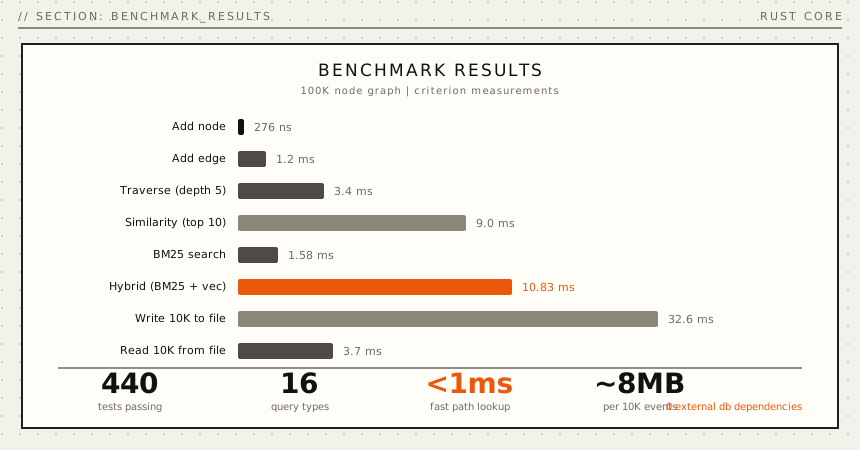
Rust core. Memory-mapped I/O. Zero-copy access. Real numbers from Criterion statistical benchmarks:
| Operation | Time | Scale |
|---|---|---|
| Add node | 276 ns | 10K graph |
| Add edge | 1.2 ms | 10K graph |
| Traverse depth-5 | 3.4 ms | 100K nodes |
| Similarity search (top 10) | 9.0 ms | 100K nodes |
| BM25 text search (fast path) | 1.58 ms | 100K nodes |
| BM25 text search (slow path) | 122 ms | 100K nodes |
| Hybrid search (BM25 + vector) | 10.83 ms | 100K nodes |
| PageRank convergence | 34.3 ms | 100K nodes |
| Bidirectional BFS shortest path | 104 us | 100K nodes |
| Belief revision (cascade) | 53.4 ms | 100K nodes |
| Drift detection | 68.4 ms | 100K nodes |
| Read 10K nodes from file | 3.7 ms | -- |
| mmap node access | 370 ns | 100K nodes |
All v0.2 query benchmarks measured with Criterion (100 samples) on Apple M4 Pro, 64 GB, Rust 1.90.0
--release. Computationally intensive queries (gap detection 297s, analogical 229s, consolidation 43.6s at 100K) are designed for periodic/offline execution and complete in <3s at 10K nodes.
Capacity: A year of daily use produces a ~24 MB file. A decade fits in ~240 MB. A lifetime of memory fits in under 1 GB.
Comparison with existing systems
| Vector DB | Markdown Files | Key-Value Store | AgenticMemory | |
|---|---|---|---|---|
| Storage / 10K events | ~500 MB | ~200 MB | ~50 MB | ~8 MB |
| Query latency (p99) | ~50 ms | ~200 ms | ~30 ms | <1 ms |
| Relationship tracking | None | None | None | 7 typed edges |
| Query types | 1 (similarity) | 1 (keyword) | 1 (key lookup) | 16 |
| Portability | Vendor-locked | File-based | API-locked | Single file |
| External dependencies | Cloud service | Embedding API | Cloud service | None |
| Reconstruct reasoning | No | No | No | Yes |
| Self-correction history | No | No | Partial | Yes |
| "What breaks if X changes?" | No | No | No | Yes |
| "Where am I guessing?" | No | No | No | Yes |
Why AgenticMemory
Memory is a graph, not a search index. When you remember why you made a decision, you traverse a chain: decision <- caused by <- these facts <- inferred from <- observations. That's graph navigation. Vector similarity search can never reconstruct this.
One file. Truly portable. Your entire memory is a single .amem file. Copy it. Back it up. Version control it. No cloud service, no API keys, no vendor lock-in.
Any LLM, any time. Start with Claude today. Switch to GPT tomorrow. Move to a local model next year. Same brain file. Cross-provider validation report with 21 interoperability tests.
Self-correcting. Corrections don't delete -- they SUPERSEDE. The old fact, the new fact, and the correction chain are all preserved. brain.resolve(old_id) always returns the current truth.
Sixteen query types. Not just search. Traversal, pattern matching, temporal comparison, causal impact, similarity, BM25 text search, hybrid search, graph centrality, shortest path, belief revision, reasoning gap detection, analogical reasoning, consolidation, drift detection, context extraction, and resolve. Five of these don't exist anywhere else.
The Query Engine
Sixteen ways to navigate a cognitive graph. Seven are foundational. Four are established algorithms adapted for cognitive graphs. Five are genuinely novel -- they don't exist in any other system.
| # | Query | What it answers |
|---|---|---|
| 1 | Traversal | "Why did I decide this?" -- walk reasoning chains |
| 2 | Pattern | "Show me all low-confidence decisions from last week" |
| 3 | Temporal | "What changed between session 5 and session 20?" |
| 4 | Impact | "What depends on this fact?" |
| 5 | Similarity | "What else do I know about this topic?" |
| 6 | Context | "Give me everything around this node" |
| 7 | Resolve | "What's the current truth after corrections?" |
| 8 | BM25 Search | "Find memories containing these exact terms" (1.58 ms @ 100K) |
| 9 | Hybrid Search | BM25 + vector fusion via RRF (10.83 ms @ 100K) |
| 10 | Centrality | "What are my foundational beliefs?" -- PageRank (34.3 ms @ 100K) |
| 11 | Shortest Path | "How are these two ideas connected?" -- BFS in 104 us |
| 12 | Belief Revision | "If I learn X, what breaks?" -- counterfactual cascade |
| 13 | Reasoning Gaps | "Where am I guessing?" -- 5 gap categories |
| 14 | Analogical | "I've solved something like this before" -- structural fingerprints |
| 15 | Consolidation | "Clean up: dedup, link contradictions, promote inferences" |
| 16 | Drift Detection | "How has my understanding of this topic evolved?" |
The five novel queries -- what makes them different
Belief Revision -- Counterfactual propagation. Inject a hypothetical fact, trace every causal edge forward, report what gets invalidated. Read-only -- nothing changes until you say so. Only possible because of typed causal edges + confidence scores.
report = brain.revise("Team now knows Go")
# report.contradicted -> ["Team has no Go experience"]
# report.invalidated_decisions -> ["Chose Rust because no Go"]
# report.total_affected -> 5 nodes
Reasoning Gaps -- Structural health audit. Finds decisions with no recorded justification, inferences built on a single fragile fact, high-impact nodes with low confidence, and correction chains that keep changing.
report = brain.gaps()
# report.health_score -> 0.73
# report.gaps -> [UnjustifiedDecision(...), SingleSourceInference(...), ...]
Analogical Reasoning -- Subgraph pattern matching. Finds past situations with the same reasoning structure even if the domain is completely different. A monolith-to-microservices migration matches a previous Flask-to-FastAPI migration -- same shape, different content.
Consolidation -- Brain maintenance. Deduplicates near-identical facts, detects unlinked contradictions, promotes stable inferences to facts. Dry-run by default. Automatic backup before any mutation.
Drift Detection -- Belief trajectory tracking. Shows how knowledge about a topic evolved session by session, computes stability scores, and identifies areas of active revision.
report = brain.drift("preferred language")
# Timeline: Python (session 1) -> Rust (session 15) -> exploring Zig (session 30)
# report.stability -> 0.3 (low -- keeps changing)
Install
One-liner (desktop profile, backwards-compatible):
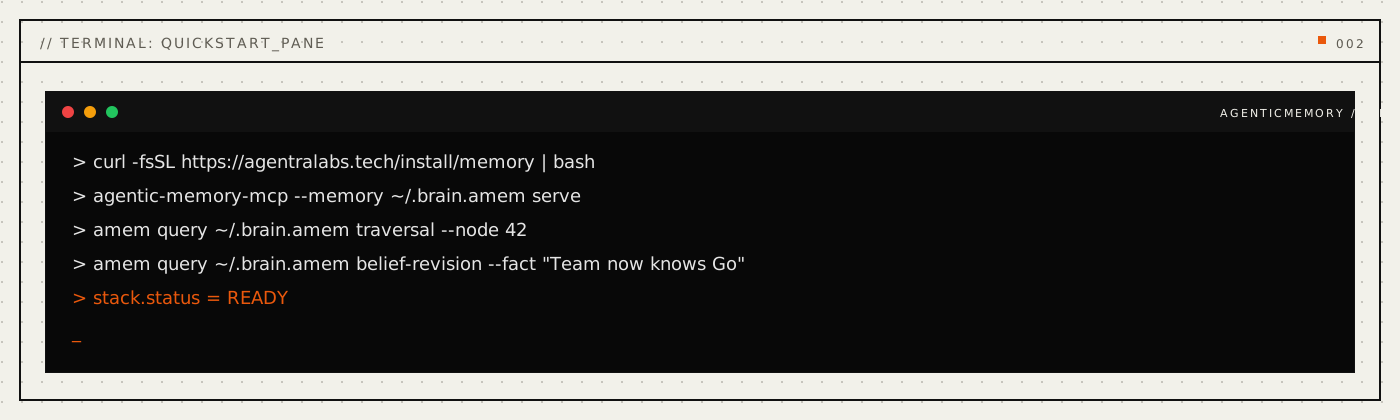
curl -fsSL https://agentralabs.tech/install/memory | bash
Downloads a pre-built agentic-memory-mcp binary to ~/.local/bin/ and merges the MCP server into your Claude Desktop and Claude Code configs. Memory defaults to ~/.brain.amem. Requires curl and jq.
If release artifacts are not available, the installer automatically falls back to cargo install --git source install.
Environment profiles (one command per environment):
# Desktop MCP clients (auto-merge Claude Desktop + Claude Code when detected)
curl -fsSL https://agentralabs.tech/install/memory/desktop | bash

# Terminal-only (no desktop config writes)
curl -fsSL https://agentralabs.tech/install/memory/terminal | bash

# Remote/server hosts (no desktop config writes)
curl -fsSL https://agentralabs.tech/install/memory/server | bash
| Channel | Command | Result |
|---|---|---|
| GitHub installer (official) | curl -fsSL https://agentralabs.tech/install/memory | bash | Installs release binaries when available, otherwise source fallback; merges MCP config |
| GitHub installer (desktop profile) | curl -fsSL https://agentralabs.tech/install/memory/desktop | bash | Explicit desktop profile behavior |
| GitHub installer (terminal profile) | curl -fsSL https://agentralabs.tech/install/memory/terminal | bash | Installs binaries only; no desktop config writes |
| GitHub installer (server profile) | curl -fsSL https://agentralabs.tech/install/memory/server | bash | Installs binaries only; server-safe behavior |
| crates.io paired crates (official) | cargo install agentic-memory-cli agentic-memory-mcp | Installs amem and agentic-memory-mcp |
| PyPI (SDK + installer) | pip install agentic-brain / pip install amem-installer | Python SDK and auto-connector tools |
| npm (wasm) | npm install @agenticamem/memory | WASM-based memory SDK for Node.js and browser |
Server auth and artifact sync
For cloud/server runtime:
export AGENTIC_TOKEN="$(openssl rand -hex 32)"
All MCP clients must send Authorization: Bearer <same-token>.
If .amem/.acb/.avis files are on another machine, sync them to the server first.
| Goal | Command |
|---|---|
| Just give me memory | Run the one-liner above |
| Python developer | pip install agentic-brain |
| Rust developer | cargo install agentic-memory-cli agentic-memory-mcp |
| Connect all AI tools | pip install amem-installer && amem-install install --auto |
Detailed install options
Python SDK (requires amem Rust binary -- see INSTALL.md):
pip install agentic-brain
pip install agentic-brain[anthropic]   # Claude
pip install agentic-brain[openai]      # GPT
pip install agentic-brain[ollama]      # Local models
pip install agentic-brain[all]         # Everything
Rust CLI + MCP:
cargo install agentic-memory-cli       # CLI (amem)
cargo install agentic-memory-mcp       # MCP server
Rust library:
cargo add agentic-memory
Deployment Model
- Standalone by default: AgenticMemory is independently installable and operable. Integration with AgenticVision or AgenticCodebase is optional, never required.
- Autonomic operations by default: runtime maintenance uses safe profile-based defaults with backup, sleep-cycle upkeep, migration safeguards, and health-ledger snapshots.
| Area | Default behavior | Controls |
|---|---|---|
| Autonomic profile | Local-first conservative posture | `AMEM_AUTONOMIC_PROFILE=desktop |
| Sleep-cycle maintenance | Decay refresh, tier balancing, completed-session auto-archive | AMEM_SLEEP_CYCLE_SECS, AMEM_SLEEP_IDLE_SECS |
| Backup + retention | Rolling backups with bounded retention | AMEM_AUTO_BACKUP_SECS, AMEM_AUTO_BACKUP_RETENTION, AMEM_AUTO_BACKUP_DIR |
| Storage migration | Policy-gated with checkpointed auto-safe path | `AMEM_STORAGE_MIGRATION_POLICY=auto-safe |
| Storage budget policy | 20-year projection + auto-rollup when budget pressure appears | `AMEM_STORAGE_BUDGET_MODE=auto-rollup |
| Prompt + feedback auto-capture | Captures MCP prompt/tool context into .amem with privacy controls | `AMEM_AUTO_CAPTURE_MODE=safe |
| Maintenance throttling | SLA-aware under sustained mutation load | AMEM_SLA_MAX_MUTATIONS_PER_MIN |
| Health ledger | Periodic operational snapshots (default: ~/.agentra/health-ledger) | AMEM_HEALTH_LEDGER_DIR, AGENTRA_HEALTH_LEDGER_DIR, AMEM_HEALTH_LEDGER_EMIT_SECS |
MCP Server
Any MCP-compatible client gets instant access to persistent graph memory. The agentic-memory-mcp crate exposes the full AgenticMemory engine over the Model Context Protocol (JSON-RPC 2.0 over stdio).
cargo install agentic-memory-mcp
Configure Claude Desktop
Add to ~/Library/Application Support/Claude/claude_desktop_config.json:
{
  "mcpServers": {
    "agentic-memory": {
      "command": "agentic-memory-mcp",
      "args": ["serve"]
    }
  }
}
Zero-config: defaults to
~/.brain.amem. Override with"args": ["--memory", "/path/to/brain.amem", "serve"].
Memory modes — control how aggressively Claude saves:
| Mode | Behavior | Config |
|---|---|---|
| smart (default) | Auto-saves facts, decisions, preferences | ["serve"] |
| minimal | Only saves when you say "remember" | ["serve", "--mode", "minimal"] |
| full | Saves everything, creates session summaries | ["serve", "--mode", "full"] |
Configure VS Code / Cursor
Add to .vscode/settings.json:
{
  "mcp.servers": {
    "agentic-memory": {
      "command": "agentic-memory-mcp",
      "args": ["serve"]
    }
  }
}
What the LLM gets
| Category | Count | Examples |
|---|---|---|
| Tools | 12 | memory_add, memory_query, memory_traverse, memory_correct, memory_resolve, memory_similar, memory_causal, session_start ... |
| Resources | 6 | amem://node/{id}, amem://session/{id}, amem://graph/stats ... |
| Prompts | 4 | remember, reflect, correct, summarize |
Once connected, the LLM can store facts, traverse reasoning chains, correct beliefs, run causal impact analysis, and maintain session continuity -- all backed by the same .amem binary graph. Full MCP docs ->
Quickstart
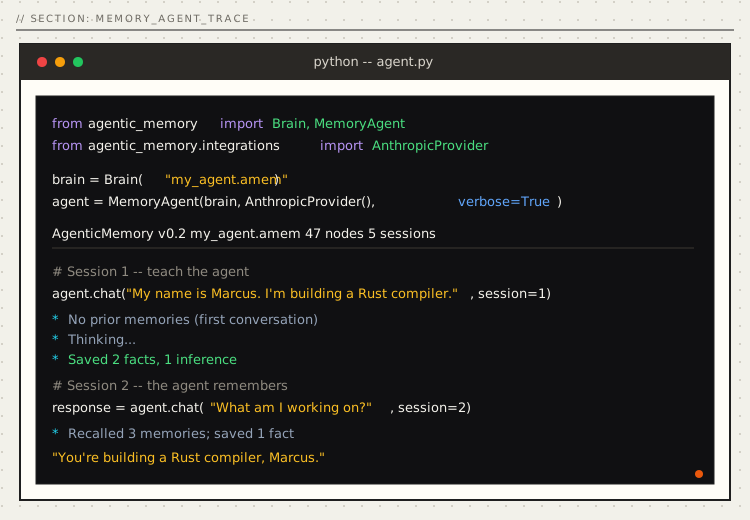
Full agent with memory -- 5 lines
from agentic_memory import Brain, MemoryAgent
from agentic_memory.integrations import AnthropicProvider

brain = Brain("my_agent.amem")
agent = MemoryAgent(brain=brain, provider=AnthropicProvider(), verbose=True)

# Session 1
agent.chat("My name is Marcus. I'm building a Rust compiler.", session=1)

# Session 2 -- the agent remembers
response = agent.chat("What am I working on?", session=2)
# -> "You're building a Rust compiler, Marcus."
Use the brain directly -- no LLM needed
from agentic_memory import Brain

brain = Brain("my_agent.amem")

# Build knowledge
fact = brain.add_fact("User lives in Toronto", session=1, confidence=0.95)
dec = brain.add_decision("Chose PostgreSQL -- team knows it well", session=2)
brain.link(dec, fact, "caused_by")

# Correct without erasing
brain.add_correction("User moved to Vancouver", session=5, supersedes=fact)

# Navigate
brain.traverse(dec, edges=["caused_by"])     # Why this decision?
brain.resolve(fact)                          # -> "User moved to Vancouver"
brain.impact(fact)                           # What depends on this?

# Search (v0.2)
brain.search("PostgreSQL")                   # Hybrid BM25 + vector
brain.search_text("Vancouver")              # Exact term match (1.58 ms @ 100K)

# Reason about your own reasoning (v0.2)
brain.revise("Team switched to MySQL")       # What breaks?
brain.gaps()                                 # Where am I guessing?
brain.centrality()                           # What are my core beliefs?
brain.drift("database choice")              # How has this evolved?
brain.analogy(node_id=42)                   # Similar past patterns
brain.consolidate(dry_run=True)             # Dedup, find contradictions
brain.shortest_path(src=42, dst=99)         # How are these connected?
Same brain, different LLMs
from agentic_memory import Brain, MemoryAgent
from agentic_memory.integrations import AnthropicProvider, OpenAIProvider

brain = Brain("shared_brain.amem")

# Monday: Claude learns
MemoryAgent(brain, AnthropicProvider()).chat(
    "I decided to use Kubernetes for deployment", session=10
)

# Tuesday: GPT remembers everything Claude learned
response = MemoryAgent(brain, OpenAIProvider()).chat(
    "What's our deployment strategy?", session=11
)
# -> "You decided to use Kubernetes for deployment."
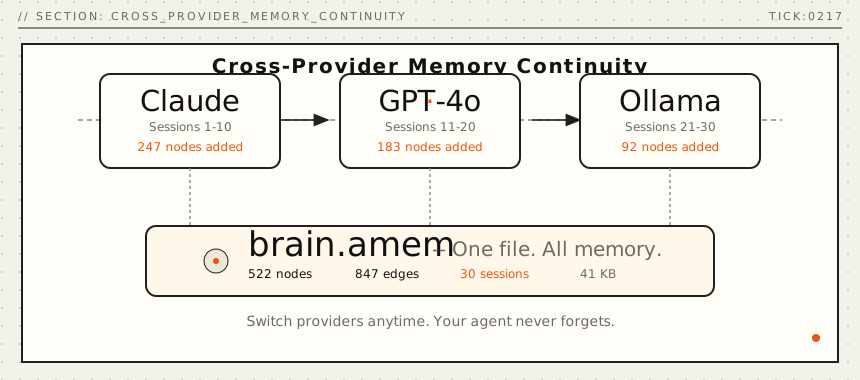
Common Workflows
-
Debug a decision -- When you need to understand why an agent made a choice:
brain.traverse(decision_id, edges=["caused_by"]) # Walk the reasoning chain brain.impact(decision_id) # See downstream effects -
Verify belief currency -- Before acting on stored knowledge:
current = brain.resolve(old_fact_id) # Follow supersedes chains to the latest version -
Audit memory health -- Periodic maintenance to keep your brain reliable:
report = brain.gaps()       # Find low-confidence nodes, stale evidence, unsupported decisions
# report.health_score -> 0.73
amem quality my_agent.amem # CLI equivalent -
Cross-session continuity -- Starting a new session with context from past work:
results = brain.search("current task description") # Hybrid BM25 + vector retrieves relevant past experience
How It Works
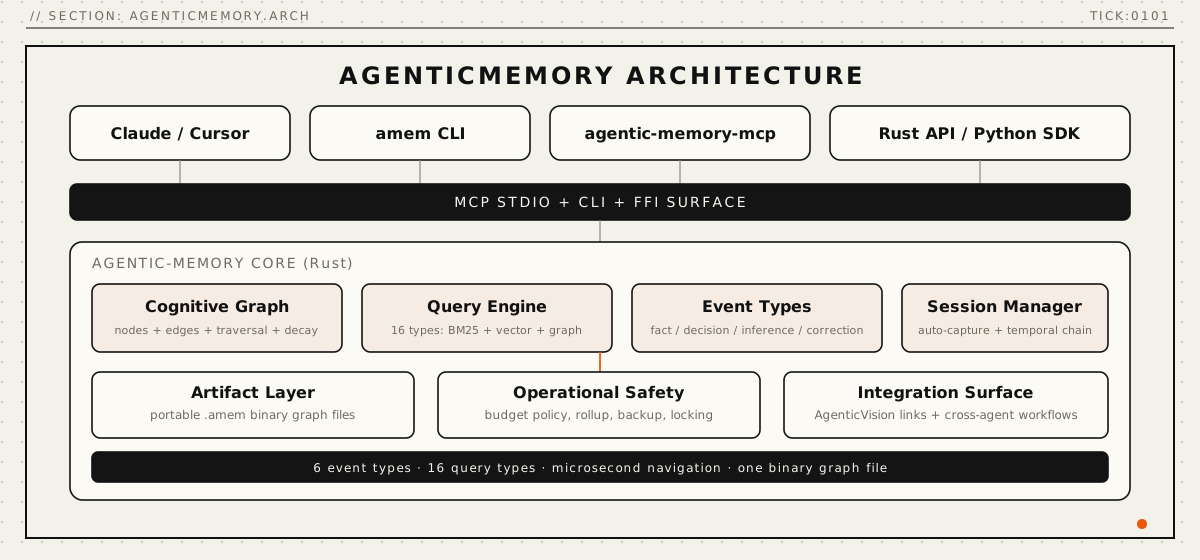
AgenticMemory stores knowledge as a typed cognitive event graph in a custom binary format. Nodes represent cognitive events (facts, decisions, inferences, corrections, skills, episodes). Edges encode causal relationships, belief revision, and temporal ordering. The query engine supports 16 navigation types across the graph.
The core runtime is written in Rust for performance and safety. All state lives in a portable .amem binary file -- no external databases, no managed vector services. The MCP server exposes the full engine over JSON-RPC stdio.
The cognitive graph in detail:
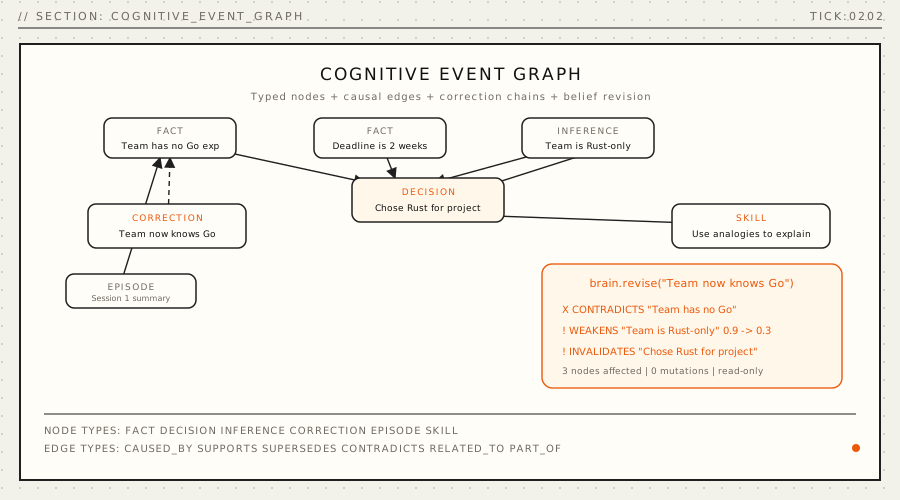
Nodes are cognitive events -- six types:
| Type | What | Example |
|---|---|---|
| Fact | Something learned | "User is a senior Rust developer" |
| Decision | Choice + reasoning | "Chose PostgreSQL -- team has 5 years experience" |
| Inference | Synthesized knowledge | "User is likely a systems architect" |
| Correction | Updated information | "User now works at DataFlow (was TechCorp)" |
| Skill | Learned preference | "Use analogies when explaining concurrency" |
| Episode | Session summary | "Discussed migration strategy, chose blue-green" |
Edges are relationships -- seven types: caused_by . supports . contradicts . supersedes . related_to . part_of . temporal_next
Queries -- sixteen types spanning retrieval, graph algorithms, and five novel cognitive operations that don't exist in any other system.
The binary .amem file uses fixed-size records (O(1) access), LZ4-compressed content, memory-mapped I/O, inline feature vectors, and a BM25 inverted index. No parsing overhead. No external services. Instant access.
File format details
+-------------------------------------+
|  HEADER           64 bytes          |  Magic . version . dimension . counts . feature flags
+-------------------------------------+
|  NODE TABLE       fixed-size rows   |  type . session . confidence . timestamp . offset
+-------------------------------------+
|  EDGE TABLE       fixed-size rows   |  source . target . type . weight
+-------------------------------------+
|  CONTENT BLOCK    LZ4 compressed    |  UTF-8 text for each node
+-------------------------------------+
|  FEATURE VECTORS  128-dim f32       |  Embedding vectors for similarity
+-------------------------------------+
|  INDEXES                            |  type . session . temporal . cluster . BM25 term . doc lengths
+-------------------------------------+
v0.2 adds BM25 term index (tag 0x05) and document lengths (tag 0x06) to the index block, plus feature flags in the header. Fully backward compatible -- v0.1 readers skip unknown tags. v0.2 readers handle files with or without BM25 indexes via automatic slow-path fallback (77x slower but correct).
Validation
This isn't a prototype. It's tested beyond what most production systems require.
| Suite | Tests | |
|---|---|---|
| Rust core engine | 179 | 13 criterion benchmarks |
| V3 Immortal Architecture | 92 | Block integrity, WAL recovery, indexes, tiered storage, retrieval, ghost writer |
| MCP server + bridge | 135 | Protocol, tools, resources, prompts, sessions, edge cases, integration bridge |
| V3 MCP tools | 4 | 13 V3 tool definitions, auto-capture middleware |
| Python SDK | 104 | 8 test modules, query expansion coverage |
| Terminal agent | 97 | 6 validation protocols |
| Cross-provider | 21 | Claude <-> GPT <-> Ollama |
| Auto-installer | 39 | Sandboxed config tests |
| Total | 671 | All passing |
Cross-provider tests prove: facts, decisions, corrections, skills, and reasoning chains transfer perfectly between Claude, GPT-4o, and Ollama (including models as small as 1B parameters). Cross-version tests prove: v0.1 files load in v0.2, v0.2 files load in v0.1 (unknown indexes gracefully skipped).
Three research papers:
- Paper I: AgenticMemory format + v0.1 (7 pages, 7 figures, 6 tables)
- Paper II: Query Expansion -- 9 new query types (10 pages, 9 figures, 6 tables, real Criterion data)
- Paper III: MCP Server -- universal LLM access via Model Context Protocol
Repository Structure
This is a Cargo workspace monorepo containing the core library, MCP server, and integration bridge tests.
agentic-memory/
├── Cargo.toml                    # Workspace root
├── crates/
│   ├── agentic-memory/           # Core library (crates.io: agentic-memory v0.3.2)
│   ├── agentic-memory-cli/       # CLI (crates.io: agentic-memory-cli v0.3.2)
│   ├── agentic-memory-mcp/       # MCP server (crates.io: agentic-memory-mcp v0.3.2)
│   └── agentic-memory-ffi/       # FFI bindings (crates.io: agentic-memory-ffi v0.3.2)
├── tests/bridge/                 # Integration tests (core ↔ MCP)
├── python/                       # Python SDK (PyPI: agentic-brain)
├── agent/                        # Terminal test agent
├── installer/                    # Auto-installer (PyPI: amem-installer)
├── examples/                     # Python + Rust usage examples
├── paper/                        # Research papers (I, II, III)
└── docs/                         # Quickstart, API ref, concepts, benchmarks
Running Tests
# All workspace tests (unit + integration + bridge)
cargo test --workspace

# Bridge integration tests only
cargo test -p agentic-memory-bridge-tests

# Stress tests
cargo test -p agentic-memory-bridge-tests --test bridge_stress
MCP Server Quick Start
cargo install agentic-memory-mcp
Configure Claude Desktop (~/Library/Application Support/Claude/claude_desktop_config.json):
{
  "mcpServers": {
    "agentic-memory": {
      "command": "agentic-memory-mcp",
      "args": ["serve"]
    }
  }
}
Roadmap: Next — Remote Server Support
The next release is planned to add HTTP/SSE transport for remote deployments. Track progress in #1.
| Feature | Status |
|---|---|
--token bearer auth | Planned |
--multi-tenant per-user brain files | Planned |
/health endpoint | Planned |
--tls-cert / --tls-key native HTTPS | Planned |
delete / export / compact CLI commands | Planned |
| Docker image + compose | Planned |
| Remote deployment docs | Planned |
Planned CLI shape (not available in current release):
agentic-memory-mcp serve-http --memory /data/brain.amem --port 8080 --token "<token>"
agentic-memory-mcp serve-http --multi-tenant --data-dir /data/users --port 8080 --token "<token>"
The .amem File
Your agent's memory. One file. Forever yours.
| Size | ~1-2 GB over 20 years |
| Format | Binary graph, portable |
| Works with | Claude, GPT, Llama, any model |
Two purposes:
- Retention: 20 years of conversations, decisions, preferences
- Enrichment: Load into ANY model — suddenly it knows you
The model is commodity. Your .amem is value.
v0.3: Grounding & Workspaces
Grounding: Agent cannot claim "you said X" without memory evidence.
Workspaces: Query across multiple .amem files simultaneously.
Migration from V2
V3 is fully backward compatible. Your V2 .amem files continue to work.
# V3 is enabled via feature flag in 0.4.0+
cargo build --features v3

# No migration command needed -- it just works
| V2 | V3 | |
|---|---|---|
| Session context | Manual memory_session_resume calls | Auto-injected via Ghost Writer |
| Capture scope | Decisions and facts only | Everything captured |
| Client support | Single-client (Claude) | Multi-client (Claude, Cursor, Windsurf, Cody) |
| Recall | Summary-based | Full procedural chains |
| Integrity | Basic | BLAKE3 cryptographic chains |
Philosophy
"A hard drive doesn't decide what's important at write time. It stores everything and lets you query later. Memory should do the same."
AgenticMemory V3 is built on three principles:
- Capture everything -- Don't filter at write time. Every token matters.
- Index smart -- Five specialized indexes for any query pattern.
- Zero friction -- One install command. Works forever. No configuration.
The result: AI agents that never forget, never lose context, and can recall any moment from any session.
Project Stats
| Lines of Code | 8,287 (V3 core + MCP layer) |
| Test Coverage | 470 V3 tests (671 total) |
| Supported Clients | 4 (Claude, Cursor, Windsurf, Cody) |
| MCP Tools | 13 V3 + 12 V2 |
| MCP Resources | 6 V3 + 6 V2 |
| Storage Efficiency | ~500MB for 20 years of memory |
Contributing
See CONTRIBUTING.md. The fastest ways to help:
- Try it and file issues
- Add an LLM provider -- write an integration for a new backend
- Write an example -- show a real use case
- Improve docs -- every clarification helps someone
Privacy and Security
- All data stays local in
.amemfiles -- no telemetry, no cloud sync by default. AMEM_AUTO_CAPTURE_REDACT=truestrips PII from prompt and tool context before storage.AMEM_AUTO_CAPTURE_MODEcontrols what gets captured:safe(default),full, oroff.- Storage budget policy prevents unbounded growth with 20-year projection and auto-rollup.
- Server mode requires an explicit
AGENTIC_TOKENenvironment variable for bearer auth.
Built by Agentra Labs