AMP: The Agent Memory Protocol 🧠
The Open Standard for Agentic Memory.


The (Short) Story
I was tired of building AI agents that forgot everything the moment I closed the terminal.
RAG (Retrieval Augmented Generation) is great for documents, but terrible for experience. It chunks text blindly, losing the narrative. When I asked my agents "Why did we decide this yesterday?", they gave me hallucinated nonsense.
So I built AMP. It's not just a database; it's a Hippocampus for your agents. It mimics the human brain's distinction between Working Memory (Short-term context) and episodic Long-Term Memory, giving your agents a continuous, evolving sense of self.
Why developers are switching to AMP?
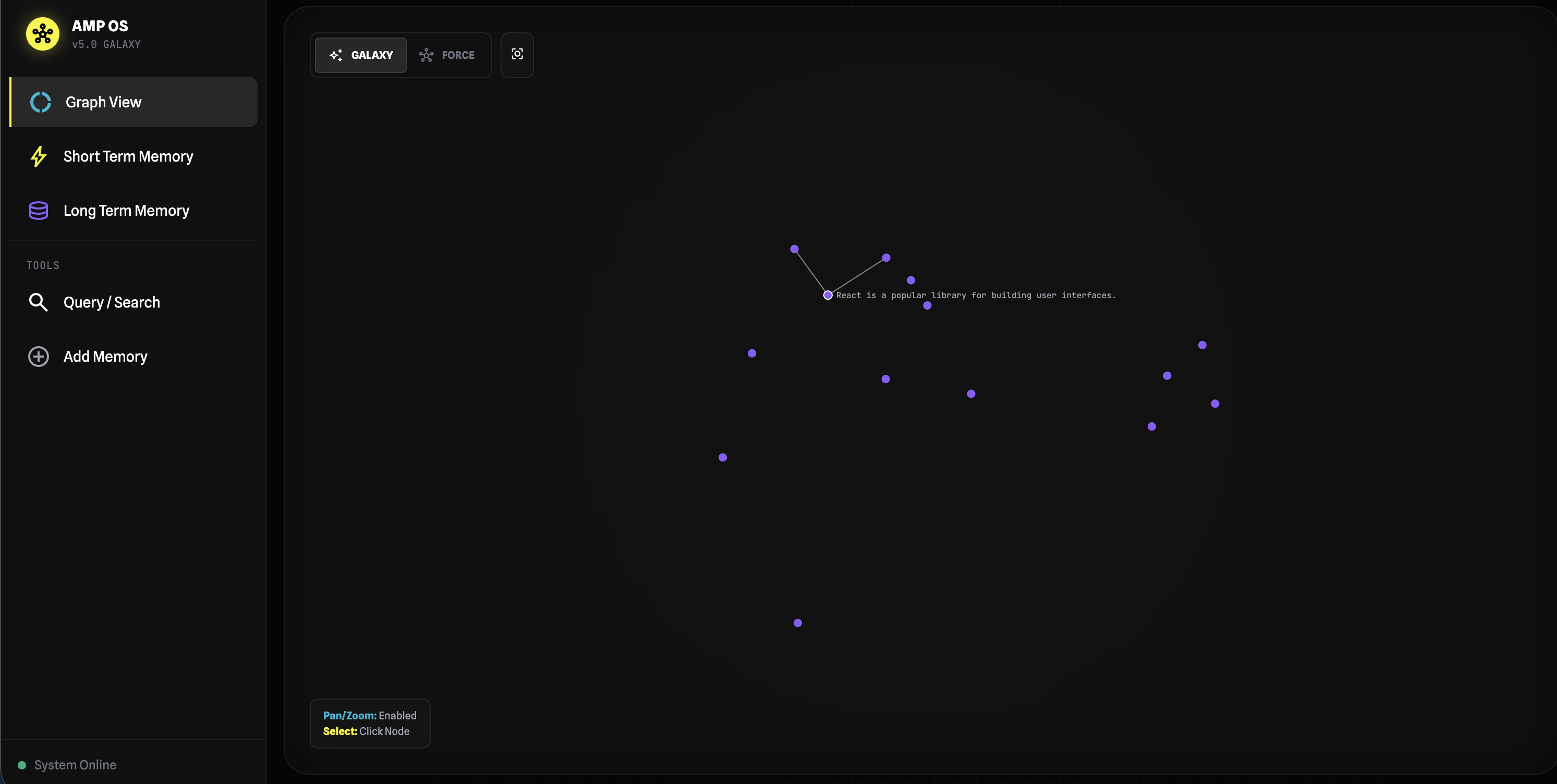
🌌 Galaxy View (Visualization)
Don't just guess what your agent knows. See it. AMP comes with a stunning, 60fps local dashboard. Watch memories form constellations in real-time. Nodes cluster by semantic meaning—if two ideas are related, they physically move together.
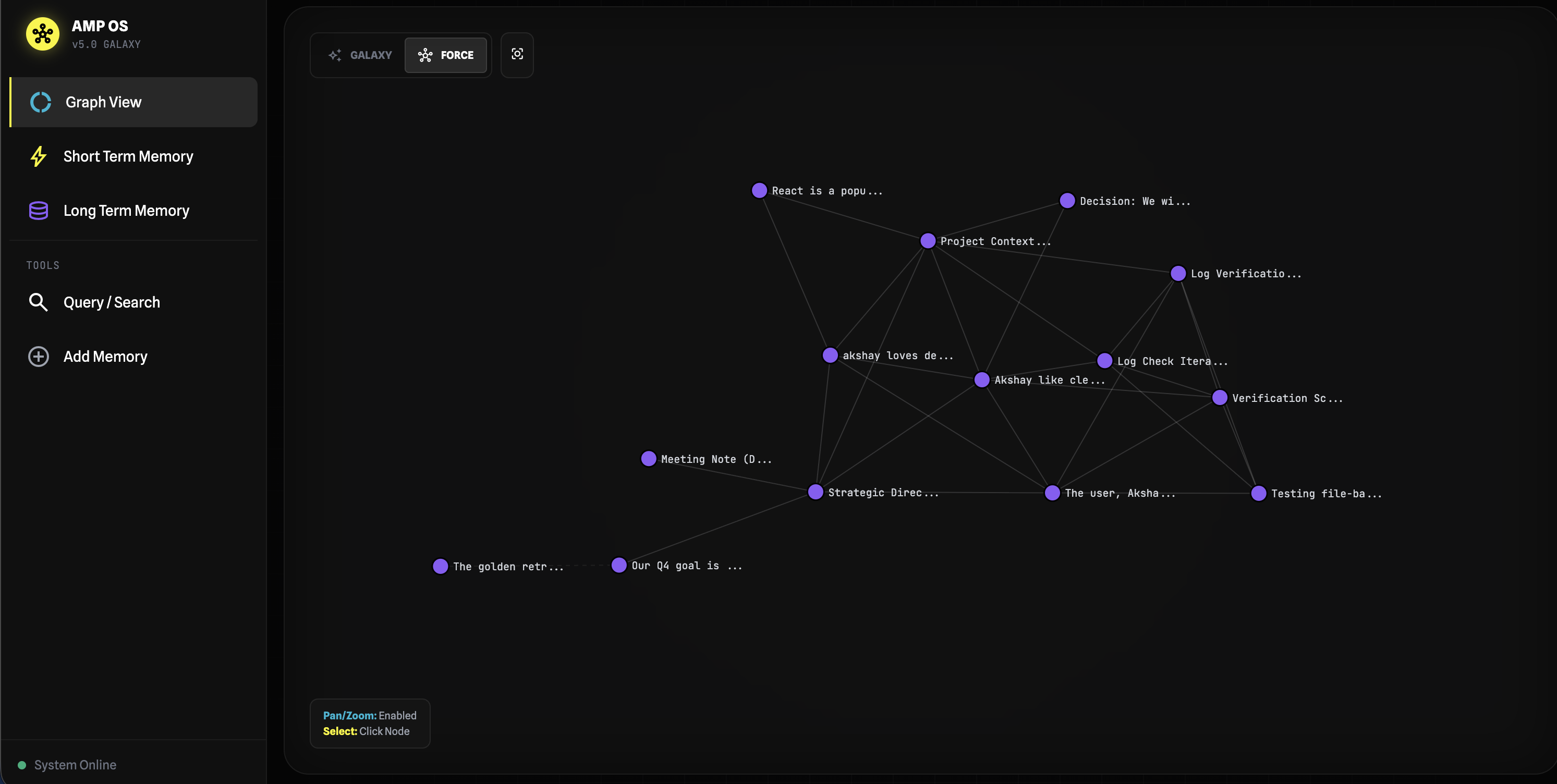
🕸️ Force Mode (Physics)
Toggle to Force Mode to see the topological connections between your memories. It uses a physics simulation (D3.js) to show you how different memory clusters are "pulled" together by shared context.
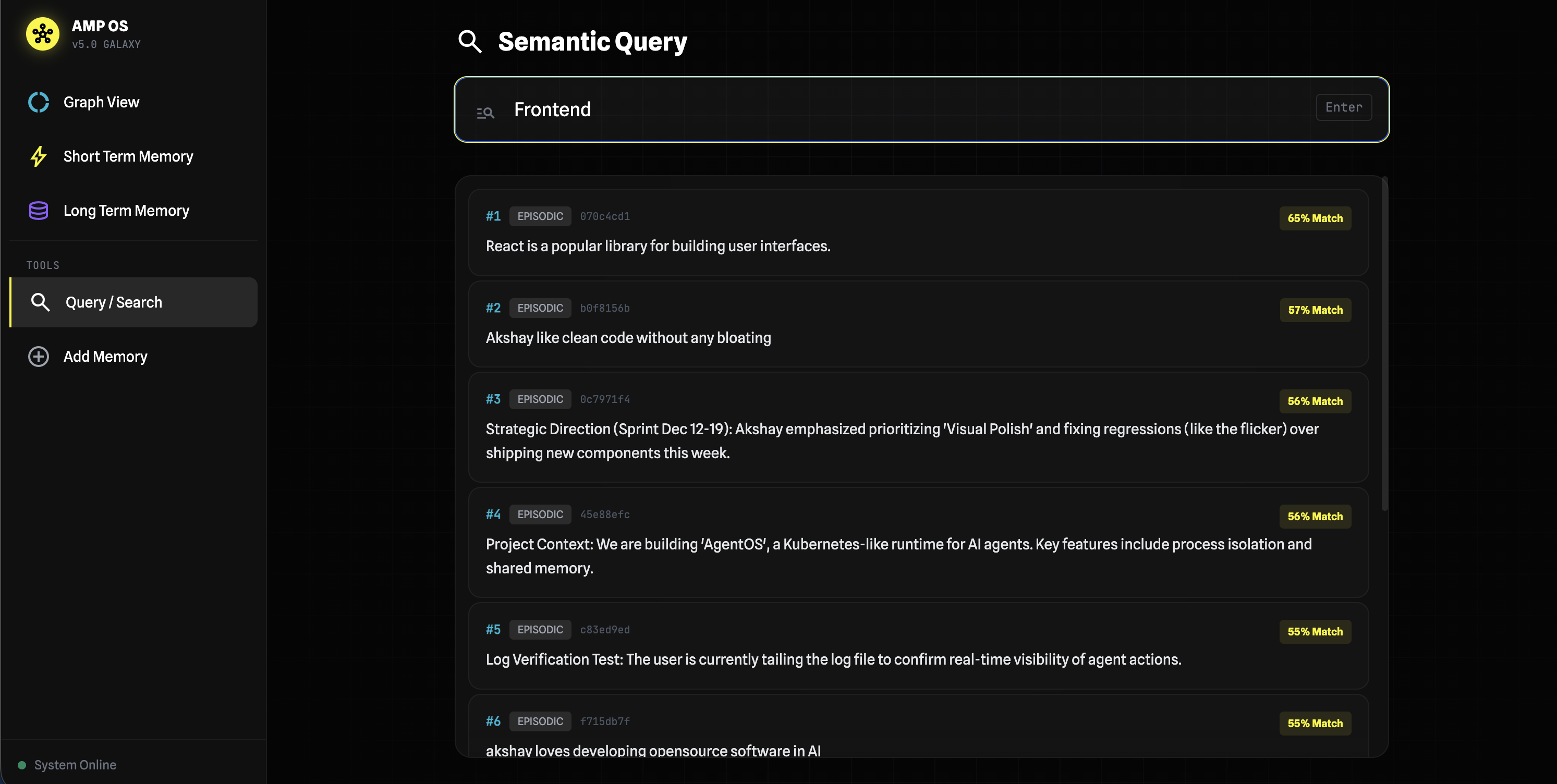
🔍 Semantic Query
Stop guessing keywords. Query your agent's memory using natural language. I built a dedicated interface that not only finds relevant memories but shows you the Relevance Score (0-100%) so you know exactly why a memory was retrieved.
🔌 MCP Native (Plug & Play)
Built from day one for the Model Context Protocol.
- Claude Desktop: Add AMP to your config, and Claude remembers you forever.
- Cursor: Give your coding assistant persistent context of your project history.
🧠 The "3-Layer" Brain
I don't just dump text into a vector store. I structure it:
- ⚡ STM (Short Term): High-fidelity buffer. "What are we doing right now?"
- 📚 LTM (Long Term): Consolidated insights. "What did we learn last week?"
- 🕸️ Graph: Connections between entities. "How is
function Arelated tobug B?"
🏆 Best-in-Class Recall
I benchmarked AMP against the leading competitor (Mem0) on the complex LoCoMo dataset. The results weren't close.
| System | LLM Recall Accuracy | Why? |
|---|---|---|
| AMP | 81.6% 🚀 | Context-First. Preserves the narrative. |
| Mem0 | 21.7% | Extraction-First. Aggressive summarization loses detail. |
Quick Setup (30 seconds)
1. Install via uv (Recommended)
# Install the tool
uv tool install amp-memory

# Start the brain
amp serve
2. Or, Install via pip
pip install amp-memory
amp serve
3. Open the Dashboard
Visit http://localhost:8000.
The interface is Galaxy Mode by default. Switch to Force Mode to see physics-based connections.
4. Connect to IDEs & Tools
AMP works native with Antigravity, Cursor, VS Code Copilot, and Claude Desktop.
Add this to your MCP configuration file (usually mcp_config.json or claude_desktop_config.json):
{
  "mcpServers": {
    "amp-memory": {
      "command": "uv",
      "args": ["tool", "run", "amp-memory", "serve"],
      "env": {
        "PYTHONPATH": "."
      }
    }
  }
}
Now you can say:
"@amp remember that I am refactoring the login controller." "@amp what was the last bug we fixed?"
It knows.
Roadmap 🗺️
- Galaxy View: Visual Semantic Space.
- Graph API: D3.js powered visualization.
- Semantic Search: Vector-based relevance sorting.
- Cloud Sync: Sync memories across devices.
- Multi-Agent Swarm: Shared memory for agent teams.
Star History
Made with ❤️ by Akshay.