[!IMPORTANT] ChronoLog MCP is now available. Integrate ChronoLog directly with LLMs through our new MCP server for real-time logging, event processing, and structured interactions.
Code - Documentation
ChronoLog
Distributed Shared Tiered Log Store
A distributed and tiered shared log storage ecosystem that uses physical time to distribute log entries while providing total log ordering.





Members
 Illinois Tech |
 UChicago |
Overview
ChronoLog is a distributed, tiered shared log storage system that provides scalable log storage with time-based data ordering and total log ordering guarantees. By leveraging physical time for data distribution and utilizing multiple storage tiers for elastic capacity scaling, ChronoLog eliminates the need for a central sequencer while maintaining high performance and scalability.
The system's modular, plugin-based architecture serves as a foundation for building scalable applications, including SQL-like query engines, streaming processors, log-based key-value stores, and machine learning integration modules.
Key Features
ChronoLog is built on four foundational pillars:
-
Time-Structured Ingestion — Events are chunked and organized by physical time, enabling high-throughput parallel writes without a central sequencer.
-
Tiered & Efficient Storage — StoryChunks flow across fast and scalable storage tiers, automatically balancing performance and capacity.
-
Concurrent Access at Scale — Multi-writer, multi-reader support with zero coordination overhead, optimized for both RDMA and TCP networks.
-
Modular, Extensible Serving Layer — Plugin-based architecture enables custom services to run directly on the log, supporting diverse application requirements.
Use Cases
ChronoLog's flexible architecture supports a wide range of applications:
-
AI & LLM Integration — MCP server for seamless LLM integration with enterprise logging and real-time event processing.
-
Machine Learning & Training — TensorFlow module for training and inference workflows using time-ordered data streams.
-
SQL-like Query Engine — Query and analyze log data with SQL semantics and time-based distribution.
-
Streaming Processor — Real-time event processing and analytics for monitoring, alerting, and data pipelines.
-
Log-based Key-Value Store — Distributed key-value stores with strong consistency guarantees.
For more information, visit chronolog.dev.
Installation
[!NOTE] ChronoLog is designed for deployment on distributed clusters and complex environments. For comprehensive installation guides, configuration details, and deployment strategies, please refer to our detailed documentation on the Wiki.
🐳 Docker Installation 
Single-Node Deployment
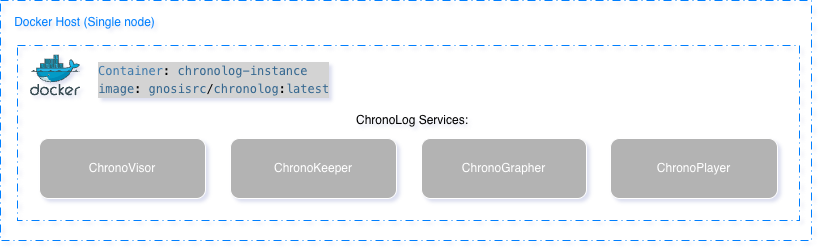
Pull Docker image:
docker pull gnosisrc/chronolog:latest
Run container interactively:
docker run -it --rm --name chronolog-instance gnosisrc/chronolog:latest
Deploy components:
/home/grc-iit/chronolog_repo/deploy/local_single_user_deploy.sh -d -w /home/grc-iit/chronolog_install/Release
Verify deployment:
pgrep -la chrono
For detailed setup instructions, troubleshooting, and advanced configuration, see: Single-node Docker tutorial
Multi-Node Deployment
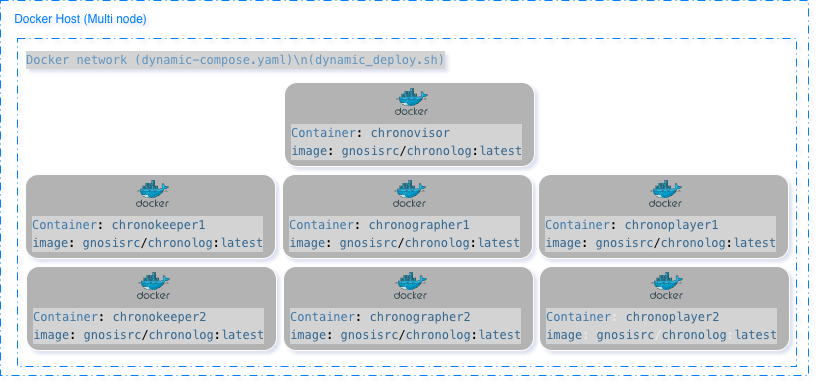
Pull Docker image:
docker pull gnosisrc/chronolog:latest
Download deployment script:
wget https://raw.githubusercontent.com/grc-iit/ChronoLog/refs/heads/develop/CI/docker/dynamic_deploy.sh
chmod +x dynamic_deploy.sh
Run default deployment:
./dynamic_deploy.sh -n 7 -k 2 -g 2 -p 2
Verify containers:
docker ps
For detailed setup instructions, troubleshooting, and advanced configuration, see: Multi-Node Docker tutorial
Documentation
Comprehensive documentation and tutorials are available on our Wiki. The documentation covers everything from getting started to advanced configuration and deployment strategies.
📚 Documentation
| Document | Description |
|---|---|
| Getting Started | Introduction and first steps with ChronoLog |
| Installation | Detailed installation guides and requirements |
| Configuration | Configuration options and settings |
| Deployment | Deployment strategies and best practices |
| Client API | API reference and usage examples |
| Client Examples | Code examples and use cases |
| Architecture | System architecture and design principles |
| Plugins | Plugin development and integration |
| Code Style Guidelines | Coding standards and conventions |
| Contributors Guidelines | Guidelines for contributing to ChronoLog |
🎓 Tutorials
| Tutorial | Description |
|---|---|
| Tutorial 1: First Steps with ChronoLog | Get started with your first ChronoLog deployment |
| Tutorial 2: How to run a Performance test | Learn how to benchmark and test ChronoLog performance |
| Tutorial 3: Running ChronoLog with Docker (single-node) | Deploy ChronoLog on a single node using Docker |
| Tutorial 4: Running ChronoLog with Docker (Multi-Node) | Deploy ChronoLog across multiple nodes using Docker |
Collaborators
We are grateful for the collaboration and support from our research and industry partners.
| Organization | Description |
|---|---|
 Argonne National Laboratory Argonne National Laboratory | Collaborating with the funcX team to enable event-based and real-time computing capabilities, supporting scalable execution of machine learning workloads and integration with Colmena framework for materials science applications. |
| University of Chicago | Working with Tom Glanzman and the Dark Energy Science Collaboration on Parsl workflow extensions for Rubin Observatory data processing, enabling extreme-scale logging and monitoring for cosmology workflows. |
 Parsl Parsl | Developing workflow extensions to enable extreme-scale logging and monitoring for large-scale scientific workflows, with potential impact across domains including biology, social science, and high energy physics. |
 Institute for Food Safety and Health (IFSH) Institute for Food Safety and Health (IFSH) | Exploring new scientific applications of ChronoLog in genomics and bioinformatics, with discussions helping shape development priorities while informing adjacent research communities about ChronoLog capabilities. |
 Lawrence Livermore National Laboratory Lawrence Livermore National Laboratory | Working with the system scheduler team to integrate ChronoLog with Sonar and Flux job scheduler, eliminating bottlenecks in HPC resource management and telemetry data collection. |
 University of Wisconsin-Madison University of Wisconsin-Madison | Working with Shaowen Wang to deploy ChronoLog as a storage backend for CyberGIS, addressing growing data volume and velocity demands while refining ChronoLog features through GIS workloads. |
 University of Illinois at Urbana-Champaign University of Illinois at Urbana-Champaign | Collaborating on Parsl workflow extensions for the Dark Energy Science Collaboration, enabling extreme-scale logging and monitoring for Rubin Observatory data processing workflows. |
 DePaul University DePaul University | Working with Tanu Malik to develop novel lightweight indexing mechanisms within the ChronoKeeper for efficient querying of log data by both identifier and value predicates. |
 ParaTools, Inc. ParaTools, Inc. | Exploring integration and evaluation of ChronoLog with performance monitoring tools, optimizing ChronoLog and its native plugins for application performance analysis use cases. |
 OmniBond Systems LLC OmniBond Systems LLC | Working with Boyd Wilson to fine-tune the storage stack using extended attributes in OrangeFS, optimizing ChronoLog's multi-tiered distributed log store performance. |
Resources
- Documentation: Visit chronolog.dev for comprehensive documentation and guides
- GitHub Repository: github.com/grc-iit/ChronoLog
- Issues & Support: Report issues or request features on GitHub Issues
- Releases: Check out the latest releases on GitHub Releases
Gnosis Research Center
Illinois Institute of Technology
Advancing the Future of Scalable Computing and Data-Driven Discovery
Connect with us:
🌐 Website • 🐦 X (Twitter) • 💼 LinkedIn • 📺 YouTube • ✉️ Email
Sponsored by:

National Science Foundation (NSF CSSI-2104013)