Claude Colony


A tmux-based multi-agent orchestration system where multiple Claude Code instances collaborate on software development tasks.
Overview
Claude Colony enables a team of AI agents to work together on complex tasks. It builds on Claude Code's native agent system (.claude/agents/) — create your agents there, then orchestrate them as a team.
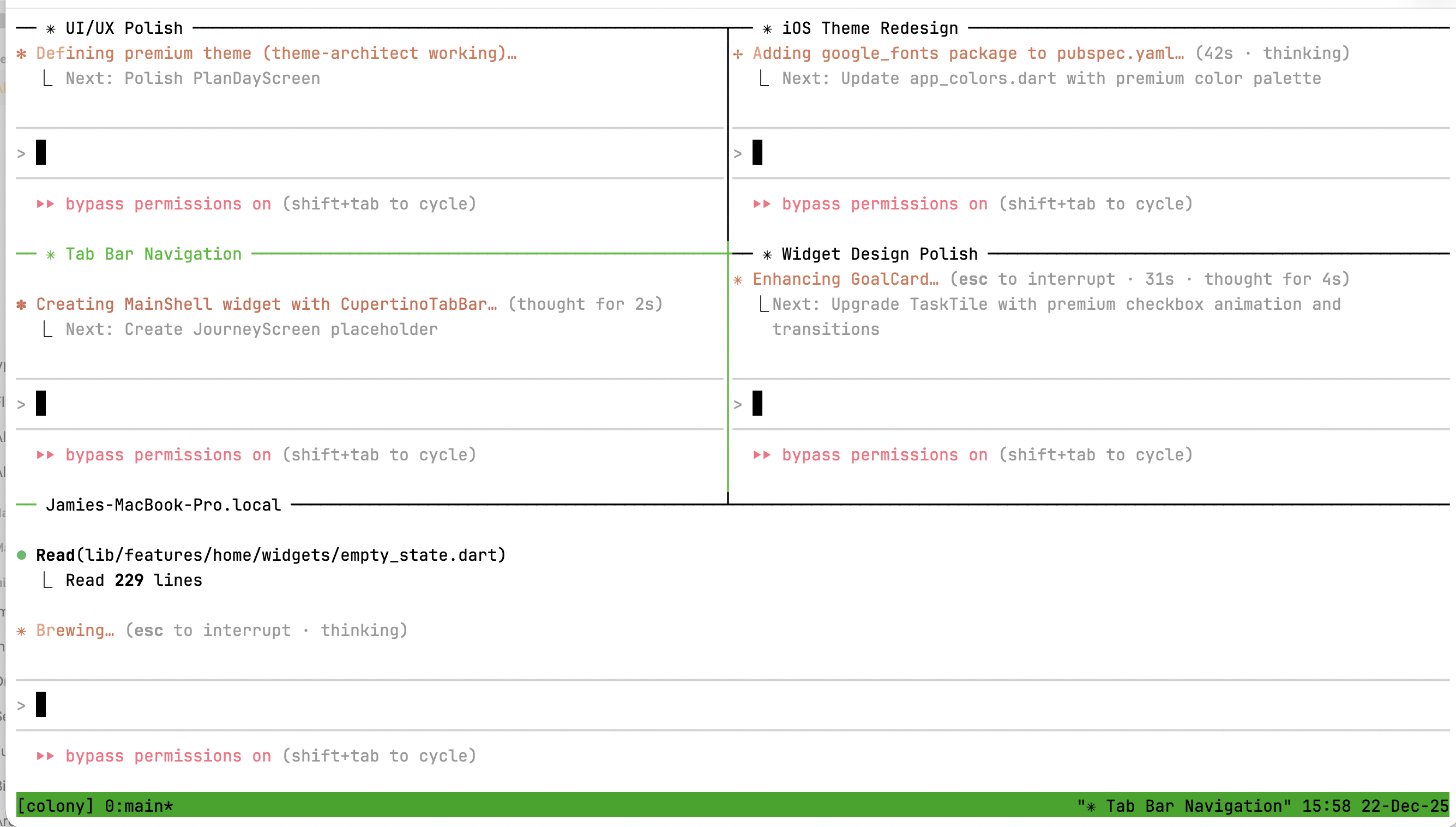
Each agent has a unique persona, role, and area of focus. They communicate via a file-based message broker and are visualized in a tmux session.
┌─────────────────────┬─────────────────────────────┐
│                     │      Specialist Agent 1     │
│                     ├─────────────────────────────┤
│   Manager Agent     │      Specialist Agent 2     │
│      (40%)          ├─────────────────────────────┤
│                     │      Specialist Agent 3     │
│                     ├─────────────────────────────┤
│                     │   Shared Context (10%)      │
└─────────────────────┴─────────────────────────────┘
Why Claude Colony?
| True Multi-Agent | Full Claude Code instances, not sandboxed sub-tasks. Each agent can spawn its own agents, use every tool, and work in parallel—just like a real dev team |
| Native Integration | Built on Claude Code's agent system — your .claude/agents/ work everywhere |
| Visual Collaboration | Watch your AI team work in real-time via tmux |
| Simple Communication | File-based @mention protocol, no complex setup |
| Ready-Made Teams | Start with fullstack, frontend, API, or mobile presets instantly |
Note: Because each agent is a full Claude Code instance with unlimited capability, token usage can add up quickly. We recommend using Claude Colony with a Max plan for the best experience.
Prerequisites
- Node.js 18+
- tmux —
brew install tmux(macOS) orapt install tmux(Linux) - Claude Code — installed and authenticated
# Verify Claude Code is working
claude --version
Installation
# Install globally from npm
npm install -g claude-colony

# Or run directly with npx
npx claude-colony --help
From Source
git clone https://github.com/jamiemurphy/claude-colony.git
cd claude-colony
npm install && npm run build && npm link
Quick Start
# Initialize colony in your project
colony init

# Start a colony with a preset
colony start --preset fullstack

# Check status
colony status

# Stop the colony
colony stop
Tip: For best results, create custom agents in
.claude/agents/tailored to your project, then build a preset that uses them withcolony create-team.
CLI Commands
| Command | Description |
|---|---|
colony init | Initialize .colony/ directory in current project |
colony start | Start a colony session |
colony stop | Stop the running colony |
colony status | Show colony status |
colony presets | List available presets |
colony presets <name> | Show preset details |
colony agents | List available agents |
colony agents <name> | Show agent details |
colony create <name> | Create a new agent |
colony build | Initialize and configure colony (init + setup) |
Start Command Options
colony start [options]

Options:
  -p, --preset <name>   Use a preset configuration
  -a, --agents <count>  Number of worker panes (default: 4)
  --no-attach           Don't attach to tmux session
Create Command Options
colony create <name> [options]

Options:
  -d, --description <desc>  Agent description
  -m, --model <model>       Model (sonnet, opus, haiku)
  -t, --tools <tools>       Comma-separated tools
  -g, --global              Create in ~/.claude/agents/
  -f, --force               Overwrite existing
Presets
Built-in presets for common team configurations:
| Preset | Description | Agents |
|---|---|---|
fullstack | Full-stack web development | UX, Frontend, Backend, DevOps |
frontend-team | UI-focused development | UX, UI Dev, Logic Dev |
api-team | Backend API development | API Dev, Data Dev, Docs |
mobile-app | Mobile app development | UX, Mobile Dev, API Dev, DevOps |
docs-team | Documentation team | API Docs, Guides, Review |
# List all presets
colony presets

# View preset details
colony presets fullstack

# Start with a preset
colony start --preset fullstack
Workflow Examples
Feature Development
colony start --preset fullstack

# Agents coordinate via @mentions:
# @ux:       "I'll design the login flow wireframes"
# @frontend: "Building the form based on UX specs"
# @backend:  "Creating /auth endpoints"
# @devops:   "Setting up CI for the new routes"
API Sprint
colony start --preset api-team

# Parallel development:
# @api-dev builds endpoints while @data-dev designs schemas
# @docs documents as features complete
Debug Session
colony start -p fullstack

# In the shared pane, give context:
# @all: "Users report 500 errors on checkout. @backend investigate
#        the /orders endpoint, @frontend check error handling"
Agents
Claude Colony uses Claude Code's native agent system. The recommended workflow is:
- Create agents in Claude Code using
.claude/agents/*.mdfiles - Use those agents in your colony presets
Creating Agents (Recommended)
Create agents directly in your project's .claude/agents/ directory. These are standard Claude Code agents that work both standalone and in colonies:
<!-- .claude/agents/api-designer.md -->
---
name: api-designer
description: REST API design specialist
model: sonnet
---

# API Designer

You are an API design specialist focused on RESTful best practices...
Agent Locations
| Location | Scope | Description |
|---|---|---|
.claude/agents/*.md | Project | Recommended. Committed to git, works with Claude Code |
~/.claude/agents/*.md | User | Personal agents, available across all projects |
| Built-in | Colony | Fallback defaults (frontend-dev, backend-dev, etc.) |
Using Your Agents
# See all available agents (from .claude/agents/ and built-ins)
colony agents

# View agent details
colony agents api-designer

# Create a preset that uses your agents
colony create-team
Quick Agent Creation
If you need a quick agent without writing markdown:
colony create my-agent -d "My custom agent" -m sonnet
This creates a .claude/agents/my-agent.md file you can then customize.
Project Structure
After running colony init:
.colony/
├── config.yaml    # Colony configuration
├── state/         # Session state
├── messages/      # Agent communication
├── agents/        # Agent prompts
├── shared/        # Shared data channels
└── reviews/       # Code reviews
Architecture
Core Components
- MessageBroker - File-based IPC with @mention routing
- SessionManager - Session state persistence
- TmuxManager - Tmux session and pane management
- CompletionDetector - Monitors worker completion
- ColonyMonitor - Real-time status monitoring
- SharedScratchpad - Typed data channels for agent collaboration
- OwnershipRegistry - File ownership tracking
- ReviewManager - Code review workflow
- DependencyGraph - Task dependency tracking
- FileLock - Concurrent access safety
Communication Protocol
Agents communicate using @mentions:
@frontend: Build the login form with validation
@backend: Create the /auth/login endpoint
@all: Team standup in 5 minutes
@manager: I'm blocked on the API schema
Agent Status
- 🟢 Ready — awaiting work
- 🟡 Working — actively processing
- 🔴 Blocked — needs input/help
- ✅ Done — declared completion
Viewing the Colony
Attach to the tmux session:
tmux attach -t colony
Navigation:
Ctrl+BthenArrow Keys- Switch panesCtrl+BthenD- Detach (colony keeps running)
How It Compares
| Claude Colony | Single Claude Code | Generic Orchestrators | |
|---|---|---|---|
| Agent architecture | Full instances | Single instance | Task-based sub-agents |
| Agents spawn sub-agents | Yes | Yes | Limited/No |
| Parallel execution | Yes | No | Yes |
Native .claude/agents/ | Yes | Yes | No |
| Visual monitoring | tmux real-time | Terminal | Varies |
| Agent communication | @mention protocol | N/A | Custom |
| Setup | colony init | N/A | Often complex |
Development
# Install dependencies
npm install

# Build
npm run build

# Run tests
npm test

# Run tests once
npm run test:run

# Type check
npm run typecheck

# Lint
npm run lint

# Full check
npm run check
License
MIT