claude-webcache



Cross-session WebFetch cache for Claude Code.
Claude Code's built-in WebFetch caches results for 15 minutes within a single session. claude-webcache extends that across sessions, indefinitely (TTL 7 days, configurable).
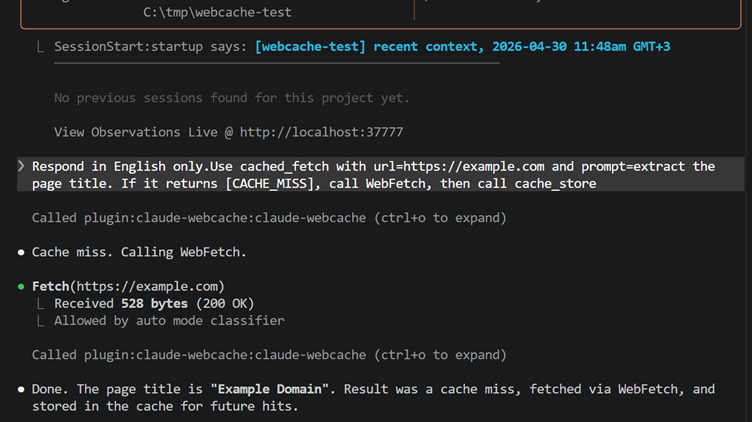
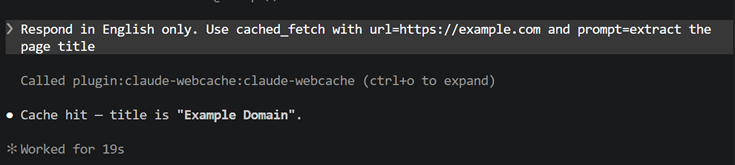
Open new session  ->  your past fetches are still there.
Cache hit         ->  instant.
Cache miss        ->  same as built-in WebFetch.
Why
Any time you re-fetch the same URLs across sessions -- docs, API references, research pages -- you're paying the full fetch cost every time. The 15-minute in-session cache evicts before your next sprint. claude-webcache keeps fetches around so the second session hits cache instead.
Install
Option 1 -- Claude Code plugin (recommended)
One line, in your terminal:
claude plugin marketplace add theYahia/claude-webcache && claude plugin install claude-webcache@theyahia
Then add the usage pattern to your ~/.claude/CLAUDE.md (see Usage pattern).
💡 Why CLI subcommands and not the TUI
/plugin install? The TUI flow currently routes through Claude Code'sremoteMarketplaceClientbackend, which has an open server-side bug rejecting all third-party plugin sources withFailed to install: This plugin uses a source type your Claude Code version does not support.See anthropics/claude-code#41653 and ~20 related open issues. The CLI subcommands above useNativeMarketplaceReaderlocally and are unaffected.Fallback (if even CLI subcommands fail on your setup):
git clone https://github.com/theYahia/claude-webcache && claude --plugin-dir ./claude-webcache/pluginThis bypasses the marketplace pipeline entirely.
Option 2 -- npm global
npm i -g @theyahia/claude-webcache
Requires Node.js 22.5+ (uses built-in node:sqlite -- no native deps).
Then register manually in ~/.claude/settings.json (replace the path with the result of npm root -g):
{
  "mcpServers": {
    "claude-webcache": {
      "command": "node",
      "args": ["/path/from/npm-root-g/claude-webcache/scripts/mcp-server.cjs"]
    }
  },
  "hooks": {
    "SessionStart": [
      {
        "matcher": "startup|clear|compact",
        "hooks": [
          { "type": "command", "command": "node /path/from/npm-root-g/claude-webcache/scripts/hook-stats.cjs" }
        ]
      }
    ]
  }
}
Option 3 -- clone (contributors)
See CONTRIBUTING.md.
Usage pattern
Add to your ~/.claude/CLAUDE.md so Claude routes web fetches through the cache:
## WebFetch caching (claude-webcache)

Before calling WebFetch, call `cached_fetch(url, prompt)` first.
- If it returns text -> use that, do NOT call WebFetch.
- If it returns `[CACHE_MISS] <url>` -> call WebFetch as normal, then call `cache_store(url, prompt, output)` with the result.
That's it. Same URL + same prompt in any future session = instant cache hit.
Tools (MCP)
| Tool | Args | Returns |
|---|---|---|
cached_fetch | url, prompt | cached text, or [CACHE_MISS] <url> |
cache_store | url, prompt, output | stored |
cache_stats | -- | { total, hits, last } |
cache_list | limit? | recent URLs (most recent first) |
Storage
SQLite at ~/.webcache/cache.db (WAL mode, concurrent-safe). Cache key = SHA256(url + "|" + prompt).
| Field | Type |
|---|---|
key | TEXT PRIMARY KEY |
url | TEXT |
prompt_hash | TEXT |
output | TEXT |
cached_at | INTEGER (ms epoch) |
hit_count | INTEGER |
last_hit_at | INTEGER |
SessionStart hook
On every new session, the hook injects a one-line stat:
webcache: 142 pages cached, 38 hits, last fetch 3h ago
Skips injection if cache is empty.
TTL
Default 7 days. Expired entries are deleted on next read of the same key. Run a manual purge by requiring src/cache.js and calling purgeExpired().
Limits
- Cache key includes the prompt -> different prompts on the same URL are separate entries. Pick consistent prompts (e.g. always
"extract title and main content") to maximize hit rate. - Output is whatever WebFetch returns (already summarized by the model). The cache doesn't re-process it.
- No semantic search, no embeddings. Exact
(url, prompt)match only.
License
MIT -- see LICENSE.