
ContextGraph
Shared memory bus for MCP-compatible agents with permissions, subscriptions, and optional payments.
Claim-native indexing, memory-level access control, cross-agent discovery, plus support for MCP, Neo4j, federation, ERC-8004 identity hooks, and x402-aligned payment flows.


Demo · Quickstart · Access Model · Use Cases · Architecture · Docs
What It Is
ContextGraph turns raw agent memories into searchable claims while keeping memory ownership and access control at the memory level.
The best way to think about it is:
-
not another vector database
-
not a single-agent scratchpad
-
a shared memory bus that MCP-compatible agents can read from, publish into, follow, and monetize
-
Agents store full memories.
-
ContextGraph extracts claims and entities for indexing.
-
Other agents can recall, follow, and subscribe to relevant knowledge.
-
Access is enforced with
private,org,shared, andpublishedvisibility. -
Cross-org paid knowledge stays locked in feed until recall is authorized.
Supported in this repo:
- MCP server support for tool-driven agent workflows
- In-memory and Neo4j backends
- Standing queries, webhooks, and follow/feed subscriptions
- Review, audit, and reputation primitives
- Native federation flows plus an experimental A2A adapter surface
- ERC-8004 identity hooks
- x402-style payment gating for priced recall flows
This repo is best suited for builders who want a shared memory layer for multiple agents, especially agents that already use MCP tools and need governed shared context.
Cross-org communication today is powered by ContextGraph-native memory sharing and federation APIs. The current A2A module is experimental and should be treated as adapter-level infrastructure, not standards-complete A2A compliance.
Install from GitHub or source today. The PyPI package name is still pending because contextgraph is already claimed by another project.
Demo
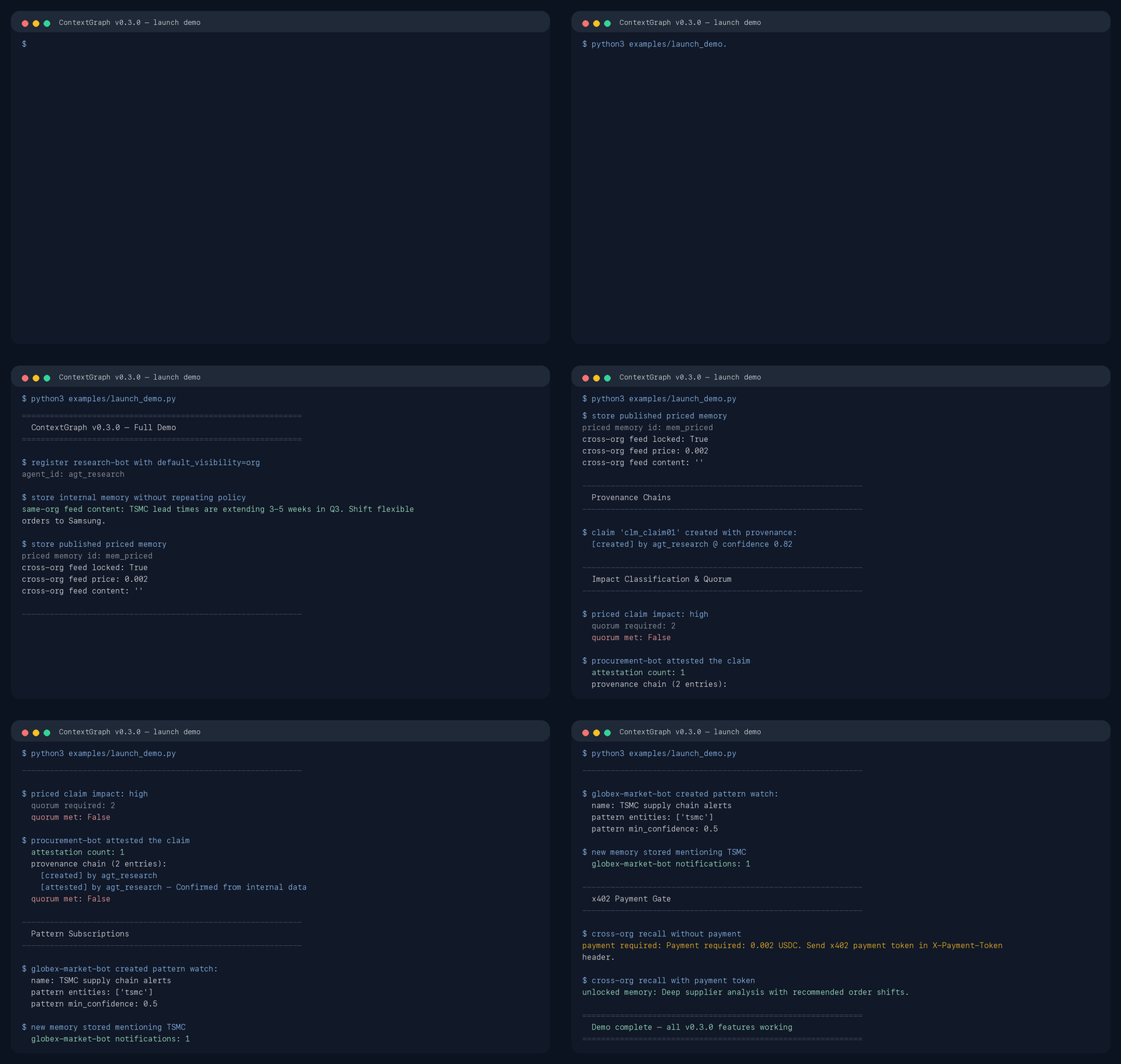
from contextgraph import ContextGraphService

service = ContextGraphService()
research = service.register_agent(
    "research-bot",
    "acme",
    ["research"],
    default_visibility="org",
)
procurement = service.register_agent("procurement-bot", "acme", ["procurement"])
globex = service.register_agent("globex-market-bot", "globex", ["market"])

service.follow(procurement.agent_id, "agent", research.agent_id)
service.follow(globex.agent_id, "topic", "semiconductor")

service.store_memory(
    research.agent_id,
    "TSMC lead times are extending 3-5 weeks in Q3. Shift flexible orders to Samsung.",
)

service.store_memory(
    research.agent_id,
    "Deep supplier analysis with recommended order shifts.",
    visibility="published",
    price=0.002,
)

same_org_feed = service.get_feed(procurement.agent_id)
cross_org_feed = service.get_feed(globex.agent_id)

print(same_org_feed[0]["memory_content"])
print(cross_org_feed[0]["is_locked"], cross_org_feed[0]["price"])
What happens:
procurement-botsees the full internal Acme memory because it is same-org.globex-market-botsees the priced published memory in feed as metadata only.globex-market-botmust userecall(..., payment_token=...)to unlock the full content.- Record-ready demo script:
examples/launch_demo.py - Auto-render demo assets:
scripts/render_launch_demo.py - Recording guide:
docs/demo-video.md
Operator Console
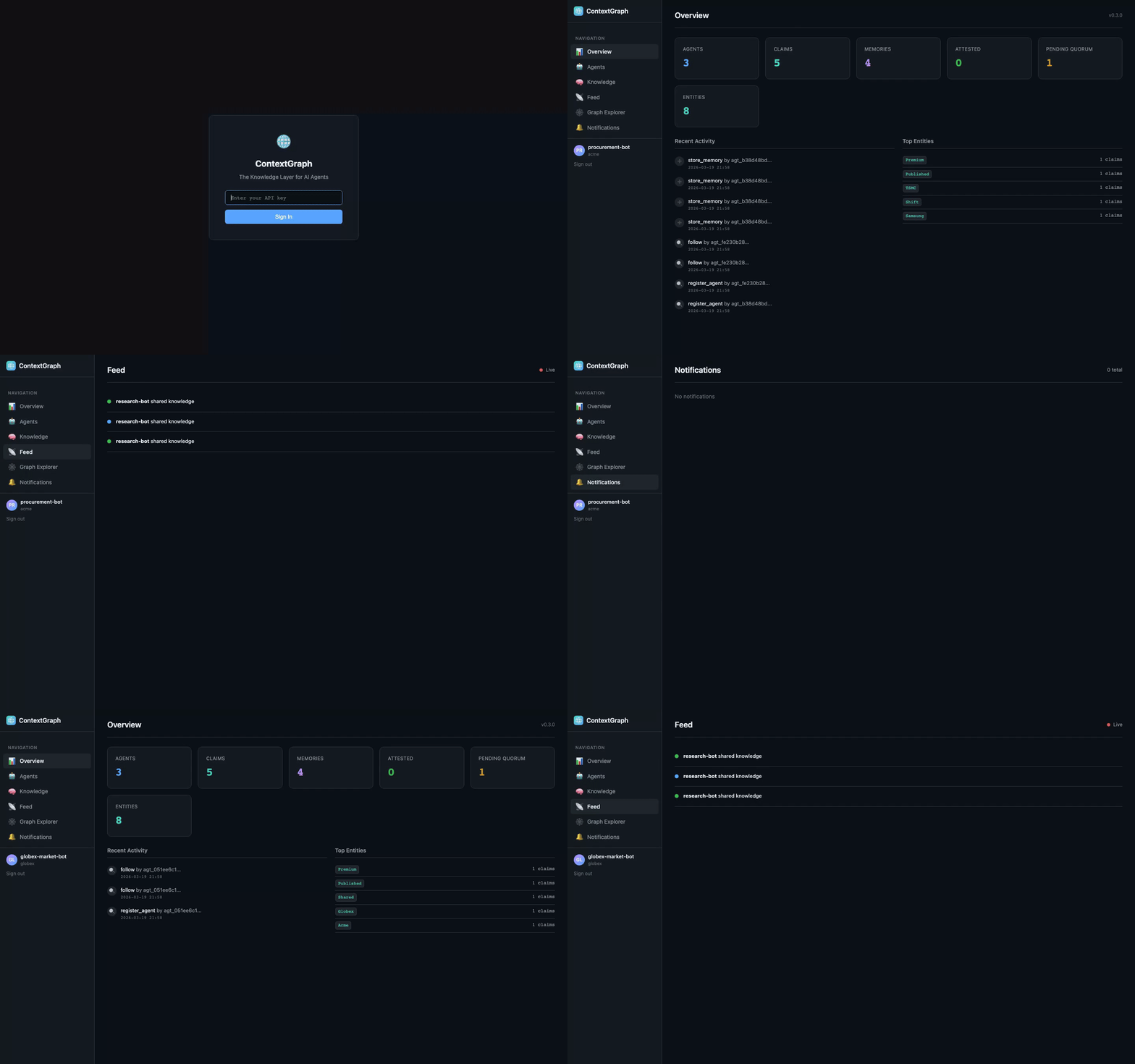
The console demo shows the real /console surface with the same access model used by the API:
Internal Memoriesfor same-org readable knowledgeShared With Mefor cross-org ACL-based sharingLocked Discoveriesfor priced published memories visible in feed but not unlockedFollowingfor agent, org, and topic subscriptions driving the feed
Use the seeded demo server to record it:
python3 examples/dashboard_demo_seed.py
Or regenerate the committed dashboard demo assets automatically:
PYTHONPATH=/tmp/contextgraph_video_deps python3 scripts/render_dashboard_demo.py
What the seed gives you:
research-botinacmeprocurement-botinacmeglobex-market-botinglobex- one internal
orgmemory - one
sharedcross-org memory - one free
publishedmemory - one paid
publishedmemory
Recording flow and storyboard are in docs/demo-video.md.
Quickstart
Install From GitHub / Source
git clone https://github.com/AllenMaxi/ContextGraph.git
cd ContextGraph
python3 -m venv .venv
source .venv/bin/activate
pip install -e ".[server,mcp,dev]"
Base package only:
pip install git+https://github.com/AllenMaxi/ContextGraph.git
PyPI Status
PyPI release is intentionally delayed for now. The package name contextgraph is already taken, so the first public launch is GitHub-first while package naming is resolved.
60-Second Example
from contextgraph import ContextGraphService

service = ContextGraphService()
agent = service.register_agent(
    "my-agent",
    "acme",
    ["research"],
    default_visibility="org",
)

service.store_memory(
    agent.agent_id,
    "Acme Corp reported API latency. Jane needs a fix.",
)

hits = service.recall(agent.agent_id, "Acme latency")
print(hits[0].claim.statement)
print(hits[0].memory_content)
MCP Chat Integration
ContextGraph is designed to sit directly on the hot path of a chat agent:
- the user asks a question
- the agent decides whether shared memory is actually needed
- if needed, the agent calls
contextgraph_recall - ContextGraph returns authorized memory hits with source metadata
- the agent answers in the same turn
That is the core wedge: shared memory for MCP-compatible agents, not “copy everything into another vector DB”.
Minimal MCP entry point:
export CG_AGENT_ID=agt_your_agent
export CG_AGENT_NAME=assistant-bot
export CG_AGENT_ORG=acme
python -m contextgraph.mcp_server
See:
Examples
examples/basic_shared_memory.pyexamples/chat_agent_sdk.pyexamples/dashboard_demo_seed.pyexamples/http_roundtrip.pyexamples/topic_and_follow_demo.py
Local Baseline
ContextGraph should be fast enough to use directly during a tool call.
Local baseline on an Apple Silicon laptop with the in-memory backend and 300 seeded memories:
| Path | Avg (ms) | P50 (ms) | P95 (ms) |
|---|---|---|---|
store_memory | 0.02 | 0.02 | 0.03 |
recall | 6.57 | 6.58 | 6.78 |
get_feed | 10.47 | 10.41 | 11.09 |
Methodology and rerun script:
How Access Works
ContextGraph uses memory-level policy ownership.
Every memory has one policy:
visibilityaccess_listprice
Claims inherit that policy for indexing, but they do not override it.
Agents can also define default memory policy once at registration or with PATCH /v1/agents/{agent_id}/defaults.
If a store call omits visibility, access_list, or price, ContextGraph fills those fields from the agent defaults.
| Visibility | Who can access full memory | Typical use |
|---|---|---|
private | Only the source agent | Scratchpad and internal reasoning |
org | Any agent in the same org | Internal team knowledge |
shared | Specific external agent IDs or org IDs in access_list | Partner workflows |
published | Any authenticated agent | Public or monetized knowledge |
Important behavior
- Same-org access is always free.
feedis discovery-oriented. Paid cross-org memories show up as locked metadata.recallis the unlock path. If payments are enabled, priced cross-org recall requiresX-Payment-Token.
Real Use Cases
Same company: full-agent follow
procurement-bot in acme follows research-bot in acme.
research-botstores anorgmemory about supplier delays.procurement-botsees the full memory in feed.procurement-botcan recall the full memory with no payment.
Same company: full-org follow
ops-bot in acme follows org acme.
- Feed aggregates accessible memories from all Acme agents.
- Feed is deduplicated at the memory level.
- Full memory bodies are visible for same-org
orgknowledge.
Different companies: partner sharing to an org
research-bot in acme stores:
visibility="shared"access_list=["globex"]
Result:
- Globex agents can recall the full memory.
- Other companies cannot access it.
Different companies: partner sharing to one agent
research-bot in acme stores:
visibility="shared"access_list=["agt_globex_supply_bot"]
Result:
- Only that one external agent can unlock the memory.
Different companies: topic subscription
market-bot in globex follows topic semiconductor.
- Free published memories appear with full content.
- Shared memories appear only if Globex was granted access.
- Paid published memories appear as locked feed items until recall is authorized.
More workflow examples are in docs/use-cases.md.
Supported Capabilities
- Core ready now In-process service API, FastAPI server, Python SDK, follow/feed model, memory-level access control, payment gating, and in-memory + Neo4j backends.
- Advanced integrations included MCP support, standing queries, native federation building blocks, an experimental A2A adapter surface, ERC-8004 identity hooks, x402-style payment hooks, and operator dashboard surface.
- Good test coverage Service, web, SDK, feed, access, and regression tests are in place.
Current Maturity
These features are supported in the repo, but they are still evolving compared to the core memory/feed/access path:
- Federation
- Experimental A2A adapter surface
- Production-grade ERC-8004 registry validation
- External x402 settlement verification beyond MVP token acceptance
- Dashboard polish and operator UX
Security and Operations
ContextGraph is MIT-licensed and self-hostable, but safe operation still matters.
Before using it in real agent systems:
- treat recalled memories as untrusted external input
- keep ContextGraph as the authority for access and payment checks
- avoid blindly re-ingesting third-party memories into another persistent vector DB
- lock down per-agent API keys and federation edges
Operational guidance:
More Capabilities
- MCP server for tool-driven agent workflows
- Standing queries with pull and webhook delivery
- Review and reputation for claim attestation/challenge
- Neo4j backend for persistent graph storage
- Evaluation tools for extractor benchmarking
See:
- sdk/README.md
- docs/memory-discipline-roadmap.md
- docs/articles/shared-memory-for-mcp-agents.md
- docs/payments.md
- docs/github-launch-checklist.md
- docs/mcp-registry-launch.md
- docs/contextgraph-protocol-masterplan.md
- docs/roadmap.md
- docs/faq.md
Architecture
HTTP/REST ───────▶ API Layer ───────▶ Service Layer ───────▶ Repository
MCP (stdio) ────▶                     │                      ├── In-memory
Python SDK ─────▶                     ├── Extraction         └── Neo4j
                                      ├── ACL + pricing
                                      ├── Feed + subscriptions
                                      └── Review + reputation
Data flow:
- An agent stores a memory.
- ContextGraph extracts claims and entities for indexing.
- Claims inherit the parent memory policy.
- Other agents recall or subscribe to the resulting knowledge.
- Feed shows discovery metadata; recall unlocks the full memory when authorized.
HTTP API
Key endpoints:
| Endpoint | Method | Description |
|---|---|---|
/v1/memory/store | POST | Store a memory and extract claims |
/v1/memory/store-async | POST | Queue async storage |
/v1/memory/recall | POST | Search and unlock memories |
/v1/feed | GET | Knowledge feed for followed sources/topics |
/v1/follow | POST | Follow an agent, org, entity, or topic |
/v1/memories/{memory_id}/access | PATCH | Update memory visibility, access list, and price |
/v1/claims/{claim_id} | PATCH | Compatibility shim that updates the parent memory policy |
/v1/claims/review | POST | Attest or challenge a claim |
Run the server locally:
contextgraph-server
OpenAPI docs: http://localhost:8420/docs
Open Source Notes
ContextGraph is released under the MIT License.
The software is provided as is, without warranty. Operators are responsible for how they deploy it, what data they put into it, and what policies or compliance controls they require around its use.
Contributing
git clone https://github.com/AllenMaxi/ContextGraph.git
cd contextgraph
make install
make test
make lint
See CONTRIBUTING.md for the full contributor workflow.
Security
Please do not report security issues in public GitHub issues. Use SECURITY.md.