Cortex
Persistent memory for Claude Code — built on neuroscience research, not guesswork



Memory that learns, consolidates, forgets intelligently, and surfaces the right context at the right time. Works standalone or with a team of specialized agents.
Getting Started | How It Works | Neural Graph | Agent Integration | Benchmarks | Scientific Foundation
Getting Started
Prerequisites
- Python 3.10+
- PostgreSQL 15+ with pgvector and pg_trgm extensions
- Claude Code CLI or desktop app
Option A — Claude Code Marketplace (recommended)
claude plugin marketplace add cdeust/Cortex
claude plugin install cortex
Restart your Claude Code session, then run:
/cortex-setup-project
This handles everything: PostgreSQL + pgvector installation, database creation, embedding model download, cognitive profile building from session history, codebase seeding, conversation import, and hook registration. Zero manual steps.
Using Claude Cowork? Install Cortex-cowork instead — uses SQLite, no PostgreSQL required.
claude plugin marketplace add cdeust/Cortex-cowork
claude plugin install cortex-cowork
Option B — Standalone MCP (no plugin)
claude mcp add cortex -- uvx --from "neuro-cortex-memory[postgresql]" neuro-cortex-memory
Adds Cortex as a standalone MCP server via uvx. No hooks, no skills — just the 33 MCP tools. Requires uv installed.
Option C — Clone + Setup Script
git clone https://github.com/cdeust/Cortex.git
cd Cortex
bash scripts/setup.sh        # macOS / Linux
python3 scripts/setup.py     # Windows / cross-platform
Installs PostgreSQL + pgvector (Homebrew on macOS, apt/dnf on Linux), creates the database, downloads the embedding model (~100 MB). On Windows, install PostgreSQL manually first, then run setup.py. Restart Claude Code after setup.
Option D — Docker
git clone https://github.com/cdeust/Cortex.git
cd Cortex

docker build -t cortex-runtime -f docker/Dockerfile .
docker run -it \
  -v $(pwd):/workspace \
  -v cortex-pgdata:/var/lib/postgresql/17/data \
  -v ~/.claude:/home/cortex/.claude-host:ro \
  -v ~/.claude.json:/home/cortex/.claude-host-json/.claude.json:ro \
  cortex-runtime
The container includes PostgreSQL 17, pgvector, the embedding model, and Claude Code. Data persists via the cortex-pgdata volume.
Option E — Manual Setup
Step-by-step instructions
1. Install PostgreSQL + pgvector
# macOS
brew install postgresql@17 pgvector
brew services start postgresql@17

# Ubuntu/Debian
sudo apt-get install postgresql postgresql-server-dev-all
sudo apt-get install postgresql-17-pgvector
sudo systemctl start postgresql
2. Create the database
createdb cortex
psql cortex -c "CREATE EXTENSION IF NOT EXISTS vector;"
psql cortex -c "CREATE EXTENSION IF NOT EXISTS pg_trgm;"
3. Install Python dependencies
pip install -e ".[postgresql]"
pip install sentence-transformers flashrank
4. Initialize schema
export DATABASE_URL=postgresql://localhost:5432/cortex
python3 -c "
from mcp_server.infrastructure.pg_schema import get_all_ddl
from mcp_server.infrastructure.pg_store import PgStore
import asyncio
asyncio.run(PgStore(database_url='$DATABASE_URL').initialize())
"
5. Pre-cache the embedding model
python3 -c "from sentence_transformers import SentenceTransformer; SentenceTransformer('all-MiniLM-L6-v2')"
6. Register MCP server
claude mcp add cortex -- uvx --from "neuro-cortex-memory[postgresql]" neuro-cortex-memory
Restart Claude Code to activate.
Verify Installation
After setup, open Claude Code in any project. The SessionStart hook should inject context automatically. You can also test manually:
python3 -m mcp_server # Should start on stdio without errors
Configuration
Cortex reads DATABASE_URL from the environment (default: postgresql://localhost:5432/cortex). All tunable parameters use the CORTEX_MEMORY_ prefix:
| Variable | Default | What It Controls |
|---|---|---|
DATABASE_URL | postgresql://localhost:5432/cortex | PostgreSQL connection string |
CORTEX_RUNTIME | auto-detected | cli (strict) or cowork (SQLite fallback) |
CORTEX_MEMORY_DECAY_FACTOR | 0.95 | Per-session heat decay rate |
CORTEX_MEMORY_HOT_THRESHOLD | 0.7 | Heat level considered "hot" |
CORTEX_MEMORY_WRRF_VECTOR_WEIGHT | 1.0 | Vector similarity weight in fusion |
CORTEX_MEMORY_WRRF_FTS_WEIGHT | 0.5 | Full-text search weight in fusion |
CORTEX_MEMORY_WRRF_HEAT_WEIGHT | 0.3 | Thermodynamic heat weight in fusion |
CORTEX_MEMORY_DEFAULT_RECALL_LIMIT | 10 | Max memories returned per query |
See mcp_server/infrastructure/memory_config.py for the full list (~40 parameters).
How It Works
Cortex runs as an MCP server alongside Claude Code. It captures what you work on, consolidates it while you're away, and resurfaces the right context when you need it.
Memory is Invisible
You don't manage memory. Cortex does.
Session start — hot memories, anchored decisions, and team context inject automatically. No manual recall needed.
During work — PostToolUse hooks capture significant actions (edits, commands, test results). Decisions are auto-detected and protected from forgetting. File edits prime related memories via spreading activation so they surface in subsequent recall.
Session end — a "dream" cycle runs automatically: decay old memories, compress verbose ones, and for long sessions, consolidate episodic memories into semantic knowledge (CLS).
Between sessions — memories cool naturally (Ebbinghaus forgetting curve). Important ones stay hot. Protected decisions never decay.
Retrieval Pipeline
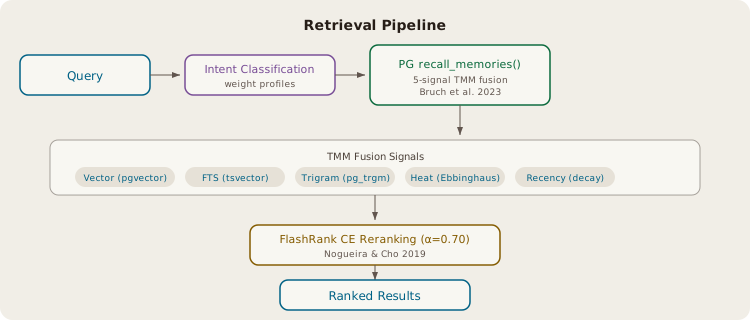
Six signals fused server-side in PostgreSQL, then reranked client-side:
| Signal | Source | Paper |
|---|---|---|
| Vector similarity | pgvector HNSW (384-dim) | Bruch et al. 2023 |
| Full-text search | tsvector + ts_rank_cd | Bruch et al. 2023 |
| Trigram similarity | pg_trgm | Bruch et al. 2023 |
| Thermodynamic heat | Ebbinghaus decay model | Ebbinghaus 1885 |
| Recency | Exponential time decay | — |
Hooks
Seven hooks integrate with Claude Code's lifecycle (managed via plugin.json, no manual setup):
| Hook | Event | What It Does |
|---|---|---|
| SessionStart | Session opens | Injects anchors + hot memories + team decisions + checkpoint |
| UserPromptSubmit | Before response | Auto-recalls relevant memories based on user's prompt |
| PostToolUse | After Edit/Write/Bash | Auto-captures significant actions as memories |
| PostToolUse | After Edit/Write/Read | Primes related memories via heat boost (spreading activation) |
| SessionEnd | Session closes | Runs dream cycle (decay, compress, CLS based on activity) |
| Compaction | Context compacts | Saves checkpoint; restores context after compaction |
| SubagentStart | Agent spawned | Briefs agent with prior work + team decisions |
Neural Graph
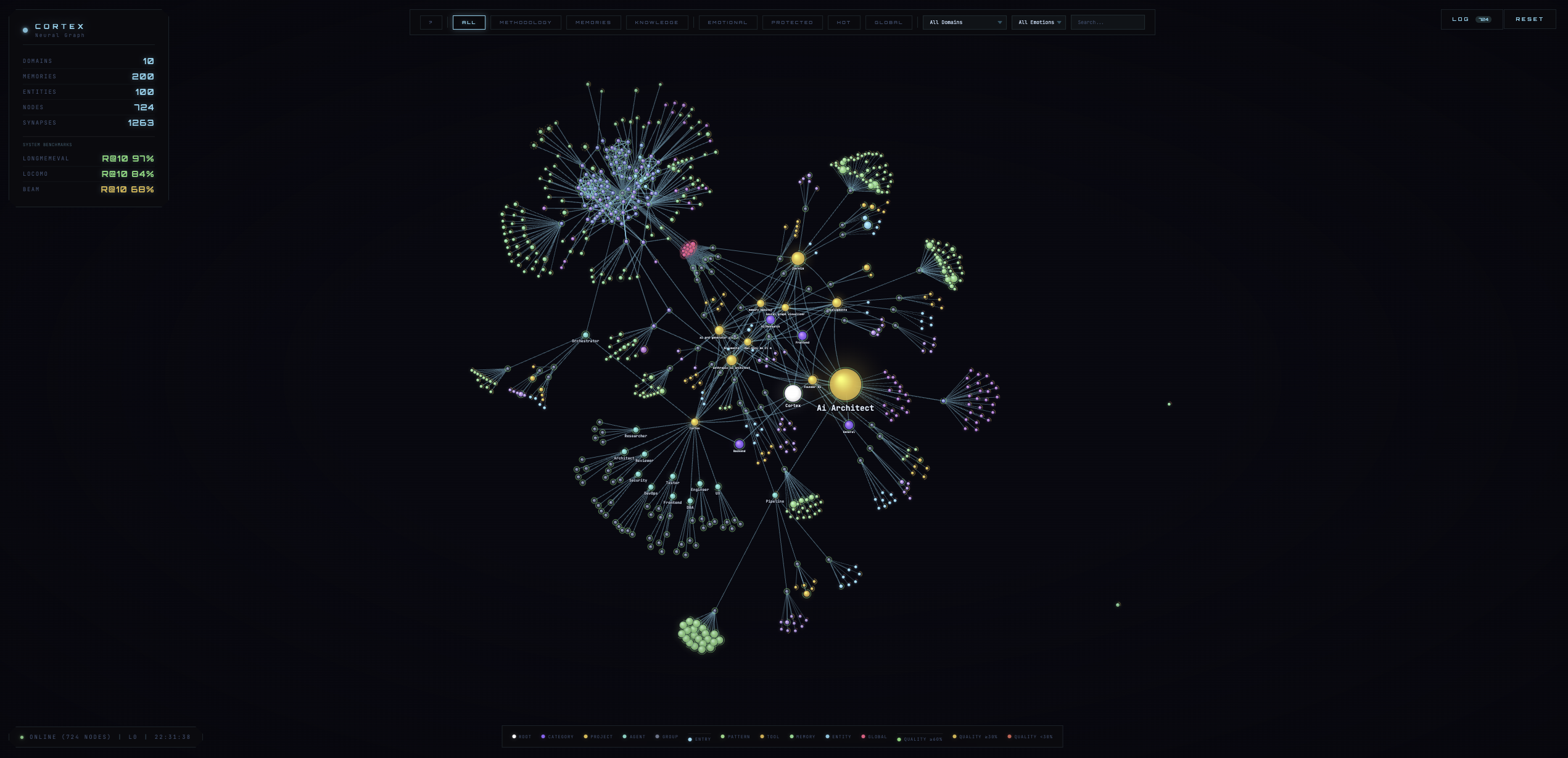
Launch the interactive visualization with /cortex-visualize. Three views: Graph, Board, and Pipeline.
Graph View
Force-directed neural graph showing domain clusters, memories, entities, and discussions connected by typed edges.
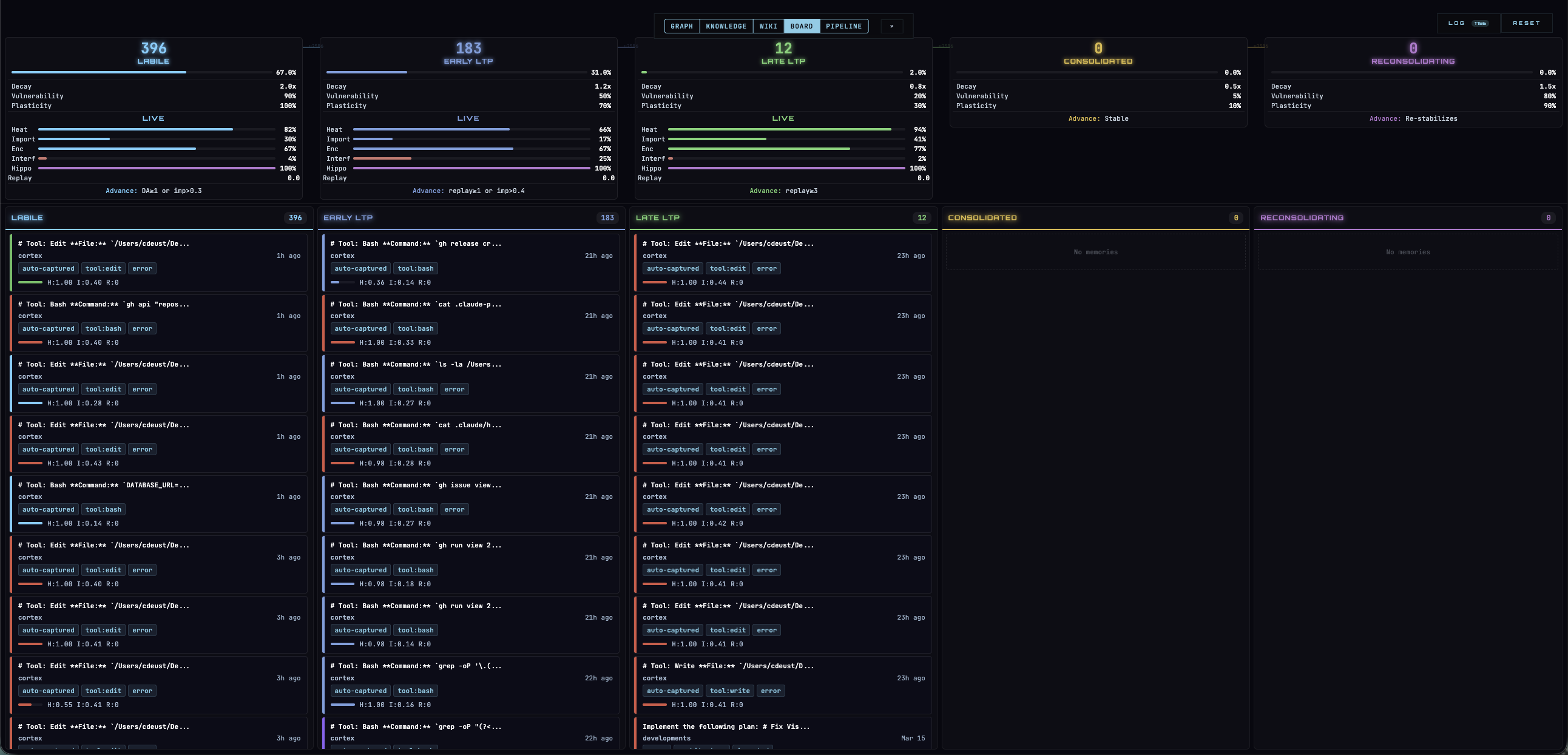
Board View
Memories organized by biological consolidation stage. Each column shows decay rate, vulnerability, and plasticity. Memory cards display domain, heat, importance, and emotional tags.
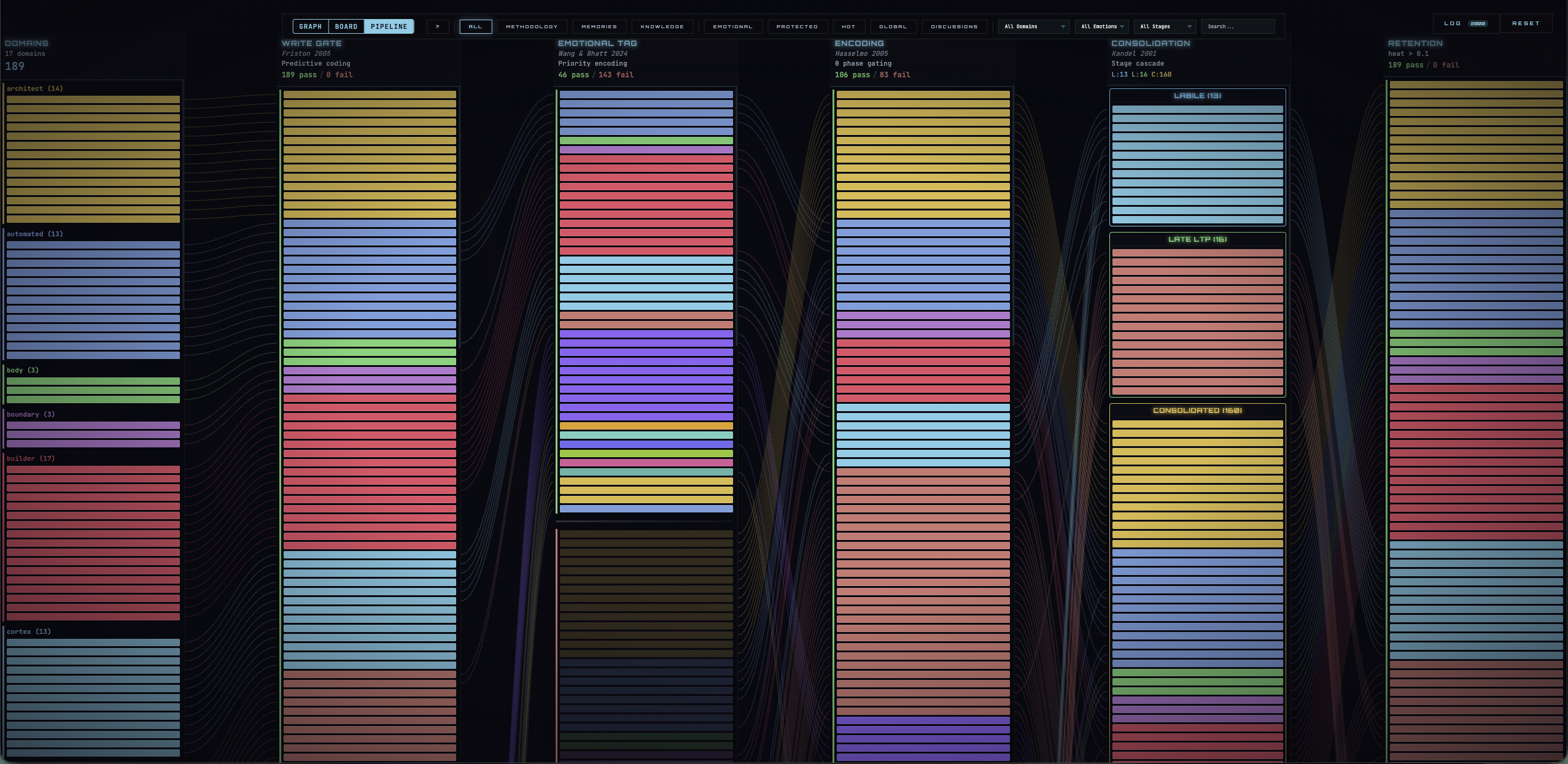
Pipeline View
Horizontal flow from domains through the write gate into consolidation stages. Block height reflects importance, color indicates domain.
Detail Panels
Click any node for full context. Discussion nodes show session timeline, tools used, keywords, and a full conversation viewer. Memory nodes show biological meters (encoding strength, interference, schema match) and git diffs.
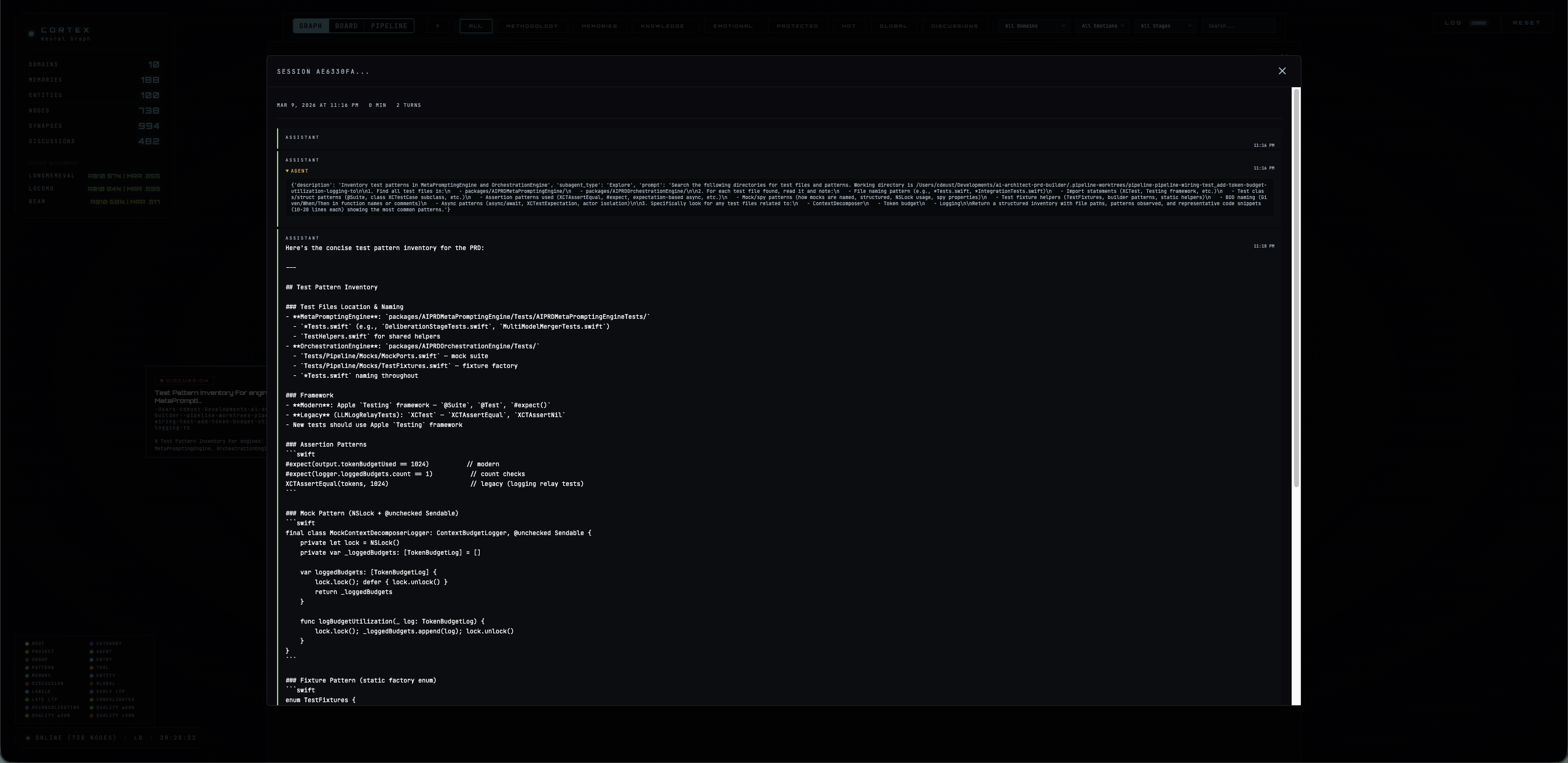
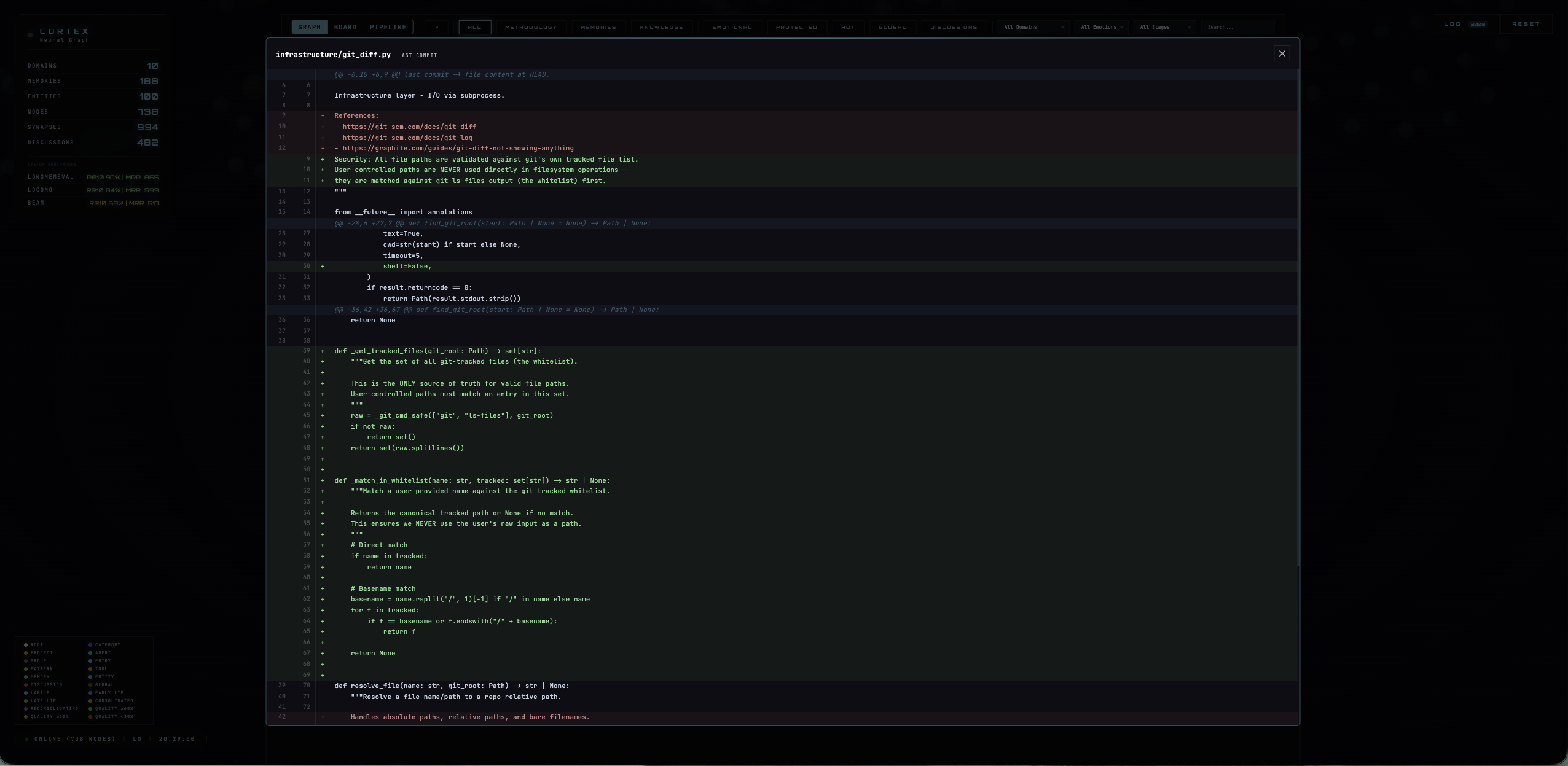
Filters
Domain, emotion, and consolidation stage dropdowns. Toggle buttons for methodology, memories, knowledge, emotional nodes, protected/hot/global memories, and discussions.
Agent Integration
Cortex is designed to work with a team of specialized agents. Each agent has scoped memory (agent_topic) while sharing critical decisions across the team.
Transactive Memory System
Based on Wegner 1987: teams store more knowledge than individuals because each member specializes, and a shared directory tells everyone who knows what.
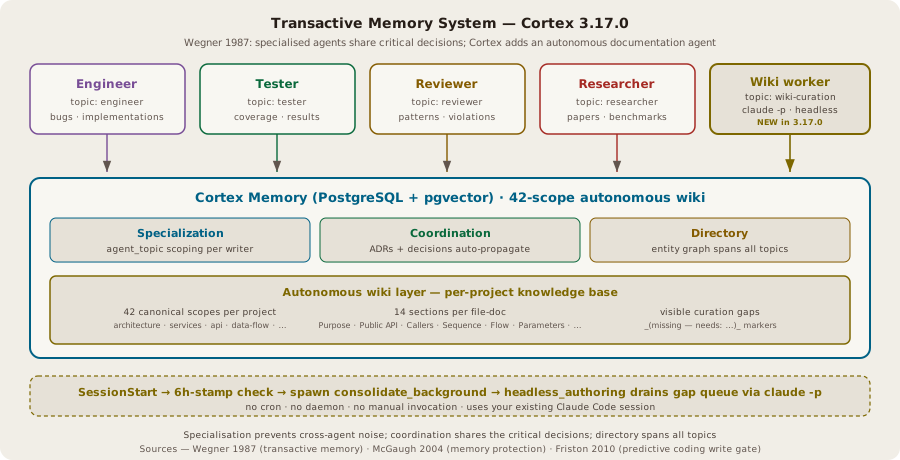
Specialization — each agent writes to its own topic. Engineer's debugging notes don't clutter tester's recall.
Coordination — decisions auto-protect and propagate. When engineer decides "use Redis over Memcached," every agent sees it at next session start.
Directory — entity-based queries span all topics. "What do we know about the reranker?" returns results from engineer, tester, and researcher.
Agent Briefing
When the orchestrator spawns a specialist agent, the SubagentStart hook automatically:
- Extracts task keywords from the prompt
- Queries agent-scoped prior work (FTS, no embedding load needed)
- Fetches team decisions (protected + global memories from other agents)
- Injects as context prefix — agent starts with knowledge
Compatible Agent Team
Works with any custom Claude Code agents. See zetetic-team-subagents for a reference team of 18 specialists:
| Agent | Specialty | Memory Topic |
|---|---|---|
| orchestrator | Parallel agent execution, coordination, merge | orchestrator |
| engineer | Clean Architecture, SOLID, any language/stack | engineer |
| architect | Module decomposition, layer boundaries, refactoring | architect |
| code-reviewer | Clean Architecture enforcement, SOLID violations | code-reviewer |
| test-engineer | Testing, CI verification, wiring checks | test-engineer |
| dba | Schema design, query optimization, migrations | dba |
| research-scientist | Benchmark improvement, neuroscience/IR papers | research-scientist |
| frontend-engineer | React/TypeScript, component design, accessibility | frontend-engineer |
| security-auditor | Threat modeling, OWASP, defense-in-depth | security-auditor |
| devops-engineer | CI/CD, Docker, PostgreSQL provisioning | devops-engineer |
| ux-designer | Usability, accessibility, design systems | ux-designer |
| data-scientist | EDA, feature engineering, data quality, bias auditing | data-scientist |
| experiment-runner | Ablation studies, hyperparameter search, statistical rigor | experiment-runner |
| mlops | Training pipelines, model serving, GPU optimization | mlops |
| paper-writer | Research paper structure, narrative flow, venue conventions | paper-writer |
| reviewer-academic | Peer review simulation (NeurIPS/CVPR/ICML style) | reviewer-academic |
| professor | Concept explanation, mental models, adaptive teaching | professor |
| latex-engineer | LaTeX templates, figures, TikZ, bibliographies | latex-engineer |
Skills
Cortex ships as a Claude Code plugin with 14 skills:
| Skill | Command | What It Does |
|---|---|---|
| cortex-remember | /cortex-remember | Store a memory with full write gate |
| cortex-recall | /cortex-recall | Search memories with intent-adaptive retrieval |
| cortex-consolidate | /cortex-consolidate | Run maintenance (decay, compress, CLS) |
| cortex-explore-memory | /cortex-explore-memory | Navigate memory by entity/domain |
| cortex-navigate-knowledge | /cortex-navigate-knowledge | Traverse knowledge graph |
| cortex-debug-memory | /cortex-debug-memory | Diagnose memory system health |
| cortex-visualize | /cortex-visualize | Launch 3D neural graph in browser |
| cortex-profile | /cortex-profile | View cognitive methodology profile |
| cortex-setup-project | /cortex-setup-project | Bootstrap a new project |
| cortex-develop | /cortex-develop | Memory-assisted development workflow |
| cortex-automate | /cortex-automate | Create prospective triggers |
Benchmarks
All scores are retrieval-only — no LLM reader in the evaluation loop. We measure whether retrieval places correct evidence in the top results.
| Benchmark | Metric | Cortex | Best in Paper | Paper |
|---|---|---|---|---|
| LongMemEval | R@10 | 98.0% | 78.4% | Wang et al., ICLR 2025 |
| LongMemEval | MRR | 0.880 | — | |
| LoCoMo | R@10 | 97.7% | — | Maharana et al., ACL 2024 |
| LoCoMo | MRR | 0.840 | — | |
| BEAM | Overall MRR | 0.627 | 0.329 (LIGHT) | Tavakoli et al., ICLR 2026 |
Per-category breakdowns
BEAM (10 abilities, 400 questions)
| Ability | MRR | R@10 |
|---|---|---|
| contradiction_resolution | 0.879 | 100.0% |
| knowledge_update | 0.867 | 97.5% |
| temporal_reasoning | 0.857 | 97.5% |
| multi_session_reasoning | 0.738 | 92.5% |
| information_extraction | 0.542 | 72.5% |
| summarization | 0.359 | 69.4% |
| preference_following | 0.356 | 62.5% |
| event_ordering | 0.353 | 62.5% |
| instruction_following | 0.242 | 52.5% |
| abstention | 0.125 | 12.5% |
LongMemEval (6 categories, 500 questions)
| Category | MRR | R@10 |
|---|---|---|
| Single-session (assistant) | 0.970 | 100.0% |
| Multi-session reasoning | 0.917 | 100.0% |
| Temporal reasoning | 0.887 | 97.7% |
| Knowledge updates | 0.884 | 100.0% |
| Single-session (user) | 0.793 | 91.4% |
| Single-session (preference) | 0.706 | 96.7% |
LoCoMo (5 categories, 1986 questions)
| Category | MRR | R@10 |
|---|---|---|
| adversarial | 0.809 | 89.0% |
| open_domain | 0.817 | 91.1% |
| multi_hop | 0.736 | 84.1% |
| single_hop | 0.714 | 91.8% |
| temporal | 0.538 | 76.1% |
Architecture
Clean Architecture with strict dependency rules. Inner layers never import outer layers.
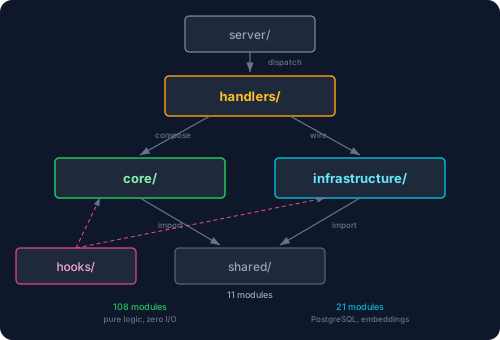
| Layer | Modules | Rule |
|---|---|---|
| core/ | 118 | Pure business logic. Zero I/O. Imports only shared/. |
| infrastructure/ | 33 | All I/O: PostgreSQL, embeddings, file system. |
| handlers/ | 62 tools | Composition roots wiring core + infrastructure. |
| hooks/ | 7 | Lifecycle automation (SessionStart/End, PostToolUse, etc.) |
| shared/ | 12 | Pure utilities. Python stdlib only. |
Storage: PostgreSQL 15+ with pgvector (HNSW) and pg_trgm. All retrieval in PL/pgSQL stored procedures.
Scientific Foundation
The Zetetic Standard
Every algorithm, constant, and threshold traces to a published paper, a measured ablation, or documented engineering source. Nothing is guessed. Where engineering defaults exist, they are labeled as such.
Paper Index (41 citations)
Information Retrieval
| Paper | Year | Venue | Module |
|---|---|---|---|
| Bruch et al. "Fusion Functions for Hybrid Retrieval" | 2023 | ACM TOIS | pg_schema.py |
| Nogueira & Cho "Passage Re-ranking with BERT" | 2019 | arXiv | reranker.py |
| Joren et al. "Sufficient Context" | 2025 | ICLR | reranker.py |
| Collins & Loftus "Spreading-activation theory" | 1975 | Psych. Review | spreading_activation.py |
Neuroscience — Encoding (5 papers)
| Paper | Year | Module |
|---|---|---|
| Friston "A theory of cortical responses" | 2005 | hierarchical_predictive_coding.py |
| Bastos et al. "Canonical microcircuits for predictive coding" | 2012 | hierarchical_predictive_coding.py |
| Wang & Bhatt "Emotional modulation of memory" | 2024 | emotional_tagging.py |
| Doya "Metalearning and neuromodulation" | 2002 | coupled_neuromodulation.py |
| Schultz "Prediction and reward" | 1997 | coupled_neuromodulation.py |
Neuroscience — Consolidation (6 papers)
| Paper | Year | Module |
|---|---|---|
| Kandel "Molecular biology of memory storage" | 2001 | cascade.py |
| McClelland et al. "Complementary learning systems" | 1995 | dual_store_cls.py |
| Frey & Morris "Synaptic tagging" | 1997 | synaptic_tagging.py |
| Josselyn & Tonegawa "Memory engrams" | 2020 | engram.py |
| Dudai "The restless engram" | 2012 | reconsolidation.py |
| Borbely "Two-process model of sleep" | 1982 | session_lifecycle.py |
Neuroscience — Retrieval & Navigation (4 papers)
| Paper | Year | Module |
|---|---|---|
| Behrouz et al. "Titans: Learning to Memorize at Test Time" | 2025 | titans_memory.py |
| Stachenfeld et al. "Hippocampus as predictive map" | 2017 | cognitive_map.py |
| Ramsauer et al. "Hopfield Networks is All You Need" | 2021 | hopfield.py |
| Kanerva "Hyperdimensional computing" | 2009 | hdc_encoder.py |
Neuroscience — Plasticity & Maintenance (14 papers)
| Paper | Year | Module |
|---|---|---|
| Hasselmo "Hippocampal theta rhythm" | 2005 | oscillatory_clock.py |
| Buzsaki "Hippocampal sharp wave-ripple" | 2015 | oscillatory_clock.py |
| Leutgeb et al. "Pattern separation in dentate gyrus" | 2007 | pattern_separation.py |
| Yassa & Stark "Pattern separation in hippocampus" | 2011 | pattern_separation.py |
| Turrigiano "The self-tuning neuron" | 2008 | homeostatic_plasticity.py |
| Abraham & Bear "Metaplasticity" | 1996 | homeostatic_plasticity.py |
| Tse et al. "Schemas and memory consolidation" | 2007 | schema_engine.py |
| Gilboa & Marlatte "Neurobiology of schemas" | 2017 | schema_engine.py |
| Hebb The Organization of Behavior | 1949 | synaptic_plasticity.py |
| Bi & Poo "Synaptic modifications" | 1998 | synaptic_plasticity.py |
| Perea et al. "Tripartite synapses" | 2009 | tripartite_synapse.py |
| Kastellakis et al. "Synaptic clustering" | 2015 | dendritic_clusters.py |
| Wang et al. "Microglia-mediated synapse elimination" | 2020 | microglial_pruning.py |
| Ebbinghaus Memory | 1885 | thermodynamics.py |
Team Memory & Preemptive Retrieval (6 papers)
| Paper | Year | Module |
|---|---|---|
| Wegner "Transactive memory" | 1987 | memory_ingest.py, session_start.py |
| Zhang et al. "Collaboration Mechanisms for LLM Agents" | 2024 | memory_ingest.py |
| McGaugh "Amygdala modulates consolidation" | 2004 | memory_ingest.py |
| Adcock et al. "Reward-motivated learning" | 2006 | memory_ingest.py |
| Bar "The proactive brain" | 2007 | preemptive_context.py |
| Smith & Vela "Context-dependent memory" | 2001 | agent_briefing.py |
Ablation Data
All ablation results committed to benchmarks/beam/ablation_results.json.
| Parameter | Tested Values | Optimal | Source |
|---|---|---|---|
| rerank_alpha | 0.30, 0.50, 0.55, 0.70 | 0.70 | BEAM 100K ablation |
| FTS weight | 0.0, 0.3, 0.5, 0.7, 1.0 | 0.0 (BEAM), 0.5 (balanced) | Cross-benchmark |
| Heat weight | 0.0, 0.1, 0.3, 0.5, 0.7 | 0.7 (BEAM), 0.3 (balanced) | Cross-benchmark |
| Adaptive alpha | CE spread QPP | Rejected | Regressed LoCoMo -5.1pp R@10 |
Engineering Defaults
Values without paper backing, explicitly documented:
| Constant | Value | Location | Status |
|---|---|---|---|
| FTS weight | 0.5 | pg_recall.py | Balanced across benchmarks |
| Heat weight | 0.3 | pg_recall.py | Balanced across benchmarks |
| CE gate threshold | 0.15 | reranker.py | Engineering default |
| Titans eta/theta | 0.9/0.01 | titans_memory.py | Paper uses learned params |
Security
Cortex runs locally (MCP over stdio, PostgreSQL on localhost, visualization on 127.0.0.1). No data leaves your machine unless you explicitly configure an external database.
Audit Score: 91/100
| Category | Score | Notes |
|---|---|---|
| Data Flow | 90 | No external data exfiltration. Embeddings computed locally. |
| SQL Injection | 95 | All queries parameterized (psycopg %s). Dynamic columns use sql.Identifier(). |
| Auth & Access Control | 85 | Docker PG uses scram-sha-256 on localhost. MCP over stdio (no network auth needed). |
| Dependency Health | 80 | Floor-pinned deps. Background install version-bounded. |
| Network Behavior | 92 | Model download on first run only. Viz servers bind 127.0.0.1. |
| Code Quality | 90 | Pydantic validation on all tools. Input length limits on remember/recall. Path traversal protected. |
| Prompt Injection | 88 | Memory content escaped in HTML rendering. Session injection uses data delimiters. |
| Secrets Management | 90 | .env/credentials in .gitignore. No hardcoded secrets. Docker credentials via env vars. |
Hardening measures
- SQL parameterization across all 7
pg_storemodules (psycopg%splaceholders) sql.Identifier()for dynamic column names (no f-string SQL)- ILIKE patterns escape
%,_,\from user input - CORS allows
*(localhost-only servers, no external exposure) - Docker PostgreSQL uses
scram-sha-256auth on127.0.0.1/32 trust_remote_coderemoved from embedding model loading- Input length validation:
remembercontent capped at 50KB, queries at 10KB - Path traversal protection via
.resolve()insync_instructions - HTML escaping (
esc()) on all user-generated content in visualization - Background
pip installversion-bounded (>=2.2.0,<4.0.0) - Secrets patterns (
.env,*.credentials.json,*.pem,*.key) in.gitignore
Development
pytest                    # 2080 tests
ruff check .              # Lint
ruff format --check .     # Format
License
MIT
Citation
@software{cortex2026,
  title={Cortex: Persistent Memory for Claude Code},
  author={Deust, Clement},
  year={2026},
  url={https://github.com/cdeust/Cortex}
}