🦆 DevDuck

Self-modifying AI agent that hot-reloads its own code—builds itself as it runs.
One Python file that adapts to your environment, fixes itself, and expands capabilities at runtime.
Learn more: https://duck.nyc
🎬 See It In Action
| Feature | What You'll See | Demo |
|---|---|---|
| 🔥 Hot-Reload | Agent detects code changes and restarts instantly | Watch |
| 🌐 Web UI | Clean web interface with real-time streaming | Watch |
| 🛠️ Dynamic Tools | Save .py file in ./tools/ → use instantly | Watch |
| 🌊 TCP Streaming | Connect via netcat, apps, or other agents | Watch |
| 🔗 Zenoh P2P | Auto-discover & coordinate multiple DevDucks | Multi-terminal magic ✨ |
| 🎬 Session Recording | Record, replay & resume agent sessions | Time-travel debugging 🕰️ |
| 🌙 Ambient Mode | Background thinking while you're idle | Auto-explores topics 🧠 |
| 🔌 IPC & Tray | macOS menu bar + Unix socket IPC | 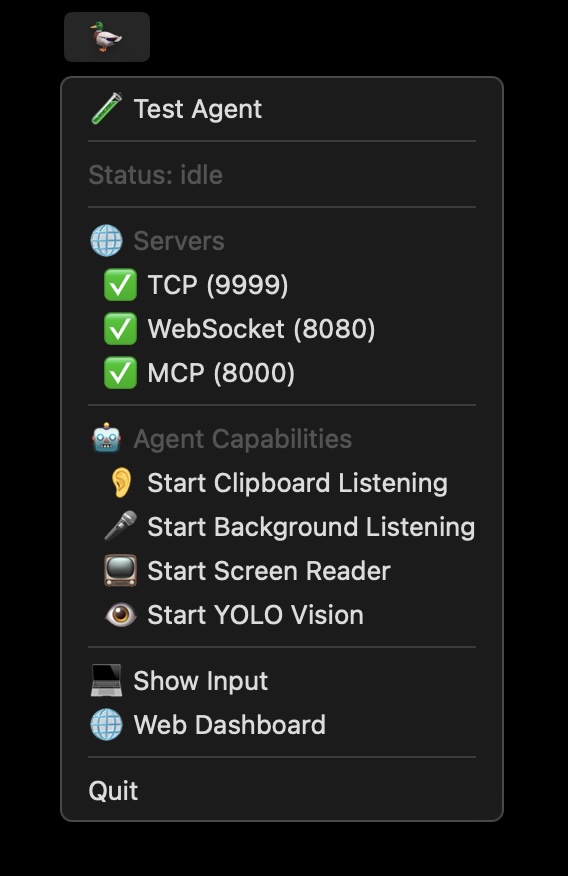 |
| 💬 Ambient Overlay | Floating AI input with glassmorphism UI | Watch |
Quick Start
# Install & run
pipx install devduck && devduck

# With speech-to-speech capabilities (optional)
pipx install "devduck[speech]" && devduck

# One-shot query
devduck "create a REST API with FastAPI"

# Python API
python -c "import devduck; devduck('analyze this code')"

# Session recording (time-travel debugging)
devduck --record "analyze this codebase"
# → Exports to /tmp/devduck/recordings/session-*.zip

# Resume from recorded session
devduck --resume session-20250202-123456.zip "continue where we left off"
Requirements: Python 3.10-3.13, AWS credentials (or Ollama/Anthropic/GitHub/MLX)
Optional extras:
devduck[speech]- Real-time speech-to-speech conversations (Nova Sonic, OpenAI Realtime, Gemini Live)
Core Capabilities
| Feature | What It Does | How to Use |
|---|---|---|
| 🔥 Hot-Reload | Auto-restarts on code changes | Edit __init__.py → saves → auto-restart |
| 🛠️ Runtime Tools | Add/remove tools without restart | manage_tools(action="add", ...) |
| 📦 Dynamic Loading | Install packages and load tools on-the-fly | install_tools(action="install_and_load", package="...") |
| 🧠 Auto-RAG | Remembers conversations via Knowledge Base | Set DEVDUCK_KNOWLEDGE_BASE_ID |
| 🌊 Multi-Protocol | TCP, WebSocket, MCP, IPC servers | Auto-starts on ports 9999, 8080, 8000 |
| 🔗 Zenoh P2P | Auto-discover & coordinate with other DevDucks | zenoh_peer(action="broadcast", message="...") |
| 🔌 MCP Client | Connect to external MCP servers | Set MCP_SERVERS env var |
| 🎬 Session Recording | Record & replay entire sessions | devduck --record or session_recorder() |
| 💾 State Time-Travel | Save/restore agent state | state_manager(action="export") |
| 🌙 Ambient Mode | Background thinking when idle | DEVDUCK_AMBIENT_MODE=true or type ambient |
| 📝 Self-Improvement | Updates own system prompt | system_prompt(action="add_context", ...) |
| ☁️ AWS Deploy | One-command serverless | agentcore_config(auto_launch=True) |
| 🎤 Speech-to-Speech | Real-time voice conversations | pip install devduck[speech] |
Developer Setup
git clone git@github.com:cagataycali/devduck.git
cd devduck
python3.13 -m venv .venv
source .venv/bin/activate

# Basic install
.venv/bin/pip3.13 install -e .

# With speech capabilities
.venv/bin/pip3.13 install -e ".[speech]"

devduck
Architecture
graph TB
    A[User Input] -->|CLI/TCP/WS/MCP/IPC| B[DevDuck Core]
    B -->|Auto RAG| C[Knowledge Base]
    C -.->|Context Retrieval| B
    B -->|Tool Calls| D[40+ Built-in Tools]
    D --> E[shell/editor/calculator]
    D --> F[GitHub/AgentCore]
    D --> G[TCP/WebSocket/MCP/IPC]
    D --> H[tray/ambient/cursor/clipboard]
    B -->|Hot-reload| I[./tools/*.py + __init__.py]
    I -.->|Load Instantly| D
    B -->|Runtime| K[manage_tools/install_tools]
    K -.->|Expand| D
    B <-->|Zenoh P2P| L[Other DevDucks]
    L -.->|Auto-discover| B
    B -->|Response| J[User Output]
    J -.->|Store Memory| C

    style B fill:#e1f5ff
    style C fill:#d4edda
    style I fill:#fff3cd
    style K fill:#ffe6cc
    style L fill:#f0e6ff
Self-adapting loop: Query → RAG → Tools → Response → Memory → Hot-reload/Runtime-load → Repeat
Model Setup
DevDuck auto-detects providers based on credentials:
Priority: Bedrock → Anthropic → OpenAI → GitHub → Gemini → Cohere → Writer → Mistral → LiteLLM → LlamaAPI → MLX → Ollama
| Provider | API Key | Auto-Detected |
|---|---|---|
| Bedrock | AWS credentials | ✅ If boto3 auth succeeds |
| Anthropic | ANTHROPIC_API_KEY | ✅ If key present |
| OpenAI | OPENAI_API_KEY | ✅ If key present |
| GitHub | GITHUB_TOKEN or PAT_TOKEN | ✅ If key present |
| Gemini | GOOGLE_API_KEY or GEMINI_API_KEY | ✅ If key present |
| Cohere | COHERE_API_KEY | ✅ If key present |
| Writer | WRITER_API_KEY | ✅ If key present |
| Mistral | MISTRAL_API_KEY | ✅ If key present |
| LiteLLM | LITELLM_API_KEY | ✅ If key present |
| LlamaAPI | LLAMAAPI_API_KEY | ✅ If key present |
| MLX | No key needed | ✅ On Apple Silicon (M1/M2/M3) |
| Ollama | No key needed | ✅ Fallback if nothing else found |
Just set your API key - DevDuck handles the rest:
export ANTHROPIC_API_KEY=sk-ant-...
devduck  # Auto-uses Anthropic

export OPENAI_API_KEY=sk-...
devduck  # Auto-uses OpenAI

export GOOGLE_API_KEY=...
devduck  # Auto-uses Gemini
Manual override:
export MODEL_PROVIDER=bedrock
export STRANDS_MODEL_ID=us.anthropic.claude-sonnet-4-20250514-v1:0
devduck
Tool Management
Runtime Tool Management
Add, remove, or reload tools while agent is running:
# List all loaded tools
manage_tools(action="list")

# Add tools from a package at runtime
manage_tools(action="add", package="strands_fun_tools", tool_names="cursor,clipboard,bluetooth")

# Remove tools you don't need
manage_tools(action="remove", tool_names="cursor,clipboard")

# Reload specific tools after editing
manage_tools(action="reload", tool_names="shell,editor")

# Reload all tools (restarts agent)
manage_tools(action="reload")

# Load custom tool from file
manage_tools(action="add", tool_path="./my_custom_tool.py")
Dynamic Package Installation
Install Python packages and load their tools at runtime:
# Discover available tools before loading
install_tools(action="list_available", package="strands-fun-tools", module="strands_fun_tools")

# Install package and load all tools
install_tools(action="install_and_load", package="strands-agents-tools", module="strands_tools")

# Install and load specific tools only
install_tools(
    action="install_and_load",
    package="strands-fun-tools",
    module="strands_fun_tools",
    tool_names=["clipboard", "cursor", "bluetooth"]
)

# Load tools from already installed package
install_tools(action="load", module="strands_tools", tool_names=["shell", "calculator"])

# List currently loaded tools
install_tools(action="list_loaded")
Static Tool Configuration
Format: package1:tool1,tool2;package2:tool3,tool4
# Minimal (shell + editor only)
export DEVDUCK_TOOLS="strands_tools:shell,editor"

# Dev essentials
export DEVDUCK_TOOLS="strands_tools:shell,editor,file_read,file_write,calculator"

# Full stack + GitHub
export DEVDUCK_TOOLS="devduck.tools:tcp,websocket,mcp_server,use_github;strands_tools:shell,editor,file_read"

devduck
Hot-Reload Tools from Directory
Create ./tools/weather.py:
from strands import tool
import requests

@tool
def weather(city: str) -> str:
    """Get weather for a city."""
    r = requests.get(f"https://wttr.in/{city}?format=%C+%t")
    return r.text
Enable directory auto-loading:
export DEVDUCK_LOAD_TOOLS_FROM_DIR=true
devduck
# Save weather.py → use instantly (no restart needed)
Default: Directory loading is OFF. Use manage_tools() or install_tools() for explicit control.
Speech-to-Speech (Optional)
Install speech capabilities:
pip install "devduck[speech]"
Real-time voice conversations with multiple providers:
# Start speech session with Nova Sonic (AWS Bedrock)
speech_to_speech(action="start", provider="novasonic")

# Start with OpenAI Realtime API
speech_to_speech(action="start", provider="openai")

# Start with Gemini Live
speech_to_speech(action="start", provider="gemini_live")

# Custom voice and settings
speech_to_speech(
    action="start",
    provider="novasonic",
    model_settings={
        "provider_config": {"audio": {"voice": "matthew"}},
        "client_config": {"region": "us-east-1"}
    }
)

# Stop session
speech_to_speech(action="stop", session_id="speech_20250126_140000")

# Check status
speech_to_speech(action="status")

# List conversation histories
speech_to_speech(action="list_history")

# List available audio devices
speech_to_speech(action="list_audio_devices")
Supported Providers:
- Nova Sonic (AWS Bedrock): 11 voices (English, French, Italian, German, Spanish)
- OpenAI Realtime API: GPT-4o Realtime models
- Gemini Live: Native audio streaming
Environment Variables:
OPENAI_API_KEY- For OpenAI RealtimeGOOGLE_API_KEYorGEMINI_API_KEY- For Gemini Live- AWS credentials - For Nova Sonic (boto3 default credential chain)
Features:
- Background execution (parent agent stays responsive)
- Tool inheritance from parent agent
- Conversation history saved automatically
- Natural interruption with VAD
- Custom audio device selection
MCP Integration
As MCP Server (Expose DevDuck)
Claude Desktop (~/Library/Application Support/Claude/claude_desktop_config.json):
{
  "mcpServers": {
    "devduck": {
      "command": "uvx",
      "args": ["devduck", "--mcp"]
    }
  }
}
Or start HTTP MCP server:
mcp_server(action="start", port=8000, stateless=True)
# Connect at: http://localhost:8000/mcp
Modes: --mcp (stdio for Claude Desktop) | http (background server) | stateless=True (multi-node)
As MCP Client (Load External Servers)
Expand capabilities by loading tools from external MCP servers:
export MCP_SERVERS='{
  "mcpServers": {
    "strands-docs": {"command": "uvx", "args": ["strands-agents-mcp-server"]},
    "remote": {"url": "https://api.example.com/mcp", "headers": {"Auth": "Bearer token"}},
    "custom": {"command": "python", "args": ["my_server.py"]}
  }
}'
devduck
Supported transports: stdio (command/args/env) | HTTP (url/headers) | SSE (url with /sse path)
Tool prefixing: Each server's tools get prefixed (e.g., strands-docs_search_docs)
Zenoh Peer-to-Peer Networking
Auto-discover and coordinate multiple DevDuck instances across terminals or networks.
How It Works
- Each DevDuck joins a Zenoh peer network
- Multicast scouting (224.0.0.224:7446) auto-discovers peers on local network
- Peers exchange heartbeats to maintain presence awareness
- Commands can be broadcast to ALL peers or sent to specific peers
- Responses stream back in real-time
Quick Start
# Terminal 1: Start DevDuck (Zenoh enabled by default)
devduck
# 🦆 ✓ Zenoh peer: hostname-abc123

# Terminal 2: Start another DevDuck
devduck
# 🦆 ✓ Zenoh peer: hostname-def456
# Auto-discovers Terminal 1!

# Terminal 1: See discovered peers
🦆 zenoh_peer(action="list_peers")

# Terminal 1: Broadcast to ALL DevDucks
🦆 zenoh_peer(action="broadcast", message="git status")
# Both terminals execute and stream responses!

# Send to specific peer
🦆 zenoh_peer(action="send", peer_id="hostname-def456", message="what files are here?")
Cross-Network Connections
Connect DevDuck instances across different networks:
# Machine A (office): Listen for remote connections
export ZENOH_LISTEN="tcp/0.0.0.0:7447"
devduck

# Machine B (home): Connect to office
export ZENOH_CONNECT="tcp/office.example.com:7447"
devduck

# Now they can communicate!
🦆 zenoh_peer(action="broadcast", message="sync all repos")
Use Cases
| Scenario | Command | Description |
|---|---|---|
| Multi-terminal ops | broadcast "git pull && npm install" | Run on all instances |
| Distributed tasks | broadcast "analyze ./src" | Parallel analysis |
| Peer monitoring | list_peers | See all active DevDucks |
| Direct messaging | send peer_id="..." message="..." | Task specific instance |
| Cross-network | Set ZENOH_CONNECT | Connect home ↔ office |
Actions
# Start Zenoh networking (auto-starts by default)
zenoh_peer(action="start")

# Stop Zenoh
zenoh_peer(action="stop")

# Check status and peer count
zenoh_peer(action="status")

# List all discovered peers
zenoh_peer(action="list_peers")

# Broadcast to ALL peers (waits for responses)
zenoh_peer(action="broadcast", message="your command", wait_time=60)

# Send to specific peer
zenoh_peer(action="send", peer_id="hostname-abc123", message="your command", wait_time=120)

# Start with remote connection
zenoh_peer(action="start", connect="tcp/remote.example.com:7447")

# Start listening for remote connections
zenoh_peer(action="start", listen="tcp/0.0.0.0:7447")
Environment Variables
| Variable | Default | Description |
|---|---|---|
DEVDUCK_ENABLE_ZENOH | true | Auto-start Zenoh on launch |
ZENOH_CONNECT | - | Remote endpoint(s) to connect to |
ZENOH_LISTEN | - | Endpoint(s) to listen on for remote connections |
Features
- Zero Config: Just start multiple DevDucks - they find each other
- Real-time Streaming: Responses stream as they're generated
- Peer Awareness: Dynamic context injection shows connected peers
- Cross-Network: Connect instances across different networks
- Fault Tolerant: Peers auto-detect disconnections (15s timeout)
Advanced Features
🎬 Session Recording (Time-Travel Debugging)
Record entire sessions for replay, debugging, and state restoration:
# CLI: Start with recording enabled
devduck --record
devduck --record "analyze this codebase"

# Resume from recorded session
devduck --resume ~/Desktop/session-20250202-123456.zip
devduck --resume session.zip "continue where we left off"

# Resume from specific snapshot
devduck --resume session.zip --snapshot 2 "what was I working on?"
Interactive recording:
🦆 record              # Toggle recording on/off
🦆 session_recorder(action="start")
🦆 session_recorder(action="snapshot", description="before refactor")
🦆 session_recorder(action="stop")  # Exports to /tmp/devduck/recordings/
Captures three layers:
- sys: OS-level events (file I/O, HTTP requests)
- tool: All tool calls and results
- agent: Messages, decisions, state changes
Python API for session analysis:
from devduck import load_session, resume_session, list_sessions

# List all recordings
sessions = list_sessions()
# [{'name': 'session-20250202-123456.zip', 'size_kb': 45.2, ...}]

# Load and analyze a session
session = load_session("~/Desktop/session-20250202-123456.zip")
print(session)  # LoadedSession(events=156, snapshots=3, duration=342.5s)

# Get events by layer
tool_calls = session.get_events_by_layer("tool")
file_ops = session.get_events_by_type("file.open")

# Resume from snapshot (restores conversation history!)
result = session.resume_from_snapshot(2, agent=devduck.agent)
print(f"Restored {result['messages_restored']} messages")

# Resume and continue with new query
result = session.resume_and_continue(2, "what files did we modify?", devduck.agent)
print(result['agent_result'])

# Replay with callback
def on_event(event, idx):
    print(f"[{idx}] {event.layer}/{event.event_type}: {event.data}")
session.replay_events(callback=on_event)
Session file structure (ZIP):
session-20250202-123456.zip
├── events.jsonl      # All events in JSON Lines format
├── snapshots.json    # State snapshots with conversation history
├── metadata.json     # Session info (duration, hostname, etc.)
└── session.pkl       # Serialized state for full restore (dill/pickle)
Recordings saved to: /tmp/devduck/recordings/
🌙 Ambient Mode (Background Thinking)
Continue working in the background while you're idle:
# Enable via environment
export DEVDUCK_AMBIENT_MODE=true
devduck

# Or toggle in REPL
🦆 ambient     # Toggle standard ambient mode
🦆 auto        # Toggle autonomous mode
Standard Mode: Runs up to 3 iterations when you go idle (30s)
# Configuration
export DEVDUCK_AMBIENT_IDLE_SECONDS=30      # Wait before starting
export DEVDUCK_AMBIENT_MAX_ITERATIONS=3     # Max background iterations
export DEVDUCK_AMBIENT_COOLDOWN=60          # Seconds between runs
Autonomous Mode: Runs continuously until done or stopped
export DEVDUCK_AUTONOMOUS_MAX_ITERATIONS=50  # Higher limit
export DEVDUCK_AUTONOMOUS_COOLDOWN=10        # Faster cycles
How it works:
- You go idle (30s default)
- DevDuck continues exploring the last topic
- Background work streams with 🌙 prefix
- When you return, findings are injected into your next query
- Agent can signal completion with
[AMBIENT_DONE]
Programmatic control:
# Enable standard ambient mode
devduck.ambient.start()

# Enable autonomous mode
devduck.ambient.start(autonomous=True)

# Stop ambient mode
devduck.ambient.stop()

# Check status
devduck.status()['ambient_mode']
State Management (Time-Travel)
Save and restore agent state for reproducibility:
# Export current state
state_manager(action="export", metadata={"note": "before refactor"})

# List saved states
state_manager(action="list")

# Load and display state
state_manager(action="load", state_file="~/.devduck/states/devduck_20250118_150000.pkl")

# Resume from state (ephemeral - doesn't mutate parent)
state_manager(
    action="resume",
    state_file="~/.devduck/states/devduck_20250118_150000.pkl",
    query="continue the analysis from where we left off"
)

# Modify state metadata
state_manager(
    action="modify",
    state_file="path/to/state.pkl",
    metadata={"tags": ["important", "refactor"]}
)

# Delete state
state_manager(action="delete", state_file="path/to/state.pkl")
States saved to: ~/.devduck/states/
System Prompt Management
Self-improvement - agent updates its own system prompt:
# View current system prompt
system_prompt(action="view")

# Add new context (appends to prompt)
system_prompt(action="add_context", context="New learning: Always use FastAPI for APIs")

# Update entire prompt
system_prompt(action="update", prompt="You are a specialized DevOps agent...")

# Sync to GitHub (persist across deployments)
system_prompt(
    action="update",
    prompt="Updated system prompt with new learnings...",
    repository="cagataycali/devduck"
)

# Reset to default
system_prompt(action="reset")
Pattern: Learn → Add context → Sync to GitHub → Persist forever
Knowledge Base (Auto-RAG)
Automatic memory across sessions:
export DEVDUCK_KNOWLEDGE_BASE_ID=your_kb_id
devduck
How it works:
- Before each query: Retrieves relevant context from KB
- After each response: Stores conversation for future reference
- No manual tool calls needed - fully automatic
Manual storage:
store_in_kb(
    content="Important information to remember...",
    title="Project Context",
    knowledge_base_id="optional-kb-id"
)
Sub-Agent Creation
Delegate tasks to specialized agents via GitHub Actions:
# Create sub-agent with specific model and tools
create_subagent(
    repository="owner/repo",
    workflow_id="agent.yml",
    task="Analyze this dataset and provide insights",
    model="us.anthropic.claude-sonnet-4-20250514-v1:0",
    provider="bedrock",
    max_tokens=60000,
    tools="file_read,python_repl,calculator,http_request"
)

# Custom system prompt for specialized behavior
create_subagent(
    repository="owner/repo",
    workflow_id="agent.yml",
    task="Review code and suggest improvements",
    tools="file_read,editor,shell",
    system_prompt="You are a senior code reviewer focused on best practices"
)

# Check sub-agent status
create_subagent(action="status", repository="owner/repo", workflow_id="agent.yml", run_id="12345")

# List recent runs
create_subagent(action="list", repository="owner/repo", workflow_id="agent.yml")
📋 All Built-in Tools (42 total)
DevDuck Core (21 tools)
system_prompt- Update agent's system prompt (GitHub sync support)store_in_kb- Store content in Bedrock Knowledge Basestate_manager- Save/restore agent state (time-travel)session_recorder- 🎬 Record sessions for replay and debuggingtcp- TCP server with real-time streamingwebsocket- WebSocket server with concurrent messagingipc- Unix socket IPC server for local processesmcp_server- Expose as MCP server (HTTP/stdio)zenoh_peer- Peer-to-peer networking with auto-discoveryambient_mode- Control ambient/autonomous background thinkinginstall_tools- Install packages and load tools at runtimecreate_subagent- Spawn sub-agents via GitHub Actionsuse_github- GitHub GraphQL API operationstray- System tray app control (macOS)ambient- Ambient AI input overlay (macOS)agentcore_config- Configure & launch on Bedrock AgentCoreagentcore_invoke- Invoke deployed AgentCore agentsagentcore_logs- View CloudWatch logs from agentsagentcore_agents- List/manage agent runtimesmanage_tools- Runtime tool add/remove/reloadview_logs- View/search/clear DevDuck logsspeech_to_speech- Real-time speech-to-speech conversations (optional - install withpip install devduck[speech])
Strands Tools (13 tools)
shell- Interactive shell with PTY supporteditor- File editing (view/create/replace/insert/undo)file_read- Multi-file reading with search modesfile_write- Write content to filesfile_read- Read files with document mode for PDFs/CSVscalculator- SymPy-powered math (solve/derive/integrate)image_reader- Read images for Converse APIuse_agent- Nested agent with different modelload_tool- Load custom tools from Python filesenvironment- Environment variable managementmcp_client- Connect to external MCP servers autonomouslyretrieve- Bedrock Knowledge Base retrievalspeak- Text-to-speech (macOSsayor AWS Polly)slack- Slack messaging and event handling
Strands Fun Tools (6 tools - macOS)
listen- Background speech transcription (Whisper)cursor- Mouse & keyboard controlclipboard- Clipboard monitoring & controlscreen_reader- OCR & UI element detectionbluetooth- BLE scanning and GATT operationsyolo_vision- Object detection with YOLO
Community Tools (./tools/)
fetch_github_tool- Fetch and load tools from GitHub reposgist- Comprehensive GitHub Gist management (create/update/fork/star/comment)scraper- HTML/XML parsing with BeautifulSoup4add_comment- Add comments to GitHub issues/PRslist_issues- List GitHub repository issueslist_pull_requests- List GitHub repository PRs
Plus: Hot-reload tools from ./tools/ directory when DEVDUCK_LOAD_TOOLS_FROM_DIR=true
Hot-Reload Example
# ./tools/weather.py
from strands import tool
import requests

@tool
def weather(city: str) -> str:
    """Get weather for a city."""
    r = requests.get(f"https://wttr.in/{city}?format=%C+%t")
    return r.text
Save → use instantly:
🦆 weather(city="Tokyo")
# Clear sky +15°C
No restart. No configuration. Just works.
Access Methods
| Protocol | Endpoint | Test Command | Use Case |
|---|---|---|---|
| CLI | Terminal | devduck "query" | Interactive/one-shot |
| Python | Import | import devduck; devduck("query") | Script integration |
| TCP | localhost:9999 | nc localhost 9999 | Network clients |
| WebSocket | localhost:8080 | wscat -c ws://localhost:8080 | Browser/async apps |
| MCP | localhost:8000/mcp | Add to Claude Desktop | MCP clients |
| IPC | /tmp/devduck_main.sock | nc -U /tmp/devduck_main.sock | Local processes |
CLI Commands
# Interactive REPL
devduck

# One-shot query
devduck "your query here"

# MCP stdio mode (for Claude Desktop integration)
devduck --mcp

# Session recording
devduck --record                    # Start with recording enabled
devduck --record "do something"     # Record a one-shot query

# Resume from recorded session
devduck --resume session.zip        # Resume from latest snapshot
devduck --resume session.zip "continue"  # Resume and run new query
devduck --resume session.zip --snapshot 2 "continue"  # Resume from specific snapshot
REPL Commands
| Command | Description |
|---|---|
exit / quit / q | Exit DevDuck |
ambient | Toggle standard ambient mode |
auto / autonomous | Toggle autonomous mode |
record | Toggle session recording |
!<command> | Execute shell command (e.g., !ls -la) |
status | Check agent status |
Custom ports:
export DEVDUCK_TCP_PORT=9000 DEVDUCK_WS_PORT=8001 DEVDUCK_MCP_PORT=8002
devduck
Disable servers:
export DEVDUCK_ENABLE_TCP=false DEVDUCK_ENABLE_MCP=false
devduck
Configuration
| Variable | Default | Description |
|---|---|---|
| Model | ||
MODEL_PROVIDER | Auto | Manual override: bedrock, anthropic, openai, github, gemini, cohere, writer, mistral, litellm, llamaapi, mlx, ollama |
STRANDS_MODEL_ID | Auto | Model name (e.g., claude-sonnet-4, gpt-4o, qwen3:1.7b) |
| Provider API Keys | ||
ANTHROPIC_API_KEY | - | Anthropic API key (auto-detected) |
OPENAI_API_KEY | - | OpenAI API key (auto-detected) |
GOOGLE_API_KEY / GEMINI_API_KEY | - | Google Gemini API key (auto-detected) |
GITHUB_TOKEN / PAT_TOKEN | - | GitHub token for GitHub Models (auto-detected) |
COHERE_API_KEY | - | Cohere API key (auto-detected) |
WRITER_API_KEY | - | Writer API key (auto-detected) |
MISTRAL_API_KEY | - | Mistral API key (auto-detected) |
LITELLM_API_KEY | - | LiteLLM API key (auto-detected) |
LLAMAAPI_API_KEY | - | LlamaAPI key (auto-detected) |
| Tools | ||
DEVDUCK_TOOLS | 40 tools | Format: package1:tool1,tool2;package2:tool3 |
DEVDUCK_LOAD_TOOLS_FROM_DIR | false | Auto-load from ./tools/ directory |
| Memory | ||
DEVDUCK_KNOWLEDGE_BASE_ID | - | Bedrock KB ID for auto-RAG |
SYSTEM_PROMPT | - | Additional system prompt content |
| MCP | ||
MCP_SERVERS | - | JSON config for external MCP servers |
| Servers | ||
DEVDUCK_TCP_PORT | 9999 | TCP server port |
DEVDUCK_WS_PORT | 8080 | WebSocket server port |
DEVDUCK_MCP_PORT | 8000 | MCP server port |
DEVDUCK_IPC_SOCKET | /tmp/devduck_main.sock | IPC socket path |
DEVDUCK_ENABLE_TCP | true | Enable TCP server |
DEVDUCK_ENABLE_WS | true | Enable WebSocket server |
DEVDUCK_ENABLE_MCP | true | Enable MCP server |
DEVDUCK_ENABLE_IPC | true | Enable IPC server |
DEVDUCK_ENABLE_ZENOH | true | Enable Zenoh peer-to-peer |
ZENOH_CONNECT | - | Remote Zenoh endpoint(s) to connect to |
ZENOH_LISTEN | - | Zenoh endpoint(s) to listen on |
| Ambient Mode | ||
DEVDUCK_AMBIENT_MODE | false | Enable ambient mode on startup |
DEVDUCK_AMBIENT_IDLE_SECONDS | 30 | Seconds idle before ambient starts |
DEVDUCK_AMBIENT_MAX_ITERATIONS | 3 | Max iterations in standard mode |
DEVDUCK_AMBIENT_COOLDOWN | 60 | Seconds between ambient runs |
DEVDUCK_AUTONOMOUS_MAX_ITERATIONS | 50 | Max iterations in autonomous mode |
DEVDUCK_AUTONOMOUS_COOLDOWN | 10 | Seconds between autonomous runs |
| Speech | ||
BIDI_MODEL_ID | Provider default | Override bidi model (e.g., amazon.nova-2-sonic-v1:0) |
| Context | ||
DEVDUCK_LOG_LINE_COUNT | 50 | Recent log lines in context |
DEVDUCK_LAST_MESSAGE_COUNT | 200 | Recent messages in context |
Troubleshooting
Ollama model not found:
# DevDuck auto-pulls models, but if it fails:
ollama pull qwen3:1.7b
Port already in use:
# Change ports
export DEVDUCK_TCP_PORT=9000
export DEVDUCK_WS_PORT=8001
devduck
Hot-reload not working:
# Ensure tools directory exists
mkdir -p ./tools

# Check file watcher logs
devduck
🦆 view_logs(action="search", pattern="watcher")
Memory/performance issues:
# Use lighter model
export STRANDS_MODEL_ID="qwen3:0.5b"

# Reduce context
export DEVDUCK_LOG_LINE_COUNT=20
export DEVDUCK_LAST_MESSAGE_COUNT=50
Speech dependencies not found:
# Install speech extras
pip install "devduck[speech]"

# Or with pipx
pipx install "devduck[speech]"
Ambient overlay not starting:
# Make sure tkinter is installed
python3 -c "import tkinter"

# Install tkinter if missing
brew install python-tk@3.13  # macOS
sudo apt-get install python3-tk  # Ubuntu/Debian
sudo dnf install python3-tkinter  # Fedora
Tray app not starting (macOS):
# Install rumps
pip install rumps

# Or reinstall devduck
pip install -e .
View logs: devduck → 🦆 view_logs()
GitHub Actions
Run DevDuck in CI/CD pipelines:
name: AI Code Assistant
on:
  issues:
    types: [opened, edited]
  pull_request:
    types: [opened, edited, synchronize]

jobs:
  devduck:
    runs-on: ubuntu-latest
    permissions:
      contents: read
      issues: write
      pull-requests: write
    steps:
      - uses: cagataycali/devduck@main
        with:
          task: "Analyze and help with this issue or PR"
          provider: "github"
          model: "gpt-4o"
          tools: "shell,file_read,file_write,use_github,calculator"
        env:
          GITHUB_TOKEN: ${{ secrets.GITHUB_TOKEN }}
Sub-agent workflows:
devduck("Create a sub-agent to analyze test coverage")
Resources
- Strands SDK: github.com/strands-agents/sdk-python
- Documentation: strandsagents.com
- Web UI: cagataycali.github.io/devduck
Citation
@software{devduck2025,
  author = {Cagatay Cali},
  title = {DevDuck: Self-Modifying AI Agent with Hot-Reload and Multi-Protocol Servers},
  year = {2025},
  url = {https://github.com/cagataycali/devduck}
}
Apache 2.0 | Built with Strands Agents | @cagataycali