GoPeak







GoPeak is an MCP server for Godot that lets AI assistants run, inspect, modify, and debug real projects end-to-end.
Quick Start (3 Minutes)
Requirements
- Godot 4.x
- Node.js 18+
- MCP-compatible client (Claude Desktop, Cursor, Cline, OpenCode, etc.)
1) Run GoPeak
npx -y gopeak
or install globally:
npm install -g gopeak
gopeak
2) Add MCP client config
{
  "mcpServers": {
    "godot": {
      "command": "npx",
      "args": ["-y", "gopeak"],
      "env": {
        "GODOT_PATH": "/path/to/godot",
        "GOPEAK_TOOL_PROFILE": "compact"
      }
    }
  }
}
GOPEAK_TOOL_PROFILE=compactis the default. It exposes 33 core tools with 22 dynamic tool groups (78 additional tools) that activate on demand — keeping token usage low while preserving full capability.
3) First prompts to try
- "List Godot projects in
/your/projectsand show project info." - "Create
scenes/Player.tscnwithCharacterBody2Droot and add a movement script." - "Run project, get debug output, then fix top error."
Why GoPeak
- Real project feedback loop: run the game, inspect logs, and fix in-context.
- 110+ tools available across scene/script/resource/runtime/LSP/DAP/input/assets.
- Token-efficient by default: compact tool surface (33 tools) + dynamic tool groups. Only activate what you need — no more 110-tool context bombs.
- Dynamic tool groups: search with
tool.catalogand matching groups auto-activate. Or manually activate withtool.groups. - Deep Godot integration: ClassDB queries, runtime inspection, debugger hooks, bridge-based scene/resource edits.
Best For
- Solo/indie developers moving quickly with AI assistance
- Teams that need AI grounded in actual project/runtime state
- Debug-heavy workflows (breakpoints, stack traces, live runtime checks)
Tool Surface Model (Important)
GoPeak supports three exposure profiles:
compact(default): 33 core tools + 22 dynamic tool groups (78 additional tools activated on demand)full: exposes full legacy tool list (110+)legacy: same exposed behavior asfull
Configure with either:
GOPEAK_TOOL_PROFILEMCP_TOOL_PROFILE(fallback alias)
Dynamic Tool Groups (compact mode)
In compact mode, 78 additional tools are organized into 22 groups that activate automatically when needed:
| Group | Tools | Description |
|---|---|---|
scene_advanced | 3 | Duplicate, reparent nodes, load sprites |
uid | 2 | UID management for resources |
import_export | 5 | Import pipeline, reimport, validate project |
autoload | 4 | Autoload singletons, main scene |
signal | 2 | Disconnect signals, list connections |
runtime | 4 | Live scene inspection, runtime properties, metrics |
resource | 4 | Create/modify materials, shaders, resources |
animation | 5 | Animations, tracks, animation tree, state machine |
plugin | 3 | Enable/disable/list editor plugins |
input | 1 | Input action mapping |
tilemap | 2 | TileSet and TileMap cell painting |
audio | 4 | Audio buses, effects, volume |
navigation | 2 | Navigation regions and agents |
theme_ui | 3 | Theme colors, font sizes, shaders |
asset_store | 3 | Search/download CC0 assets |
testing | 6 | Screenshots, viewport capture, input injection |
dx_tools | 4 | Error log, project health, find usages, scaffold |
intent_tracking | 9 | Intent capture, decision logs, handoff briefs |
class_advanced | 1 | Class inheritance inspection |
lsp | 3 | GDScript completions, hover, symbols |
dap | 6 | Breakpoints, stepping, stack traces |
version_gate | 2 | Version validation, patch verification |
How it works:
-
Auto-activation via catalog: Search with
tool.catalogand matching groups activate automatically."Use
tool.catalogwith queryanimationand show relevant tools." -
Manual activation: Directly activate a group with
tool.groups."Use
tool.groupsto activate thedapgroup for debugging." -
Deactivation: Remove groups when done to reduce context.
"Use
tool.groupsto reset all active groups."
The server sends notifications/tools/list_changed so MCP clients (Claude Code, Claude Desktop) automatically refresh the tool list.
Don't worry about tokens
GoPeak uses cursor-based pagination for tools/list — even in full profile, tools are delivered in pages (default 33) instead of dumping all 110+ definitions at once. Your AI client fetches the next page only when it needs more.
Set page size with GOPEAK_TOOLS_PAGE_SIZE:
{
  "env": {
    "GOPEAK_TOOLS_PAGE_SIZE": "25"
  }
}
Installation Options
A) Recommended: npx
npx -y gopeak
B) Global install
npm install -g gopeak
gopeak
C) From source
git clone https://github.com/HaD0Yun/godot-mcp.git
cd godot-mcp
npm install
npm run build
node build/index.js
GoPeak also exposes two CLI bin names:
gopeakgodot-mcp
Documentation
CI
GitHub Actions runs on push/PR and executes:
npm run buildnpx tsc --noEmitnpm run smoke
Run the same checks locally:
npm run ci
Versioning & Release
Use the built-in bump script to keep package.json and server.json in sync:
node scripts/bump-version.mjs patch
node scripts/bump-version.mjs minor --dry-run
Full release checklist: docs/release-process.md.
Addons (Recommended)
Auto Reload + Editor Bridge + Runtime Addon installer
Install in your Godot project folder:
curl -sL https://raw.githubusercontent.com/HaD0Yun/godot-mcp/main/install-addon.sh | bash
PowerShell:
iwr https://raw.githubusercontent.com/HaD0Yun/godot-mcp/main/install-addon.ps1 -UseBasicParsing | iex
Then enable plugins in Project Settings → Plugins (especially godot_mcp_editor for bridge-backed scene/resource tools).
Core Capabilities
- Project control: launch editor, run/stop project, capture debug output
- Scene editing: create scenes, add/delete/reparent nodes, edit properties
- Script workflows: create/modify scripts, inspect script structure
- Resources: create/modify resources, materials, shaders, tilesets
- Signals/animation: connect signals, build animations/tracks/state machines
- Runtime tools: inspect live tree, set properties, call methods, metrics
- LSP + DAP: diagnostics/completion/hover + breakpoints/step/stack trace
- Input + screenshots: keyboard/mouse/action injection and viewport capture
- Asset library: search/fetch CC0 assets (Poly Haven, AmbientCG, Kenney)
Tool families (examples)
| Area | Examples |
|---|---|
| Project | project.list, project.info, editor.run |
| Scene/Node | scene.create, scene.node.add, set_node_properties |
| Script | script.create, script.modify, script.info |
| Runtime | runtime.status, inspect_runtime_tree, call_runtime_method |
| LSP/DAP | lsp.diagnostics, lsp_get_hover, dap_set_breakpoint, dap.output |
| Input/Visual | inject_key, inject_mouse_click, capture_screenshot |
Project Visualizer
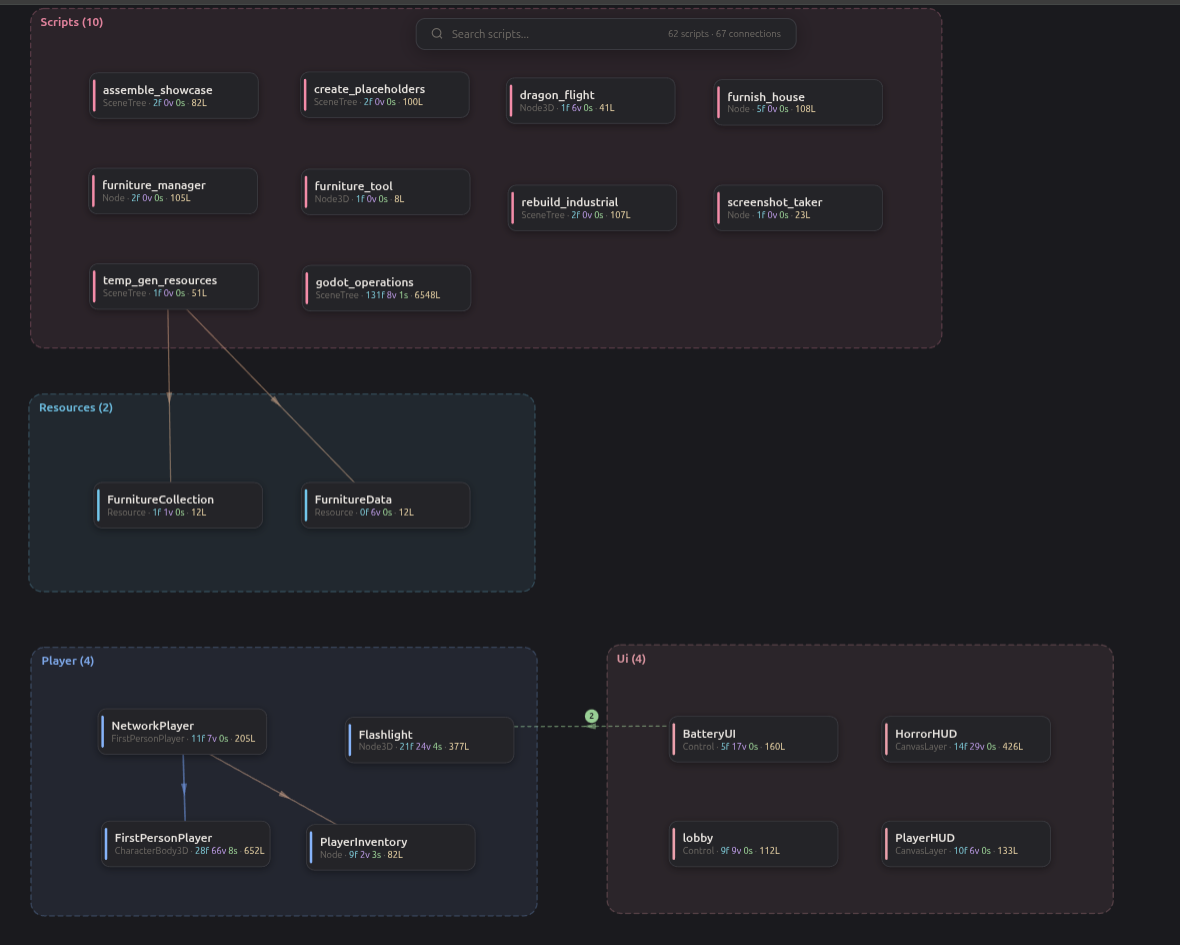
Visualize your entire project architecture with visualizer.map (map_project legacy). Scripts are grouped by folder structure into color-coded categories.
Quick Prompt Examples
Build
- "Create a Player scene with CharacterBody2D, Sprite2D, CollisionShape2D, and a basic movement script."
- "Add an enemy spawner scene and wire spawn signals to GameManager."
Debug
- "Run the project, collect errors, and fix the top 3 issues automatically."
- "Set a breakpoint at
scripts/player.gd:42, continue execution, and show stack trace when hit."
Runtime testing
- "Press
ui_accept, move mouse to (400, 300), click, then capture a screenshot." - "Inspect live scene tree and report nodes with missing scripts or invalid references."
Discovery & dynamic groups
- "Use
tool.catalogwith querytilemapand list the most relevant tools." - "Activate the
daptool group for breakpoint debugging withtool.groups." - "Find import pipeline tools with
tool.catalogqueryimportand run the best one for texture settings." - "Reset all active tool groups with
tool.groupsto reduce context."
Technical Reference
Environment variables
| Name | Purpose | Default |
|---|---|---|
GOPEAK_TOOL_PROFILE | Tool exposure profile: compact, full, legacy | compact |
MCP_TOOL_PROFILE | Fallback profile env alias | compact |
GODOT_PATH | Explicit Godot executable path | auto-detect |
GODOT_BRIDGE_PORT | Bridge/Visualizer HTTP+WS port override (aliases: MCP_BRIDGE_PORT, GOPEAK_BRIDGE_PORT) | 6505 |
DEBUG | Enable server debug logs (true/false) | false |
LOG_MODE | Recording mode: lite or full | lite |
GOPEAK_TOOLS_PAGE_SIZE | Number of tools per tools/list page (pagination) | 33 |
GOPEAK_BRIDGE_PORT | Port for unified bridge/visualizer server | 6505 |
GOPEAK_BRIDGE_HOST | Bind host for bridge/visualizer server | 127.0.0.1 |
Ports
| Port | Service |
|---|---|
6505 (default) | Unified Godot Bridge + Visualizer server (+ /health, /mcp) on loopback by default |
6005 | Godot LSP |
6006 | Godot DAP |
7777 | Runtime addon command socket (only needed for runtime tools) |
Minimal port profiles
- Core editing only: bridge port (
GODOT_BRIDGE_PORT, default6505) - Core + runtime actions (screenshots/input/runtime inspect): bridge port +
7777 - Full debugging + diagnostics: bridge port +
6005+6006+7777
Troubleshooting
- Godot not found → set
GODOT_PATH - No MCP tools visible → restart your MCP client
- Project path invalid → confirm
project.godotexists - Runtime tools not working → install/enable runtime addon plugin
- Need a tool that is not visible → run
tool.catalogto search and auto-activate matching groups, or usetool.groupsto activate a specific group
Docs & Project Links
License
MIT — see LICENSE.
Credits
- Original MCP server by Coding-Solo
- GoPeak enhancements by HaD0Yun
- Project visualizer inspired by tomyud1/godot-mcp