graph-tool-call
LLM agents can't fit thousands of tool definitions into context.
Vector search finds similar tools, but misses the workflow they belong to.
graph-tool-call builds a tool graph and retrieves the right chain — not just one match.
| Baseline (all tools) | graph-tool-call | |
|---|---|---|
| 248 tools (K8s API) | 12% accuracy | 82% accuracy |
| Token usage | 8,192 tokens | 1,699 tokens (79% reduction) |
| 50 tools (GitHub API) | 100% accuracy | 90% accuracy, 88% fewer tokens |
Measured with qwen3:4b (4-bit) — full benchmark below
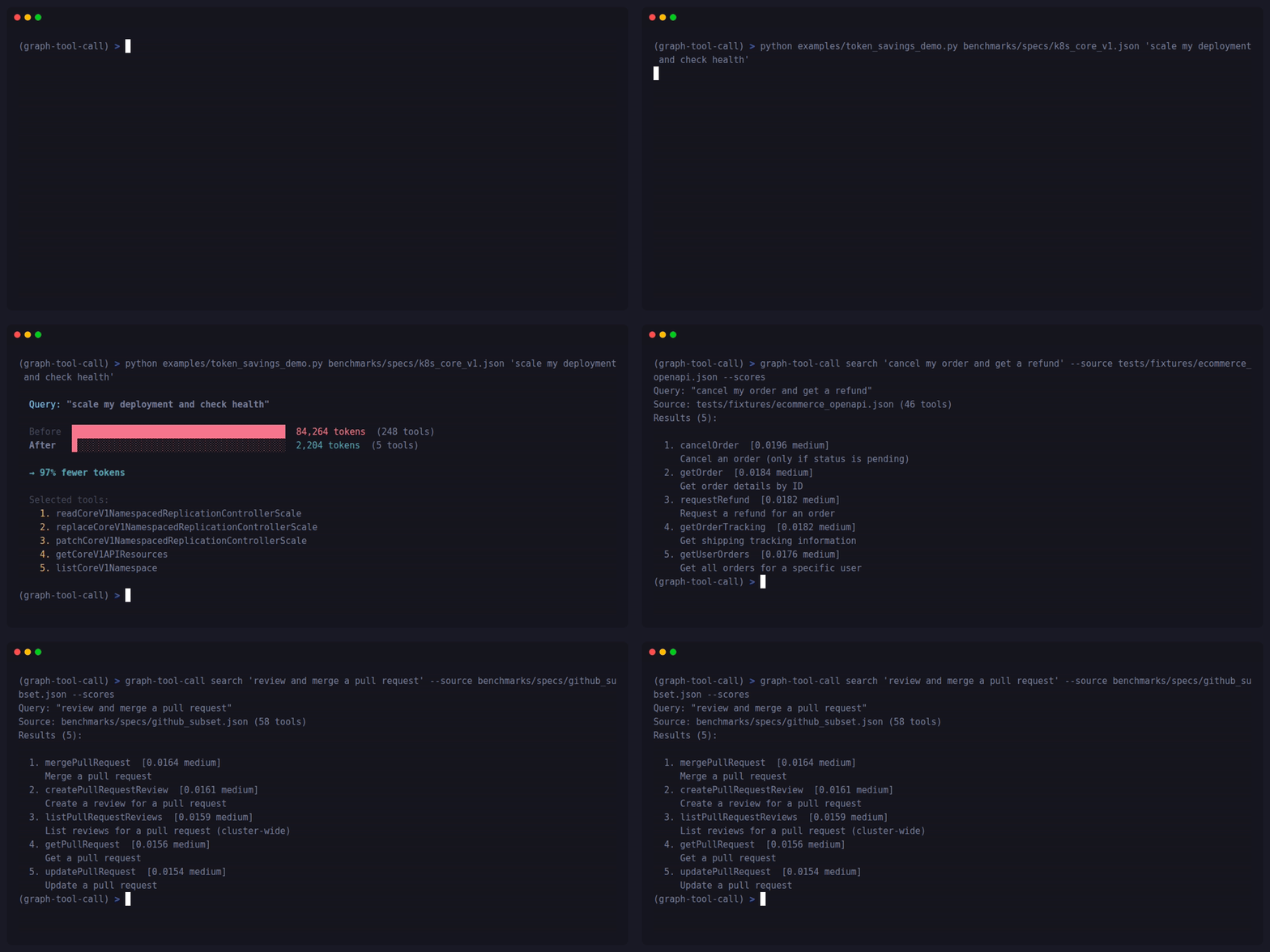



The Problem
LLM agents need tools. But as tool count grows, two things break:
- Context overflow — 248 Kubernetes API endpoints = 8,192 tokens of tool definitions. The LLM chokes and accuracy drops to 12%.
- Vector search misses workflows — Searching "cancel my order" finds
cancelOrder, but the actual flow islistOrders → getOrder → cancelOrder → processRefund. Vector search returns one tool; you need the chain.
graph-tool-call solves both. It models tool relationships as a graph, retrieves multi-step workflows via hybrid search (BM25 + graph traversal + embedding + MCP annotations), and cuts token usage by 64–91% while maintaining or improving accuracy.
At a Glance
| What you get | How |
|---|---|
| Workflow-aware retrieval | Graph edges encode PRECEDES, REQUIRES, COMPLEMENTARY relations |
| Hybrid search | BM25 + graph traversal + embedding + MCP annotations, fused via wRRF |
| Zero dependencies | Core runs on Python stdlib only — add extras as needed |
| Any tool source | Auto-ingest from OpenAPI / Swagger / MCP / Python functions |
| History-aware | Previously called tools are demoted; next-step tools are boosted |
| MCP Proxy | 172 tools across servers → 3 meta-tools, saving ~1,200 tokens/turn |
Why Not Just Vector Search?
| Scenario | Vector-only | graph-tool-call |
|---|---|---|
| "cancel my order" | Returns cancelOrder | listOrders → getOrder → cancelOrder → processRefund |
| "read and save file" | Returns read_file | read_file + write_file (COMPLEMENTARY relation) |
| "delete old records" | Returns any tool matching "delete" | Destructive tools ranked first via MCP annotations |
| "now cancel it" (after listing orders) | No context from history | Demotes used tools, boosts next-step tools |
| Multiple Swagger specs with overlapping tools | Duplicate tools in results | Cross-source auto-deduplication |
| 1,200 API endpoints | Slow, noisy results | Categorized + graph traversal for precise retrieval |
How It Works
OpenAPI / MCP / Python functions → Ingest → Build tool graph → Hybrid retrieve → Agent
Example: User says "cancel my order and process a refund"
Vector search finds cancelOrder. But the actual workflow is:
                    ┌──────────┐
          PRECEDES  │listOrders│  PRECEDES
         ┌─────────┤          ├──────────┐
         ▼         └──────────┘          ▼
   ┌──────────┐                    ┌───────────┐
   │ getOrder │                    │cancelOrder│
   └──────────┘                    └─────┬─────┘
                                        │ COMPLEMENTARY
                                        ▼
                                 ┌──────────────┐
                                 │processRefund │
                                 └──────────────┘
graph-tool-call returns the entire chain, not just one tool. Retrieval combines four signals via weighted Reciprocal Rank Fusion (wRRF):
- BM25 — keyword matching
- Graph traversal — relation-based expansion (PRECEDES, REQUIRES, COMPLEMENTARY)
- Embedding similarity — semantic search (optional, any provider)
- MCP annotations — read-only / destructive / idempotent hints
Installation
The core package has zero dependencies — just Python standard library. Install only what you need:
pip install graph-tool-call                    # core (BM25 + graph) — no dependencies
pip install graph-tool-call[embedding]         # + embedding, cross-encoder reranker
pip install graph-tool-call[openapi]           # + YAML support for OpenAPI specs
pip install graph-tool-call[mcp]              # + MCP server mode
pip install graph-tool-call[all]               # everything
All extras
| Extra | Installs | When to use |
|---|---|---|
openapi | pyyaml | YAML OpenAPI specs |
embedding | numpy | Semantic search (connect to Ollama/OpenAI/vLLM) |
embedding-local | numpy, sentence-transformers | Local sentence-transformers models |
similarity | rapidfuzz | Duplicate detection |
langchain | langchain-core | LangChain integration |
visualization | pyvis, networkx | HTML graph export, GraphML |
dashboard | dash, dash-cytoscape | Interactive dashboard |
lint | ai-api-lint | Auto-fix bad API specs |
mcp | mcp | MCP server mode |
pip install graph-tool-call[lint]
pip install graph-tool-call[similarity]
pip install graph-tool-call[visualization]
pip install graph-tool-call[dashboard]
pip install graph-tool-call[langchain]
Quick Start
Try it in 30 seconds (no install needed)
uvx graph-tool-call search "user authentication" \
  --source https://petstore.swagger.io/v2/swagger.json
Query: "user authentication"
Source: https://petstore.swagger.io/v2/swagger.json (19 tools)
Results (5):

  1. getUserByName
     Get user by user name
  2. deleteUser
     Delete user
  3. createUser
     Create user
  4. loginUser
     Logs user into the system
  5. updateUser
     Updated user
Python API
from graph_tool_call import ToolGraph

# Build a tool graph from the official Petstore API
tg = ToolGraph.from_url(
    "https://petstore3.swagger.io/api/v3/openapi.json",
    cache="petstore.json",
)

print(tg)
# → ToolGraph(tools=19, nodes=22, edges=100)

# Search for tools
tools = tg.retrieve("create a new pet", top_k=5)
for t in tools:
    print(f"{t.name}: {t.description}")

# Search with workflow guidance
results = tg.retrieve_with_scores("process an order", top_k=5)
for r in results:
    print(f"{r.tool.name} [{r.confidence}]")
    for rel in r.relations:
        print(f"  → {rel.hint}")

# Execute an API directly (OpenAPI tools)
result = tg.execute(
    "addPet", {"name": "Buddy", "status": "available"},
    base_url="https://petstore3.swagger.io/api/v3",
)
MCP Server (Claude Code, Cursor, Windsurf, etc.)
Run as an MCP server — any MCP-compatible agent can use tool search with just a config entry:
// .mcp.json
{
  "mcpServers": {
    "tool-search": {
      "command": "uvx",
      "args": ["graph-tool-call[mcp]", "serve",
               "--source", "https://api.example.com/openapi.json"]
    }
  }
}
The server exposes 6 tools: search_tools, get_tool_schema, execute_tool, list_categories, graph_info, load_source.
Search results include workflow guidance — relations between tools and suggested execution order:
{
  "tools": [
    {"name": "createOrder", "relations": [
      {"target": "getOrder", "type": "precedes", "hint": "Call this tool before getOrder"}
    ]},
    {"name": "getOrder", "prerequisites": ["createOrder"]}
  ],
  "workflow": {"suggested_order": ["createOrder", "getOrder", "updateOrderStatus"]}
}
MCP Proxy (aggregate multiple MCP servers)
When you have many MCP servers, their tool names pile up in every LLM turn. MCP Proxy bundles them behind a single server — 172 tools → 3 meta-tools, saving ~1,200 tokens per turn.
Step 1. Create backends.json with your existing MCP servers:
// ~/backends.json
{
  "backends": {
    "playwright": {
      "command": "npx",
      "args": ["@playwright/mcp", "--headless"]
    },
    "filesystem": {
      "command": "npx",
      "args": ["-y", "@anthropic/mcp-filesystem", "/home"]
    },
    "my-api": {
      "command": "uvx",
      "args": ["some-mcp-server"],
      "env": { "API_KEY": "sk-..." }
    }
  },
  "top_k": 10,
  "cache_path": "~/.cache/mcp-proxy-cache.json"
}
Embedding is optional. Add
"embedding": "ollama/qwen3-embedding:0.6b"for cross-language search (requires Ollama running). Without it, BM25 keyword search still works.
Step 2. Register the proxy with Claude Code:
claude mcp add -s user tool-proxy -- \
  uvx "graph-tool-call[mcp]" proxy --config ~/backends.json
Step 3. Remove the original individual servers (so they don't duplicate):
claude mcp remove playwright -s user
claude mcp remove filesystem -s user
claude mcp remove my-api -s user
Step 4. Restart Claude Code and verify:
claude mcp list
# tool-proxy: ... - ✓ Connected
# (individual servers should be gone)
That's it. The proxy exposes search_tools, get_tool_schema, and call_backend_tool. After searching, matched tools are dynamically injected for 1-hop direct calling.
Alternative: .mcp.json config
// .mcp.json (project-level or global)
{
  "mcpServers": {
    "tool-proxy": {
      "command": "uvx",
      "args": ["graph-tool-call[mcp]", "proxy",
               "--config", "/path/to/backends.json"]
    }
  }
}
Direct Integration (OpenAI, Ollama, vLLM, Azure, etc.)
Use retrieve() to search, then convert to OpenAI function-calling format. Works with any OpenAI-compatible API:
from openai import OpenAI
from graph_tool_call import ToolGraph
from graph_tool_call.langchain.tools import tool_schema_to_openai_function

# Build graph from any source
tg = ToolGraph.from_url(
    "https://petstore3.swagger.io/api/v3/openapi.json",
    cache="petstore.json",
)

# Retrieve only the relevant tools for a query
tools = tg.retrieve("create a new pet", top_k=5)

# Convert to OpenAI function-calling format
openai_tools = [
    {"type": "function", "function": tool_schema_to_openai_function(t)}
    for t in tools
]

# Use with any provider — OpenAI, Azure, Ollama, vLLM, llama.cpp, etc.
client = OpenAI()  # or OpenAI(base_url="http://localhost:11434/v1") for Ollama
response = client.chat.completions.create(
    model="gpt-4o",
    tools=openai_tools,  # only 5 relevant tools instead of all 248
    messages=[{"role": "user", "content": "create a new pet"}],
)
Anthropic Claude API
from anthropic import Anthropic
from graph_tool_call import ToolGraph

tg = ToolGraph.from_url("https://api.example.com/openapi.json")
tools = tg.retrieve("cancel an order", top_k=5)

# Convert to Anthropic tool format
anthropic_tools = [
    {
        "name": t.name,
        "description": t.description,
        "input_schema": {
            "type": "object",
            "properties": {
                p.name: {"type": p.type, "description": p.description}
                for p in t.parameters
            },
            "required": [p.name for p in t.parameters if p.required],
        },
    }
    for t in tools
]

client = Anthropic()
response = client.messages.create(
    model="claude-sonnet-4-20250514",
    tools=anthropic_tools,
    messages=[{"role": "user", "content": "cancel my order"}],
    max_tokens=1024,
)
SDK Middleware (zero code changes)
Already have tool-calling code? Add one line to automatically filter tools:
from graph_tool_call import ToolGraph
from graph_tool_call.middleware import patch_openai

tg = ToolGraph.from_url("https://api.example.com/openapi.json")

patch_openai(client, graph=tg, top_k=5)  # ← add this line

# Existing code unchanged — 248 tools go in, only 5 relevant ones are sent
response = client.chat.completions.create(
    model="gpt-4o",
    tools=all_248_tools,
    messages=messages,
)
# Also works with Anthropic
from graph_tool_call.middleware import patch_anthropic
patch_anthropic(client, graph=tg, top_k=5)
LangChain Integration
pip install graph-tool-call[langchain]
from graph_tool_call import ToolGraph
from graph_tool_call.langchain import GraphToolRetriever

tg = ToolGraph.from_url("https://api.example.com/openapi.json")

# Use as a LangChain retriever — compatible with any chain/agent
retriever = GraphToolRetriever(tool_graph=tg, top_k=5)
docs = retriever.invoke("cancel an order")

for doc in docs:
    print(doc.page_content)       # "cancelOrder: Cancel an existing order"
    print(doc.metadata["tags"])   # ["order"]
Benchmark
graph-tool-call verifies two things.
- Can performance be maintained or improved by giving the LLM only a subset of retrieved tools?
- Does the retriever itself rank the correct tools within the top K?
The evaluation compared the following configurations on the same set of user requests.
- baseline: pass all tool definitions to the LLM as-is
- retrieve-k3 / k5 / k10: pass only the top K retrieved tools
- + embedding / + ontology: add semantic search and LLM-based ontology enrichment on top of retrieve-k5
The model used was qwen3:4b (4-bit, Ollama).
Evaluation Metrics
- Accuracy: Did the LLM ultimately select the correct tool?
- Recall@K: Was the correct tool included in the top K results at the retrieval stage?
- Avg tokens: Average tokens passed to the LLM
- Token reduction: Token savings compared to baseline
Results at a glance
- Small-scale APIs (19~50 tools): baseline is already strong. In this range, graph-tool-call's main value is 64~91% token savings while maintaining near-baseline accuracy.
- Large-scale APIs (248 tools): baseline collapses to 12%. In contrast, graph-tool-call maintains 78~82% accuracy. At this scale, it's not an optimization — it's closer to a required retrieval layer.
Full pipeline comparison
How to read the metrics
- End-to-end Accuracy: Did the LLM ultimately succeed in selecting the correct tool or performing the correct workflow?
- Gold Tool Recall@K: Was the canonical gold tool designated as the correct answer included in the top K at the retrieval stage?
- These two metrics measure different things, so they don't always match.
- In particular, evaluations that accept alternative tools or equivalent workflows as correct answers may show
End-to-end Accuracythat doesn't exactly matchGold Tool Recall@K.- baseline has no retrieval stage, so
Gold Tool Recall@Kdoes not apply.
| Dataset | Tools | Pipeline | End-to-end Accuracy | Gold Tool Recall@K | Avg tokens | Token reduction |
|---|---|---|---|---|---|---|
| Petstore | 19 | baseline | 100.0% | — | 1,239 | — |
| Petstore | 19 | retrieve-k3 | 90.0% | 93.3% | 305 | 75.4% |
| Petstore | 19 | retrieve-k5 | 95.0% | 98.3% | 440 | 64.4% |
| Petstore | 19 | retrieve-k10 | 100.0% | 98.3% | 720 | 41.9% |
| GitHub | 50 | baseline | 100.0% | — | 3,302 | — |
| GitHub | 50 | retrieve-k3 | 85.0% | 87.5% | 289 | 91.3% |
| GitHub | 50 | retrieve-k5 | 87.5% | 87.5% | 398 | 87.9% |
| GitHub | 50 | retrieve-k10 | 90.0% | 92.5% | 662 | 79.9% |
| Mixed MCP | 38 | baseline | 96.7% | — | 2,741 | — |
| Mixed MCP | 38 | retrieve-k3 | 86.7% | 93.3% | 328 | 88.0% |
| Mixed MCP | 38 | retrieve-k5 | 90.0% | 96.7% | 461 | 83.2% |
| Mixed MCP | 38 | retrieve-k10 | 96.7% | 100.0% | 826 | 69.9% |
| Kubernetes core/v1 | 248 | baseline | 12.0% | — | 8,192 | — |
| Kubernetes core/v1 | 248 | retrieve-k5 | 78.0% | 91.0% | 1,613 | 80.3% |
| Kubernetes core/v1 | 248 | retrieve-k5 + embedding | 80.0% | 94.0% | 1,728 | 78.9% |
| Kubernetes core/v1 | 248 | retrieve-k5 + ontology | 82.0% | 96.0% | 1,699 | 79.3% |
| Kubernetes core/v1 | 248 | retrieve-k5 + embedding + ontology | 82.0% | 98.0% | 1,924 | 76.5% |
How to read this table
- baseline is the result of passing all tool definitions to the LLM without any retrieval.
- retrieve-k variants pass only a subset of retrieved tools to the LLM, so both retrieval quality and LLM selection ability affect performance.
- Therefore, a baseline accuracy of 100% does not mean retrieve-k accuracy must also be 100%.
Gold Tool Recall@Kmeasures whether retrieval placed the canonical gold tool in the top-k, whileEnd-to-end Accuracymeasures whether the final task execution succeeded.- Because of this, evaluations that accept alternative tools or equivalent workflows may show the two values not exactly matching.
Key insights
- Petstore / GitHub / Mixed MCP: When tool count is small or medium, baseline is already strong. In this range, graph-tool-call's main value is significantly reducing tokens without much accuracy loss.
- Kubernetes core/v1 (248 tools): When tool count is large, baseline collapses due to context overload. graph-tool-call recovers performance from 12.0% to 78.0~82.0% by narrowing candidates through retrieval.
- In practice, retrieve-k5 is the best default. It offers a good balance of token efficiency and performance. On large datasets, adding embedding / ontology yields further improvement.
Retrieval performance: Does the retriever find the correct tools in the top K?
The table below measures the quality of retrieval itself, before the LLM stage. Only BM25 + graph traversal were used here — no embedding or ontology.
How to read the metrics
- Gold Tool Recall@K: Was the canonical gold tool designated as the correct answer included in the top K at the retrieval stage?
- This table shows how well the retriever constructs the candidate set, not the final LLM selection accuracy.
- Therefore, this table should be read together with the End-to-end Accuracy table above.
- Even if retrieval places the gold tool in the top-k, the final LLM doesn't always select the correct answer.
- Conversely, in end-to-end evaluations that accept alternative tools or equivalent workflows as correct, the final accuracy and gold recall may not exactly match.
| Dataset | Tools | Gold Tool Recall@3 | Gold Tool Recall@5 | Gold Tool Recall@10 |
|---|---|---|---|---|
| Petstore | 19 | 93.3% | 98.3% | 98.3% |
| GitHub | 50 | 87.5% | 87.5% | 92.5% |
| Mixed MCP | 38 | 93.3% | 96.7% | 100.0% |
| Kubernetes core/v1 | 248 | 82.0% | 91.0% | 92.0% |
How to read this table
- Gold Tool Recall@K shows the retriever's ability to include the correct tool in the candidate set.
- On small datasets,
k=5alone achieves high recall. - On large datasets, increasing
kraises recall, but also increases the tokens passed to the LLM. - In practice, you should consider not just recall but also token cost and final end-to-end accuracy together.
Key insights
- Petstore / Mixed MCP:
k=5alone includes nearly all correct tools in the candidate set. - GitHub: There is a recall gap between
k=5andk=10, sok=10may be better if higher recall is needed. - Kubernetes core/v1: Even with a large number of tools,
k=5already achieves 91.0% gold recall. The retrieval stage alone can significantly compress the candidate set while retaining most correct tools. - Overall,
retrieve-k5is the most practical default.k=3is lighter but may miss some correct tools, whilek=10may increase token costs relative to recall gains.
When do embedding and ontology help?
On the largest dataset, Kubernetes core/v1 (248 tools), we compared adding extra signals on top of retrieve-k5.
| Pipeline | End-to-end Accuracy | Gold Tool Recall@5 | Interpretation |
|---|---|---|---|
| retrieve-k5 | 78.0% | 91.0% | BM25 + graph alone is a strong baseline |
| + embedding | 80.0% | 94.0% | Recovers queries that are semantically similar but differently worded |
| + ontology | 82.0% | 96.0% | LLM-generated keywords/example queries significantly improve retrieval quality |
| + embedding + ontology | 82.0% | 98.0% | Accuracy maintained, gold recall at its highest |
Summary
- Embedding compensates for semantic similarity that BM25 misses.
- Ontology expands the searchable representation itself when tool descriptions are short or non-standard.
- Using both together may show limited additional gains in end-to-end accuracy, but the ability to include correct tools in the candidate set becomes strongest.
Reproduce it
# Retrieval quality (fast, no LLM needed)
python -m benchmarks.run_benchmark
python -m benchmarks.run_benchmark -d k8s -v

# Pipeline benchmark (LLM comparison)
python -m benchmarks.run_benchmark --mode pipeline -m qwen3:4b
python -m benchmarks.run_benchmark --mode pipeline --pipelines baseline retrieve-k3 retrieve-k5 retrieve-k10

# Save baseline and compare
python -m benchmarks.run_benchmark --mode pipeline --save-baseline
python -m benchmarks.run_benchmark --mode pipeline --diff
Basic Usage
From OpenAPI / Swagger
from graph_tool_call import ToolGraph

# From file (JSON / YAML)
tg = ToolGraph()
tg.ingest_openapi("path/to/openapi.json")

# From URL — auto-discovers all spec groups from Swagger UI
tg = ToolGraph.from_url("https://api.example.com/swagger-ui/index.html")

# With caching — build once, reload instantly
tg = ToolGraph.from_url(
    "https://api.example.com/swagger-ui/index.html",
    cache="my_api.json",
)

# Supports: Swagger 2.0, OpenAPI 3.0, OpenAPI 3.1
From MCP Server Tools
from graph_tool_call import ToolGraph

mcp_tools = [
    {
        "name": "read_file",
        "description": "Read a file",
        "inputSchema": {"type": "object", "properties": {"path": {"type": "string"}}},
        "annotations": {"readOnlyHint": True, "destructiveHint": False},
    },
    {
        "name": "delete_file",
        "description": "Delete a file permanently",
        "inputSchema": {"type": "object", "properties": {"path": {"type": "string"}}},
        "annotations": {"readOnlyHint": False, "destructiveHint": True},
    },
]

tg = ToolGraph()
tg.ingest_mcp_tools(mcp_tools, server_name="filesystem")

tools = tg.retrieve("delete temporary files", top_k=5)
MCP annotations (readOnlyHint, destructiveHint, idempotentHint, openWorldHint) are used as retrieval signals.
Query intent is automatically classified — read queries prioritize read-only tools, delete queries prioritize destructive tools.
Directly From an MCP Server
from graph_tool_call import ToolGraph

tg = ToolGraph()

# Public MCP endpoint
tg.ingest_mcp_server("https://mcp.example.com/mcp")

# Local/private MCP endpoint (explicit opt-in)
tg.ingest_mcp_server(
    "http://127.0.0.1:3000/mcp",
    allow_private_hosts=True,
)
ingest_mcp_server() calls HTTP JSON-RPC tools/list, fetches the tool list,
then ingests it with MCP annotations preserved.
Remote ingest safety defaults:
- private / localhost hosts are blocked by default
- remote response size is capped
- redirects are limited
- unexpected content types are rejected
From Python Functions
from graph_tool_call import ToolGraph

def read_file(path: str) -> str:
    """Read contents of a file."""

def write_file(path: str, content: str) -> None:
    """Write contents to a file."""

tg = ToolGraph()
tg.ingest_functions([read_file, write_file])
Parameters are extracted from type hints, descriptions from docstrings.
Manual Tool Registration
from graph_tool_call import ToolGraph

tg = ToolGraph()

tg.add_tools([
    {
        "type": "function",
        "function": {
            "name": "get_weather",
            "description": "Get current weather for a city",
            "parameters": {
                "type": "object",
                "properties": {"city": {"type": "string"}},
            },
        },
    },
])

tg.add_relation("get_weather", "get_forecast", "complementary")
Embedding-based Hybrid Search
Add embedding-based semantic search on top of BM25 + graph. No heavy dependencies needed — use any external embedding server (Ollama, OpenAI, vLLM, etc.) or local sentence-transformers.
pip install graph-tool-call[embedding]           # numpy only (~20MB)
pip install graph-tool-call[embedding-local]      # + sentence-transformers (~2GB, local models)
# Ollama (recommended — lightweight, cross-language)
tg.enable_embedding("ollama/qwen3-embedding:0.6b")

# OpenAI
tg.enable_embedding("openai/text-embedding-3-large")

# vLLM / llama.cpp / any OpenAI-compatible server
tg.enable_embedding("vllm/Qwen/Qwen3-Embedding-0.6B")
tg.enable_embedding("vllm/model@http://gpu-box:8000/v1")
tg.enable_embedding("llamacpp/model@http://192.168.1.10:8080/v1")
tg.enable_embedding("http://localhost:8000/v1@my-model")

# Sentence-transformers (requires embedding-local extra)
tg.enable_embedding("sentence-transformers/all-MiniLM-L6-v2")

# Custom callable
tg.enable_embedding(lambda texts: my_embed_fn(texts))
Weights are automatically rebalanced when embedding is enabled. You can fine-tune them:
tg.set_weights(keyword=0.1, graph=0.4, embedding=0.5)
Save and Load
Build once, reuse everywhere. The full graph structure (nodes, edges, relation types, weights) is preserved.
# Save
tg.save("my_graph.json")

# Load
tg = ToolGraph.load("my_graph.json")

# Or use cache= in from_url() for automatic save/load
tg = ToolGraph.from_url(url, cache="my_graph.json")
When embedding search is enabled, saved graphs also preserve:
- embedding vectors
- restorable embedding provider config when available
- retrieval weights
- diversity settings
This lets ToolGraph.load() restore hybrid retrieval state without rebuilding embeddings from scratch.
Analysis and Dashboard
report = tg.analyze()
print(report.orphan_tools)

app = tg.dashboard_app()
# or: tg.dashboard(port=8050)
analyze() builds an operational summary with duplicates, conflicts, orphan tools,
category coverage, and relation counts. dashboard() launches the interactive
Dash Cytoscape UI for graph inspection and retrieval testing.
Advanced Features
Cross-Encoder Reranking
Second-stage reranking using a cross-encoder model.
tg.enable_reranker()  # default: cross-encoder/ms-marco-MiniLM-L-6-v2
tools = tg.retrieve("cancel order", top_k=5)
After narrowing candidates with wRRF, (query, tool_description) pairs are jointly encoded for more precise ranking.
MMR Diversity
Reduces redundant results to secure more diverse candidates.
tg.enable_diversity(lambda_=0.7)
History-Aware Retrieval
Pass previously called tool names to improve next-step retrieval.
# First call
tools = tg.retrieve("find my order")
# → [listOrders, getOrder, ...]

# Second call
tools = tg.retrieve("now cancel it", history=["listOrders", "getOrder"])
# → [cancelOrder, processRefund, ...]
Already-used tools are demoted, and tools closer to the next step in the graph are boosted.
wRRF Weight Tuning
Adjust the contribution of each signal.
tg.set_weights(
    keyword=0.2,     # BM25 text matching
    graph=0.5,       # graph traversal
    embedding=0.3,   # semantic similarity
    annotation=0.2,  # MCP annotation matching
)
LLM-Enhanced Ontology
Build richer tool ontologies using any LLM. Useful for category generation, relation inference, and search keyword expansion.
tg.auto_organize(llm="ollama/qwen2.5:7b")
tg.auto_organize(llm=lambda p: my_llm(p))
tg.auto_organize(llm=openai.OpenAI())
tg.auto_organize(llm="litellm/claude-sonnet-4-20250514")
Supported LLM inputs
| Input | Wrapped as |
|---|---|
OntologyLLM instance | Pass-through |
callable(str) -> str | CallableOntologyLLM |
OpenAI client (has chat.completions) | OpenAIClientOntologyLLM |
"ollama/model" | OllamaOntologyLLM |
"openai/model" | OpenAICompatibleOntologyLLM |
"litellm/model" | litellm.completion wrapper |
Duplicate Detection
Find and merge duplicate tools across multiple API specs.
duplicates = tg.find_duplicates(threshold=0.85)
merged = tg.merge_duplicates(duplicates)
# merged = {"getUser_1": "getUser", ...}
Export and Visualization
# Interactive HTML (vis.js)
tg.export_html("graph.html", progressive=True)

# GraphML (Gephi, yEd)
tg.export_graphml("graph.graphml")

# Neo4j Cypher
tg.export_cypher("graph.cypher")
API Spec Lint Integration
Auto-fix poor OpenAPI specs before ingestion using ai-api-lint.
pip install graph-tool-call[lint]
tg = ToolGraph.from_url(url, lint=True)
CLI Reference
# One-liner search (ingest + retrieve in one step)
graph-tool-call search "cancel order" --source https://api.example.com/openapi.json
graph-tool-call search "delete user" --source ./openapi.json --scores --json

# MCP server
graph-tool-call serve --source https://api.example.com/openapi.json
graph-tool-call serve --graph prebuilt.json
graph-tool-call serve -s https://api1.com/spec.json -s https://api2.com/spec.json

# Build and save graph
graph-tool-call ingest https://api.example.com/openapi.json -o graph.json
graph-tool-call ingest ./spec.yaml --embedding --organize

# Search from pre-built graph
graph-tool-call retrieve "query" -g graph.json -k 10

# Analyze, visualize, dashboard
graph-tool-call analyze graph.json --duplicates --conflicts
graph-tool-call visualize graph.json -f html
graph-tool-call info graph.json
graph-tool-call dashboard graph.json --port 8050
Full API Reference
ToolGraph methods
| Method | Description |
|---|---|
add_tool(tool) | Add a single tool (auto-detects format) |
add_tools(tools) | Add multiple tools |
ingest_openapi(source) | Ingest from OpenAPI / Swagger spec |
ingest_mcp_tools(tools) | Ingest from MCP tool list |
ingest_mcp_server(url) | Fetch and ingest from MCP HTTP server |
ingest_functions(fns) | Ingest from Python callables |
ingest_arazzo(source) | Ingest Arazzo 1.0.0 workflow spec |
from_url(url, cache=...) | Build from Swagger UI or spec URL |
add_relation(src, tgt, type) | Add a manual relation |
auto_organize(llm=...) | Auto-categorize tools |
build_ontology(llm=...) | Build complete ontology |
retrieve(query, top_k=10) | Search for tools |
validate_tool_call(call) | Validate and auto-correct a tool call |
assess_tool_call(call) | Return allow / confirm / deny decision |
enable_embedding(provider) | Enable hybrid embedding search |
enable_reranker(model) | Enable cross-encoder reranking |
enable_diversity(lambda_) | Enable MMR diversity |
set_weights(...) | Tune wRRF fusion weights |
find_duplicates(threshold) | Find duplicate tools |
merge_duplicates(pairs) | Merge detected duplicates |
apply_conflicts() | Detect and add CONFLICTS_WITH edges |
analyze() | Build operational analysis summary |
save(path) / load(path) | Serialize / deserialize |
export_html(path) | Export interactive HTML visualization |
export_graphml(path) | Export to GraphML format |
export_cypher(path) | Export as Neo4j Cypher statements |
dashboard_app() / dashboard() | Build or launch interactive dashboard |
suggest_next(tool, history=...) | Suggest next tools based on graph |
Feature Comparison
| Feature | Vector-only solutions | graph-tool-call |
|---|---|---|
| Dependencies | Embedding model required | Zero (core runs on stdlib) |
| Tool source | Manual registration | Auto-ingest from Swagger / OpenAPI / MCP |
| Search method | Flat vector similarity | Multi-stage hybrid (wRRF + rerank + MMR) |
| Behavioral semantics | None | MCP annotation-aware retrieval |
| Tool relations | None | 6 relation types, auto-detected |
| Call ordering | None | State machine + CRUD + response→request data flow |
| Deduplication | None | Cross-source duplicate detection |
| Ontology | None | Auto / LLM-Auto modes |
| History awareness | None | Demotes used tools, boosts next-step |
| Spec quality | Assumes good specs | ai-api-lint auto-fix integration |
| LLM dependency | Required | Optional (better with, works without) |
Documentation
| Doc | Description |
|---|---|
| Architecture | System overview, pipeline layers, data model |
| WBS | Work Breakdown Structure — Phase 0~4 progress |
| Design | Algorithm design — spec normalization, dependency detection, search modes, call ordering, ontology modes |
| Research | Competitive analysis, API scale data, commerce patterns |
| Release Checklist | Release process, changelog flow, pre-release checks |
| OpenAPI Guide | How to write API specs that produce better tool graphs |
Contributing
Contributions are welcome.
# Development setup
git clone https://github.com/SonAIengine/graph-tool-call.git
cd graph-tool-call
pip install poetry
poetry install --with dev --all-extras   # install all optional deps for full test coverage

# Run tests
poetry run pytest -v

# Lint
poetry run ruff check .
poetry run ruff format --check .

# Run benchmarks
python -m benchmarks.run_benchmark -v