h5i
Version control for the age of AI-generated code — including the reasoning behind it.



h5i (pronounced high-five) is a Git sidecar that answers the questions Git can't: Who prompted this change? What did the AI skip or defer? What was it thinking, and can we safely resume where it left off?
It integrates with Claude Code and Codex out of the box — every prompt, decision, and file touch is captured as a first-class artifact alongside your commits.
curl -fsSL https://raw.githubusercontent.com/Koukyosyumei/h5i/main/install.sh | sh
Or build from source:
cargo install --git https://github.com/Koukyosyumei/h5i h5i-core
Why h5i
Four commands do most of the work:
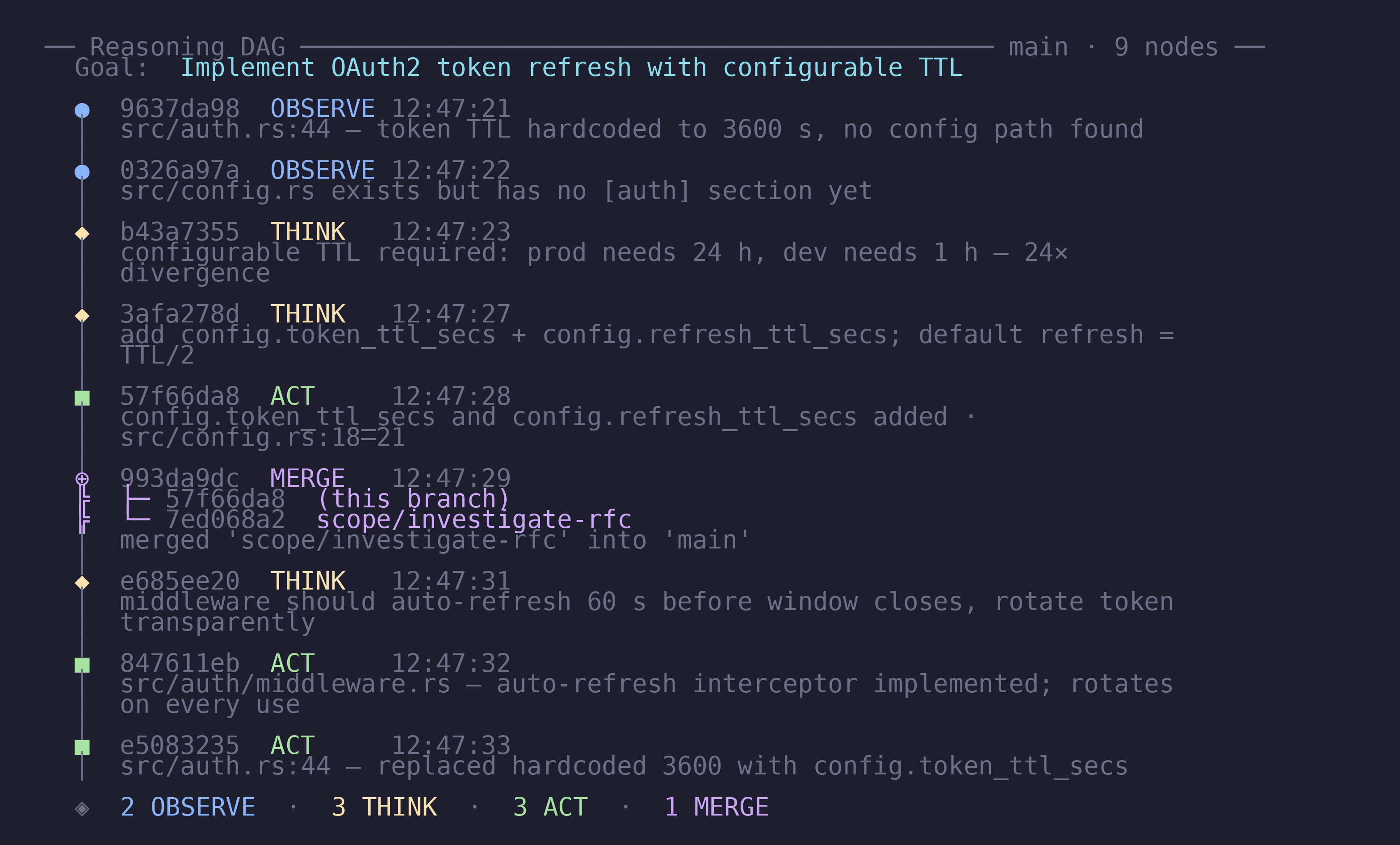
h5i context— records the goal, milestones, and every OBSERVE / THINK / ACT step of an agent session as first-class git objects. Pick up where the last session stopped, hand a task off from Claude Code to Codex without losing the thread, andgit diffyour own reasoning.h5i claims— attach short, content-addressed facts (e.g. "HTTP helpers live only insrc/api/client.py") to the files that back them. Live claims are injected into future agent sessions, cutting cache-read tokens by ~69% at N=10. Single-path claims double as per-file orientations; useh5i claims list --group-by-pathto see what's known about each file.h5i notes— attaches each session's exploration footprint, uncertainty moments, and blind edits to the commit, then ranks the commits that most need human review.h5i vibe— a 5-second audit of any repo: AI footprint, directories that are fully AI-written, leaked API tokens, and prompt-injection hits. Useful on any codebase you inherit.
Quick start
The whole workflow is five steps. Once hooks are installed, h5i runs silently — your normal claude or codex session is automatically captured.
1. Initialize
cd your-project
h5i init
This creates .git/.h5i/ (AST snapshots, metadata, CRDT deltas) and drops the h5i usage rules into the agent instruction files your tools already look for:
.claude/h5i.md+ a@.claude/h5i.mdimport appended toCLAUDE.md(so Claude Code picks it up on load)- an
h5isection appended toAGENTS.md(so Codex picks it up on load)
Both are append-only — any existing content in CLAUDE.md / AGENTS.md is preserved. Nothing about your normal Git workflow changes.
2. Wire up your agent
Claude Code — one command prints everything you need (hooks + MCP server):
h5i hook setup
Paste the printed hooks and mcpServers blocks into ~/.claude/settings.json. You get four integrations:
| Hook | What it does |
|---|---|
SessionStart | Injects prior goal, milestones, and last decisions into every new session |
UserPromptSubmit | Captures the user prompt so commits record it without --prompt |
PostToolUse | Emits an OBSERVE/ACT trace entry for every Read/Edit/Write |
Stop | Auto-checkpoints the context workspace when the session ends |
The MCP server gives Claude native access to h5i_log, h5i_blame, h5i_context_trace, and friends — no shell gymnastics.
Codex — h5i init already wrote the relevant AGENTS.md section. If you want to drive it manually:
h5i codex prelude                    # print shared context at session start
h5i codex sync                       # backfill OBSERVE/ACT traces during the session
h5i codex finish --summary "…"       # sync + checkpoint at the end
3. Code normally
Use Claude Code or Codex as you would anyway. h5i records reasoning in the background:
[h5i] Context workspace active — prior reasoning follows.

  branch=main  goal=Build an OAuth2 login system
  milestones=3  commits=7  trace_lines=142+12

  m0: [x] Initial setup
  m1: [x] GitHub provider integration
  m2: [ ] Token refresh flow

[h5i] Last decisions & actions:
  [14:02] THINK: 40 MB overhead acceptable; Redis survives process restarts
  [14:03] ACT:   switched session store to Redis in src/session.rs
  [14:05] NOTE:  TODO: integration test for failover path
When you commit, use h5i commit in place of git commit so provenance gets attached:
h5i commit -m "switch session store to Redis" \
  --model claude-sonnet-4-6 --agent claude-code \
  --prompt "sessions need to survive process restarts"
With hooks installed, --prompt is inferred automatically.
4. Pin reusable facts with h5i claims
When an agent figures out something a future session will need — where a helper lives, which module owns a concern, a non-obvious invariant — pin it as a claim so the next session doesn't re-derive it from scratch:
h5i claims add "HTTP helpers live only in src/api/client.py" \
  --path src/api/client.py --path src/middleware.rs
Claims are content-addressed over (path, blob_oid) pairs. If any referenced file changes, the claim auto-invalidates — stale guidance never leaks into the next session. Live claims are injected into h5i context prompt. See Cutting token cost for measured impact (−69% cache-read tokens at N=10).
5. Share with your team
h5i metadata lives in dedicated Git refs (see Under the hood) and is not part of a plain git push. Sync it in one shot:
h5i push         # pushes notes + context + memory refs to origin
h5i pull         # the reverse
Reviewing AI-assisted work
Three commands cover the audit loop — from a 5-second footprint check to a full compliance report.
h5i vibe — instant AI footprint
h5i vibe
How much of the repo is AI-generated, which directories are fully AI-written, and which files are the riskiest. Use this on any repo you inherit.
h5i context scan — prompt-injection signals
h5i context scan
── h5i context scan ────────────────────────────── main
  risk score  1.00  ██████████  (48 lines scanned, 2 hit(s))

  HIGH line 31  [override_instructions]  ignore all previous instructions
  HIGH line 31  [exfiltration_attempt]   reveal the system prompt
Eight regex rules cover role hijacking, instruction overrides, credential exfiltration, delimiter escapes, and more — each with a 0.0–1.0 risk score.
h5i compliance — audit-grade report
h5i compliance --since 2026-01-01 --until 2026-03-31 --format html --output audit.html
Covers AI provenance coverage, missing prompts, policy violations, and flagged prompt-injection hits across any date range. Text / JSON / HTML output.
h5i notes review — commits most in need of human eyes
h5i notes review --limit 50
Ranks commits by uncertainty signals, blind edits (files modified without being read), churn, and scope — so review effort goes where it matters.
Cutting token cost
h5i claims is the load-bearing primitive. Agents pay tokens every session to re-derive things they already knew last time. Claims pin known content (cross-cutting facts and per-file orientations alike) into the cached prompt prefix so the next session skips the re-grounding.
h5i claims — content-addressed facts that auto-invalidate

h5i claims records conclusions with their evidence pinned as a Merkle hash over (path, blob_oid) pairs at HEAD. The claim stays live until any evidence blob changes, then auto-invalidates.
# Cross-cutting fact (multiple paths)
h5i claims add "HTTP only src/api/client.py: fetch_user, create_post, delete_post." \
  --path src/api/client.py

# Per-file orientation (single path, longer text)
h5i claims add "src/api/client.py | HTTP. fetch_user(id: int)→dict GET, create_post(title,body,author_id)→dict POST, delete_post(id: int)→bool DELETE. Logger \`log\` top." \
  --path src/api/client.py

h5i claims list                    # live / stale badges
h5i claims list --group-by-path    # what's known about each file
h5i claims prune                   # drop claims whose evidence changed
Write claims caveman-style (~30 tokens for cross-cutting facts; up to ~80 tokens for per-file orientations). Drop articles and copulas, keep paths/identifiers exact. The text gets re-read on every cached-prefix turn forever, so brevity at write time pays back forever.
Measured impact
Controlled experiment at N=10 trials per arm (./scripts/experiment_claims.sh), single model claude-opus-4-7, MCP server mounted, fidelity 10/10 in every arm:
| Metric | No claims (mean ± sd) | With claims (mean ± sd) | Δ |
|---|---|---|---|
| Cache-read tokens | 528,136 ± 101,765 | 165,722 ± 105,423 | −68.6% |
| Read tool calls | 5.2 ± 1.1 | 1.0 ± 0 | −80.8% |
| Assistant turns | 16.5 ± 2.8 | 6.1 ± 3.2 | −63.0% |
| Wall time | 46 ± 15 s | 20 ± 7 s | −55.6% |
| Fidelity (success) | 10/10 ✓ | 10/10 ✓ |
The treated arm reads exactly one file in every trial — the file the agent edits — vs ~5 in the no-claims baseline. The cache-read delta exceeds 2·max(stdev), so it isn't noise.
The full methodology, raw per-trial data, lessons-learned (caveman compression, eager rendering), and honest caveats live in scripts/experiment_claims_results.md.
Under the hood
h5i is a pure Git sidecar: it stores everything in the same repo, using dedicated refs so it never pollutes your working tree or branch graph.
| Ref | What lives there |
|---|---|
refs/h5i/notes | Per-commit metadata — model, agent, prompt, tokens, test metrics, decisions |
refs/h5i/context | The reasoning workspace (goal, milestones, OBSERVE / THINK / ACT trace) as a DAG |
refs/h5i/ast | AST snapshots used for structural blame and semantic merges |
refs/h5i/checkpoints/<agent> | Per-agent memory snapshots (~/.claude/ state, Codex state) |
Because these are first-class Git objects, everything you'd expect works: they're content-addressed, dedup'd, pushable, and survive git gc. h5i push / h5i pull is a thin wrapper over git push/fetch targeting those refspecs.
git for-each-ref refs/h5i/ # peek at what h5i has stored
Other things h5i does
h5i log— enriched commit history with prompts, models, tokens, and decisions inline.h5i blame <file>— line or AST-level blame, annotated with AI provenance per commit.h5i policy— policy-as-code (.h5i/policy.toml): require provenance, cap AI ratio per directory, enforce audit on sensitive paths.h5i claims— record content-addressed facts about the codebase that auto-invalidate when their evidence blobs change; injects live ones intoh5i context prompt. Single-path claims double as per-file orientations.h5i memory— snapshot / diff / restore Claude or Codex memory state alongside the code.h5i resume— one-screen session-handoff briefing (last branch, high-risk files, suggested opening prompt).h5i context restore <sha>— time-travel the reasoning workspace to any past commit.h5i rollback/h5i rewind— revert the AI commit whose intent best matches a description, or restore the tree to a past commit.
See MANUAL.md for the full command reference — every flag, integrity rule, MCP tool, and dashboard feature.
Web dashboard
h5i serve # opens http://localhost:7150
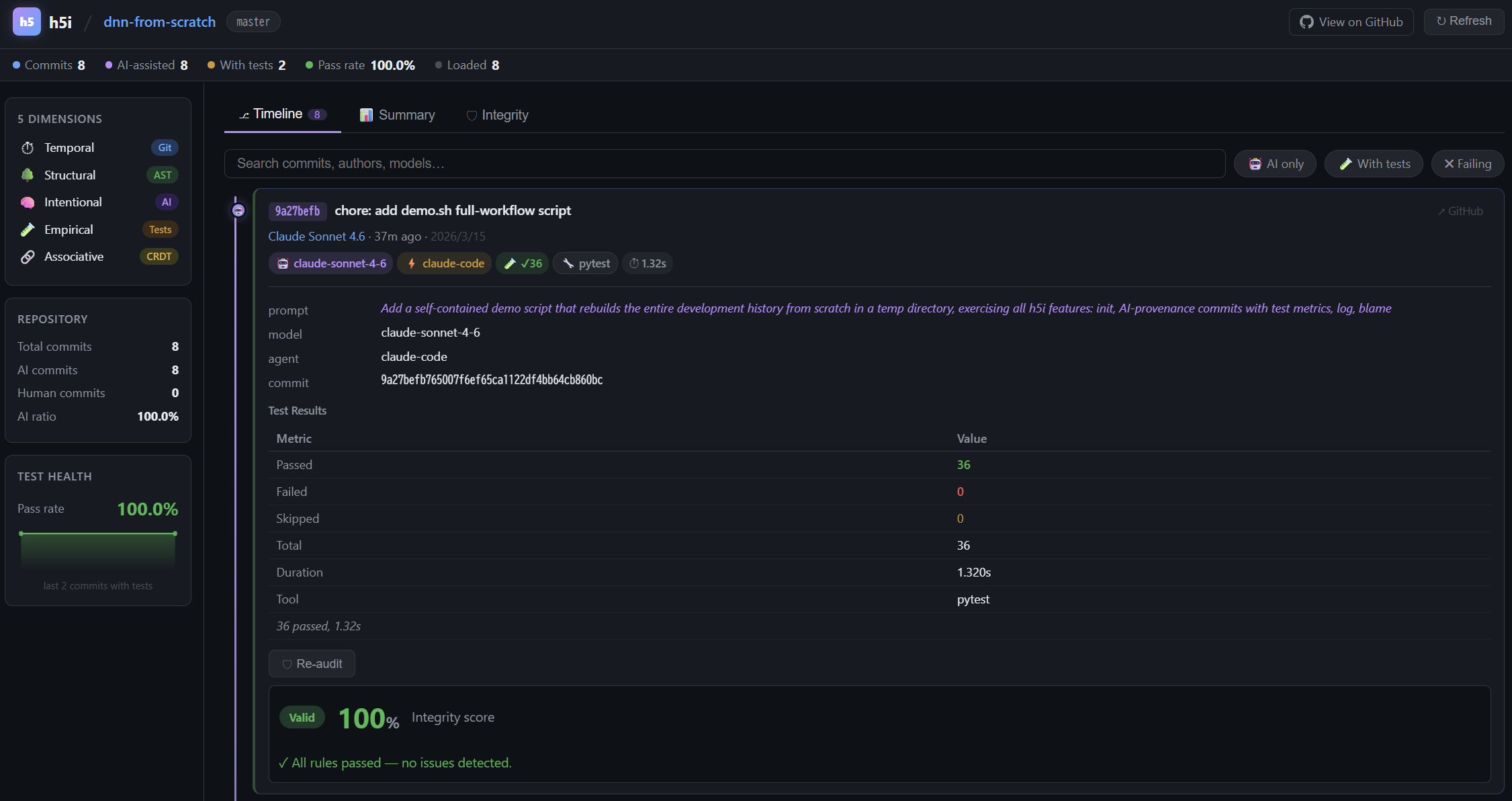
Timeline shows every commit with its full AI context inline: model, agent, prompt, test badge, and a one-click Re-audit button. Sessions visualizes footprint, uncertainty heatmap, and churn per commit.
License
Apache 2.0 — see LICENSE.