Slack MCP Server
Full workspace access via local session mirroring. DMs, threads, and history—no admin approval required.





Why This Exists
I built this because I was working with someone to help me manage a complex workload, and we kept hitting walls. They needed context from my messages—"what did X say about Y?"—but Slack's API blocks access to DMs without admin approval.
Screenshotting messages is not a workflow.
This server bridges the gap. It creates a secure, local bridge between Claude and your Slack web session. It gives your AI the same access you already have in the browser—search history, summarize threads, find that thing someone sent you three weeks ago—without fighting the platform.
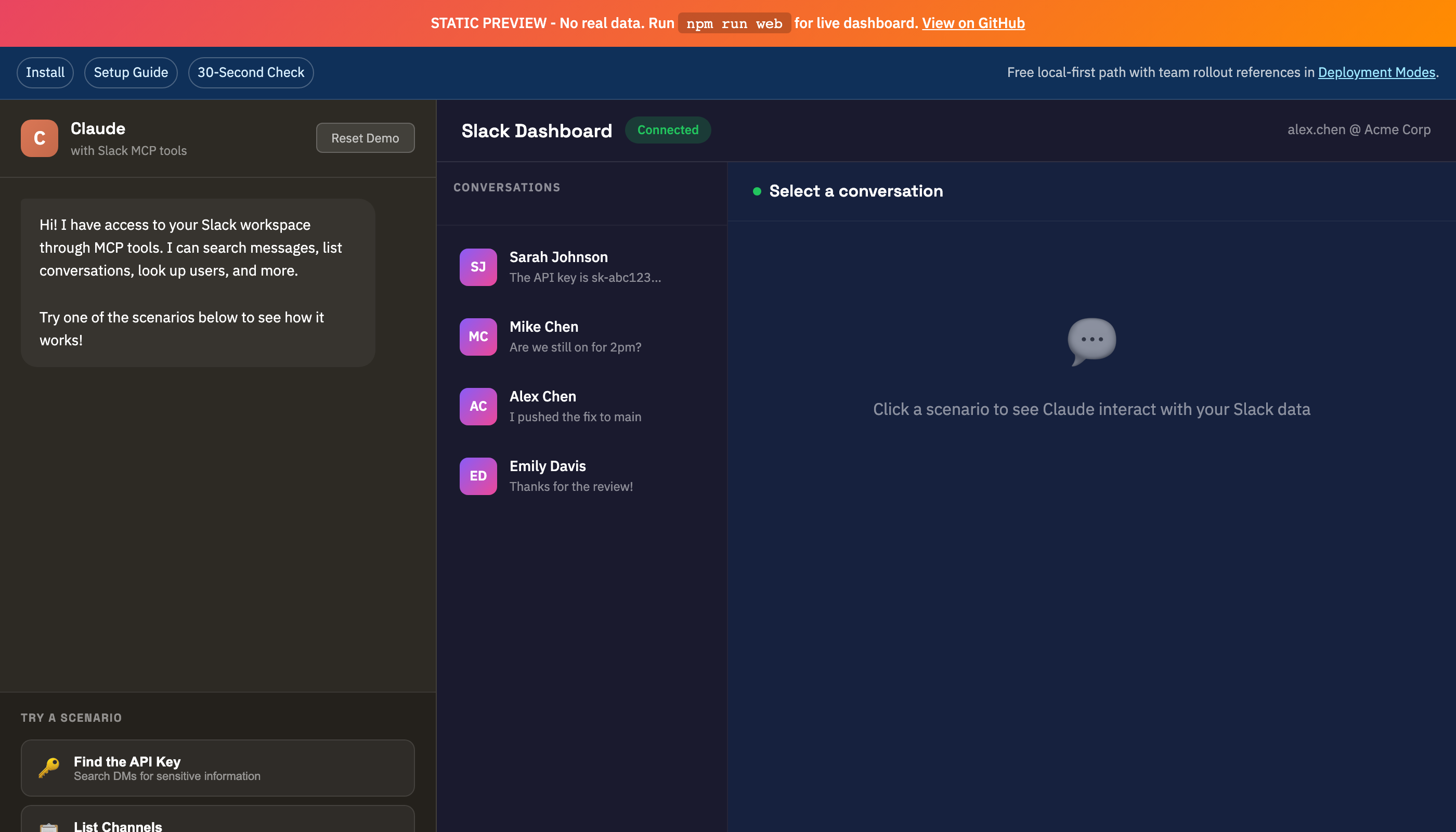
Try the Interactive Demo - See the Web UI in action
Architecture: Local Session Mirroring
Instead of authenticating as a bot, this server leverages your existing Chrome session credentials (macOS) or manual token injection (Linux/Windows). It mirrors your user access exactly—if you can see it in Slack, Claude can see it too.
sequenceDiagram
    participant Chrome as Chrome Browser
    participant Script as AppleScript
    participant Store as Token Store
    participant MCP as MCP Server
    participant Slack as Slack API

    Note over Chrome: You're logged into Slack
    Script->>Chrome: Execute JavaScript in Slack tab
    Chrome-->>Script: xoxc- token + xoxd- cookie
    Script->>Store: Save to ~/.slack-mcp-tokens.json
    Store->>Store: Encrypt in macOS Keychain

    Note over MCP: Claude asks for DMs
    MCP->>Store: Load credentials
    Store-->>MCP: Token + Cookie
    MCP->>Slack: GET conversations.history
    Slack-->>MCP: Full message history
    MCP-->>MCP: Return to Claude
Why Not OAuth?
flowchart LR
    subgraph Traditional["Official Slack API (OAuth)"]
        A[Create App] --> B[Request Scopes]
        B --> C[Admin Approval]
        C --> D[User Authorization]
        D --> E[Limited Access]
        E --> F["No DMs without<br/>per-conversation consent"]
    end

    subgraph ThisServer["Session Mirroring"]
        G[Open Slack in Chrome] --> H[Mirror Session]
        H --> I[Full Access]
        I --> J["Your DMs, Channels,<br/>Search, History"]
    end

    style Traditional fill:#ffcccc
    style ThisServer fill:#ccffcc
Trade-off: Session tokens expire every 1-2 weeks. Auto-refresh (macOS) or manual update keeps things running.
Features
Core Capabilities
- Read Any Message - DMs, private channels, public channels
- Full Export - Conversations with threads and resolved usernames
- Search - Query across your entire workspace
- Send Messages - DMs or channels, with thread support
- User Directory - List and search 500+ users with pagination
Stability
- Auto Token Refresh - Extracts fresh tokens from Chrome automatically (macOS only)
- Atomic Writes - File operations use temp-file-then-rename to prevent corruption
- Zombie Protection - Background timers use
unref()for clean process exit - Race Condition Safety - Mutex locks prevent concurrent token extraction
- Rate Limit Handling - Exponential backoff with jitter
Tools
| Tool | Description |
|---|---|
slack_health_check | Verify token validity and workspace info |
slack_token_status | New: Detailed token age, health, and cache stats |
slack_refresh_tokens | Auto-extract fresh tokens from Chrome |
slack_list_conversations | List DMs/channels (with lazy discovery cache) |
slack_conversations_history | Get messages from a channel or DM |
slack_get_full_conversation | Export full history with threads |
slack_search_messages | Search across workspace |
slack_send_message | Send a message to any conversation |
slack_get_thread | Get thread replies |
slack_users_info | Get user details |
slack_list_users | List workspace users (paginated, 500+ supported) |
Quick Start
Option A: npm (Recommended)
npm install -g @jtalk22/slack-mcp
Option B: Clone Repository
git clone https://github.com/jtalk22/slack-mcp-server.git
cd slack-mcp-server
npm install
Option C: Docker
docker pull ghcr.io/jtalk22/slack-mcp-server:latest
Configuration
Step 1: Get Your Tokens
macOS (Automatic)
# Have Chrome open with Slack (app.slack.com) logged in
npx @jtalk22/slack-mcp tokens:auto
# Or if cloned: npm run tokens:auto
Linux/Windows (Manual)
Auto-refresh requires macOS + Chrome. On other platforms, extract tokens manually:
- Open https://app.slack.com in your browser
- Press F12 → Console → Run:
// Get token JSON.parse(localStorage.localConfig_v2).teams[Object.keys(JSON.parse(localStorage.localConfig_v2).teams)[0]].token - Press F12 → Application → Cookies → Copy the
dcookie value (starts withxoxd-) - Create
~/.slack-mcp-tokens.json:{ "SLACK_TOKEN": "xoxc-your-token-here", "SLACK_COOKIE": "xoxd-your-cookie-here", "updated_at": "2024-01-01T00:00:00.000Z" }
Step 2: Configure Claude
Claude Desktop (macOS)
Edit ~/Library/Application Support/Claude/claude_desktop_config.json:
{
  "mcpServers": {
    "slack": {
      "command": "npx",
      "args": ["-y", "@jtalk22/slack-mcp"]
    }
  }
}
Claude Desktop (Windows)
Edit %APPDATA%\Claude\claude_desktop_config.json:
{
  "mcpServers": {
    "slack": {
      "command": "npx",
      "args": ["-y", "@jtalk22/slack-mcp"],
      "env": {
        "SLACK_TOKEN": "xoxc-your-token",
        "SLACK_COOKIE": "xoxd-your-cookie"
      }
    }
  }
}
Note: Windows/Linux users must provide tokens via
envsince auto-refresh is macOS-only.
Claude Code (CLI)
Add to ~/.claude.json:
{
  "mcpServers": {
    "slack": {
      "type": "stdio",
      "command": "npx",
      "args": ["-y", "@jtalk22/slack-mcp"]
    }
  }
}
Claude Code reads tokens from ~/.slack-mcp-tokens.json automatically.
Docker Configuration
{
  "mcpServers": {
    "slack": {
      "command": "docker",
      "args": ["run", "-i", "--rm",
               "-v", "~/.slack-mcp-tokens.json:/root/.slack-mcp-tokens.json",
               "ghcr.io/jtalk22/slack-mcp-server"]
    }
  }
}
Step 3: Restart Claude
Fully quit and reopen Claude. The Slack tools will appear.
Architecture
Token Persistence (4 Layers)
Priority 1: Environment Variables (SLACK_TOKEN, SLACK_COOKIE)
    ↓ fallback
Priority 2: Token File (~/.slack-mcp-tokens.json)
    ↓ fallback
Priority 3: macOS Keychain (encrypted)
    ↓ fallback
Priority 4: Chrome Auto-Extraction (macOS only)
Stability Features
Atomic Writes
All file operations (tokens, DM cache) use atomic writes:
Write to temp file → chmod 600 → rename to target
This prevents JSON corruption if the process is killed mid-write.
Zombie Process Protection
Background refresh timers use unref():
const timer = setInterval(refreshTokens, 4 * 60 * 60 * 1000);
timer.unref(); // Process can exit even if timer is pending
When Claude closes the MCP connection, the server exits cleanly.
Race Condition Prevention
A mutex lock prevents concurrent Chrome extractions:
if (refreshInProgress) return null; // Skip if already refreshing
refreshInProgress = true;
try { return extractFromChromeInternal(); }
finally { refreshInProgress = false; }
Web UI (for claude.ai)
Since claude.ai doesn't support MCP, use the REST server:
npm run web
# Or: npx @jtalk22/slack-mcp web
Magic Link: The console prints a one-click URL with the API key embedded:
════════════════════════════════════════════════════════════
  Slack Web API Server v1.1.7
════════════════════════════════════════════════════════════

  Dashboard: http://localhost:3000/?key=smcp_xxxxxxxxxxxx
Just click the link - no copy-paste needed. The key is saved to your browser and stripped from the URL for security.
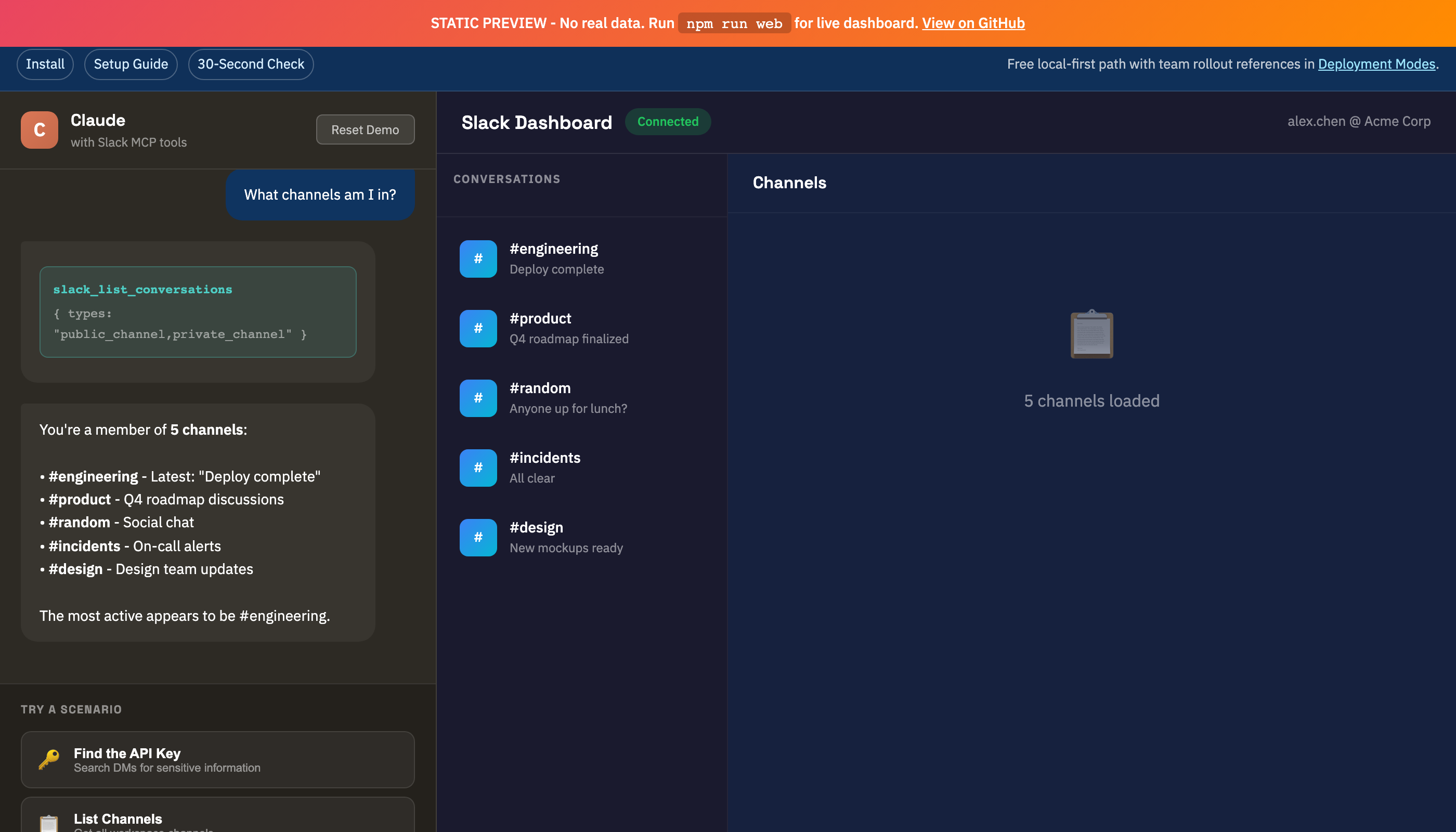
Screenshots
| DMs View | Channels View |
|---|---|
|  |
Troubleshooting
Tokens Expired
# macOS: Auto-refresh from Chrome
slack_refresh_tokens  # In Claude
# Or: npm run tokens:auto

# Linux/Windows: Manual update
# Edit ~/.slack-mcp-tokens.json with fresh values
DMs Not Showing
Use discover_dms: true to force discovery:
slack_list_conversations with discover_dms=true
This caches DM channel IDs for 24 hours.
Chrome Extraction Fails
- Chrome must be running (not minimized to Dock)
- Slack tab must be open at
app.slack.com - You must be logged in
Claude Desktop Not Seeing Tools
- Verify JSON syntax in config file
- Check logs:
~/Library/Logs/Claude/mcp*.log - Fully restart Claude (Cmd+Q, then reopen)
Project Structure
slack-mcp-server/
├── src/
│   ├── server.js         # MCP server (stdio transport)
│   └── web-server.js     # REST API + Web UI
├── lib/
│   ├── token-store.js    # 4-layer persistence + atomic writes
│   ├── slack-client.js   # API client, LRU cache, retry logic
│   ├── tools.js          # MCP tool definitions
│   └── handlers.js       # Tool implementations
├── public/
│   ├── index.html        # Web UI
│   └── demo.html         # Interactive demo
└── scripts/
    └── token-cli.js      # Token management CLI
Security
- Token files stored with
chmod 600(owner-only) - macOS Keychain provides encrypted backup
- Web server binds to localhost only
- Never commit tokens to version control
- API keys are cryptographically random (
crypto.randomBytes)
Platform Support
| Feature | macOS | Linux | Windows |
|---|---|---|---|
| MCP Server | Yes | Yes | Yes |
| Token File | Yes | Yes | Yes |
| Auto-Refresh from Chrome | Yes | No | No |
| Keychain Storage | Yes | No | No |
| Web UI | Yes | Yes | Yes |
Contributing
PRs welcome. Run node --check on modified files before submitting.
If you find this project useful, consider sponsoring or starring the repo.
License
MIT - See LICENSE
Disclaimer
This project uses unofficial Slack APIs. Use at your own risk. Not affiliated with or endorsed by Slack Technologies.