ContractGuard



Japanese contract risk analysis built as an AI engineering case study — LangGraph workflow + pgvector RAG + multi-modal ingestion + recoverable streaming UX.
⚠️ Not a legal service. This repository has never been operated commercially — Japan Attorney Act §72 (弁護士法第72条) reserves paid legal advice for licensed attorneys. The codebase is published as an open-source technical artifact only. Outputs are not legal opinions.
Status
Production-ready open-source reference implementation. The full stack — frontend, backend, OCR, payment, email, Postgres, Redis, error tracking — is wired with real integrations and ready to deploy. It has simply never been launched, by design (Attorney Act §72).
A synthetic Japanese contract sits in docs/samples/ so the local flow can be exercised end-to-end immediately after clone.
Architecture
flowchart LR
  U[React/Vite UI<br/>text, PDF, image upload] --> API[FastAPI routers]
  API --> Q[Quote + PII + OCR budget guards]
  Q --> PAY[KOMOJU checkout<br/>reference implementation]
  PAY --> JOB[Persistent analysis job]
  JOB --> SSE[Recoverable SSE stream<br/>status + events + after_seq]
  JOB --> LG[LangGraph pipeline]
  LG --> P[parse_contract]
  P --> A[clause-by-clause risk analysis]
  A --> T[tool call: analyze_clause_risk]
  T --> RAG[(PostgreSQL pgvector<br/>331 Japanese legal articles)]
  A --> S[tool call: generate_suggestion<br/>medium/high risks only]
  S --> REP[report generation + translation]
  REP --> CACHE[(Redis 72h report cache)]
  REP --> DB[(PostgreSQL orders/reports/costs)]
Tech Stack
| Layer | Stack |
|---|---|
| Frontend | React, Vite, TypeScript, i18next (9 languages) |
| Backend | FastAPI, SQLAlchemy async, Alembic, APScheduler |
| AI workflow | LangGraph + OpenAI tool calling, MCP server |
| RAG | PostgreSQL pgvector, 331 public e-Gov Japanese statutes |
| OCR | Google Cloud Vision (DOCUMENT_TEXT_DETECTION) |
| Storage | PostgreSQL (orders / reports / events), Redis (72h cache + rate limiting) |
| Payment | KOMOJU checkout |
| Resend | |
| Observability | Sentry + PostHog |
| Infra | Docker Compose (local), Fly.io + Vercel (deployment reference) |
Quick Start (local)
Local run only requires an OpenAI API key.
cp .env.example .env
# Edit .env: set OPENAI_API_KEY
docker compose up --build
Then open http://localhost:5173 and upload docs/samples/sample-contract-ja.txt.
In this minimal mode:
- ✅ Plain-text contracts and text-based PDFs (selectable text) work end-to-end.
- ❌ Image / scanned-PDF OCR is disabled. To enable it, add
GOOGLE_APPLICATION_CREDENTIALS_JSONandGOOGLE_VISION_PROJECT_ID. - KOMOJU / Resend auto-bypass in dev — no real payment, no real email.
Production Setup
The repository is shaped to deploy to production by setting APP_ENV=production and supplying credentials for each external service:
| Service | Required env vars |
|---|---|
| OpenAI | OPENAI_API_KEY |
| Google Cloud Vision (OCR) | GOOGLE_APPLICATION_CREDENTIALS_JSON, GOOGLE_VISION_PROJECT_ID |
| KOMOJU (payment) | KOMOJU_SECRET_KEY, KOMOJU_PUBLISHABLE_KEY, KOMOJU_WEBHOOK_SECRET |
| Resend (email) | RESEND_API_KEY |
| Sentry | SENTRY_DSN, VITE_SENTRY_DSN |
| PostHog | POSTHOG_API_KEY, VITE_POSTHOG_KEY |
| Database / Cache | DATABASE_URL (managed Postgres + pgvector), REDIS_URL (managed Redis) |
| App | FRONTEND_URL (non-localhost), ADMIN_API_TOKEN |
When APP_ENV=production, the app refuses to boot if any of the above is missing or FRONTEND_URL still points at localhost. Strict-validation logic lives in backend/config.py (validate_runtime()).
fly.toml and vercel.json describe the deployment topology used during development. The service is not currently hosted.
Flow
- Upload a contract (text, PDF, or image). The upload route runs text extraction, PII checks, token estimation, non-contract detection, and OCR budget guards.
- Checkout reference path creates an order. Empty KOMOJU credentials trigger a local bypass in dev.
/review/:orderIdstarts or resumes the persistent analysis job and streams progress events that survive page refresh.- LangGraph parses clauses, analyzes each clause with RAG-grounded tool calls, and generates suggestions only where the risk warrants it.
/report/:orderIdshows the saved report, clause excerpts, risk filters, and PDF export — retained for 72 hours.
User contract text is deleted after analysis. The vector store contains only public e-Gov statutes; user contracts are never embedded.
Demo
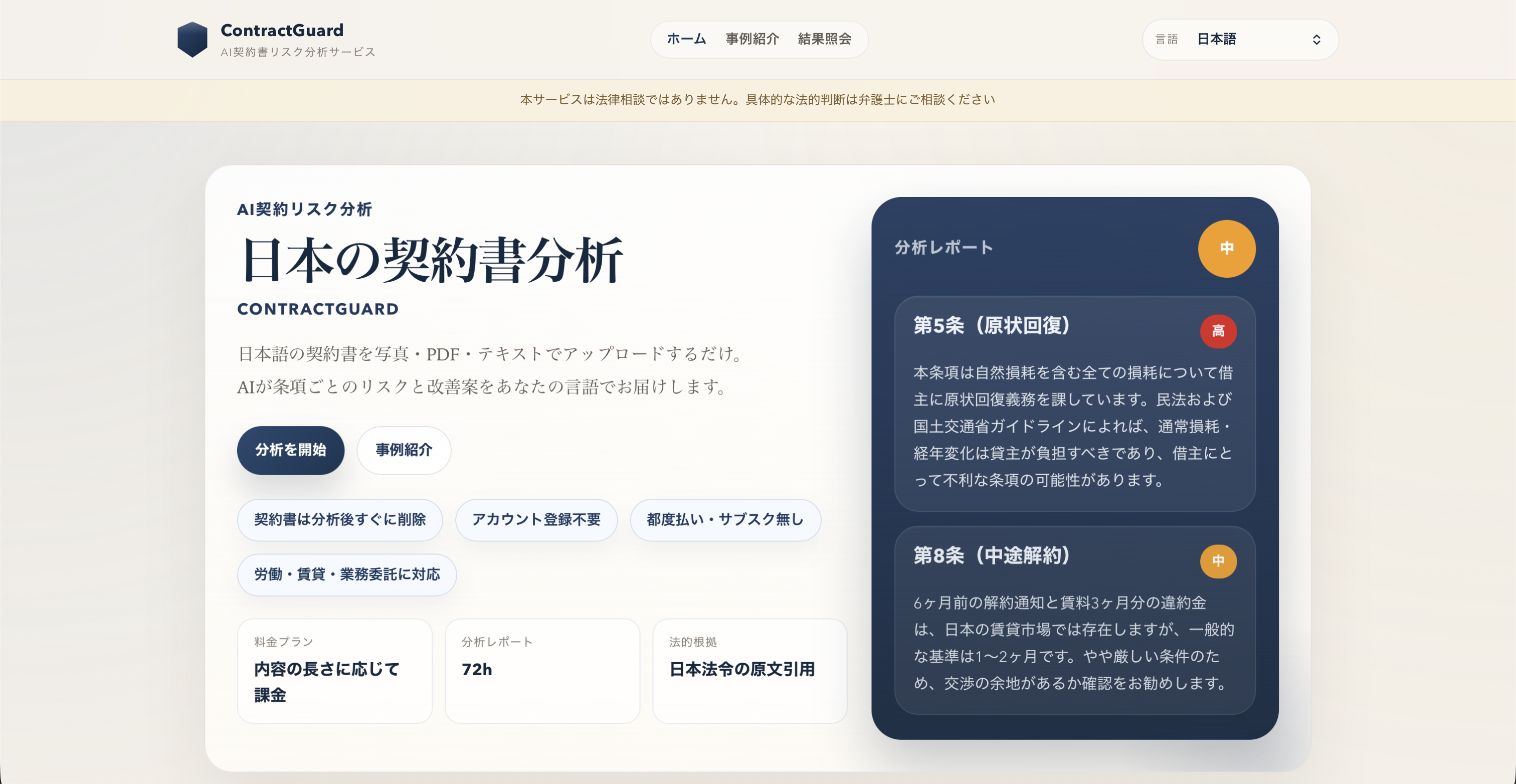
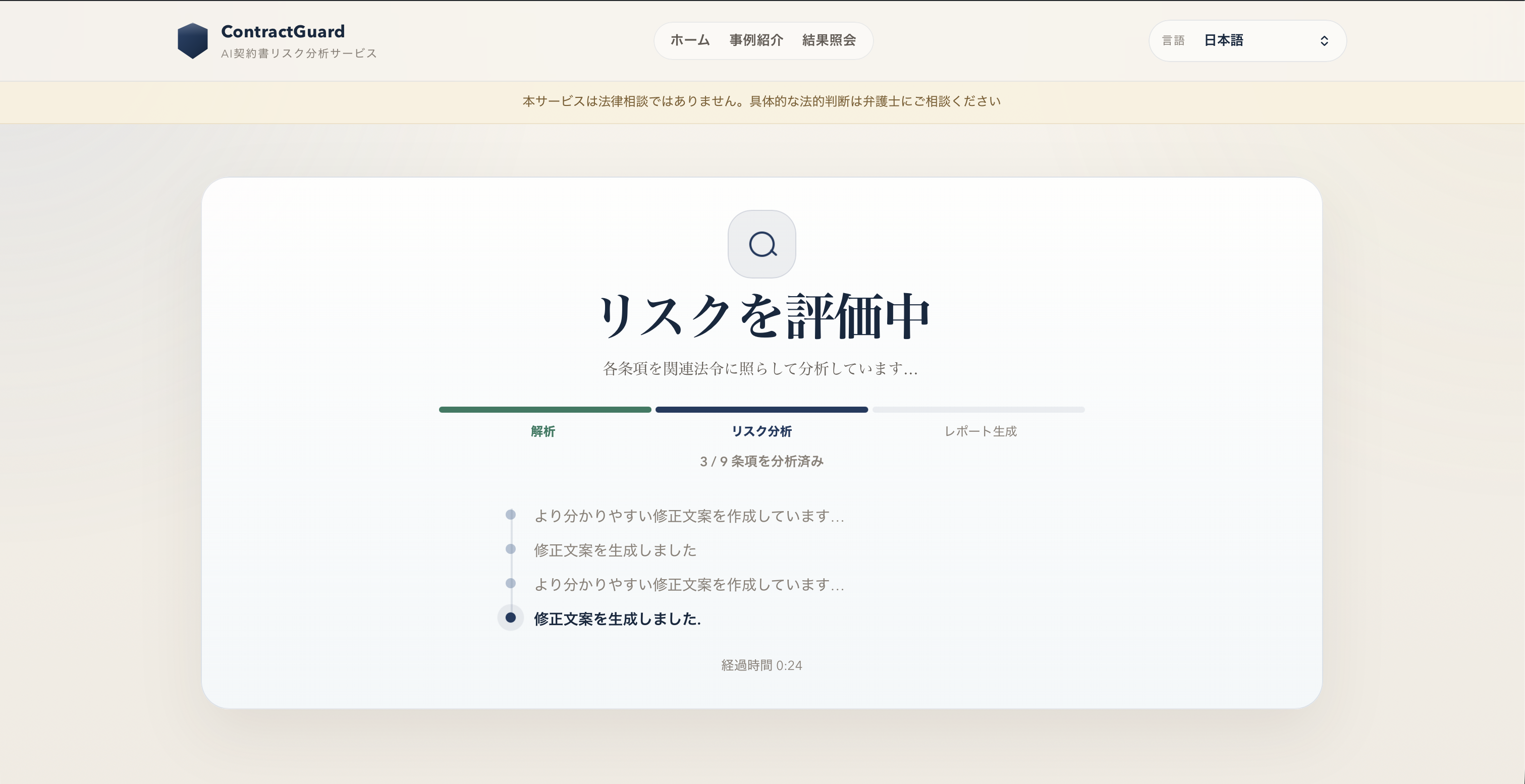
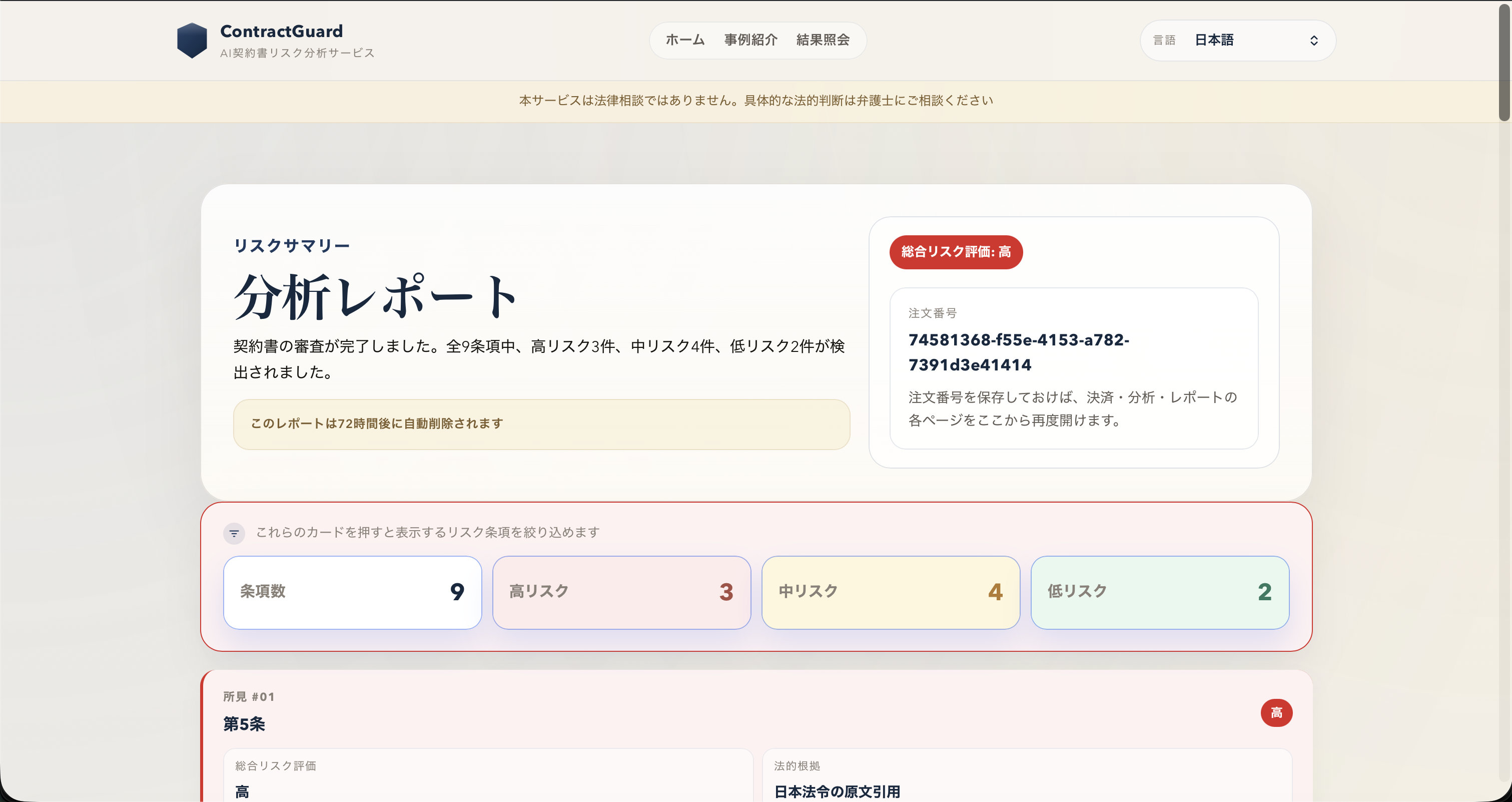
Repository Map
backend/agent/graph.py— LangGraph pipeline.backend/agent/tools.py— RAG-grounded tool calls.backend/services/analysis_executor.py— persistent analysis job + event sourcing.backend/rag/store.py— pgvector storage and search.backend/config.py— runtime configuration and strict validation.frontend/src/pages/ReviewPage.tsx— recoverable analysis progress UI.frontend/src/pages/ReportPage.tsx— report UI with risk filters and PDF export.tests/— backend pytest suites.scripts/smoke_local_flow.sh— end-to-end local smoke test.