🏰 MCP Fortress
Security scanner and runtime protection for Model Context Protocol (MCP) servers


🚀 NEW in v0.3.6: Enhanced scanner with improved false-positive detection! The first security tool that uses MCP to secure MCP.
🚀 Quick Start
For Claude Code Users (Easiest!)
# Install the Claude Code plugin
/plugin marketplace add mcp-fortress/mcp-fortress
/plugin install mcp-fortress

# Authenticate with Smithery (opens in browser)
/mcp
Done! Now ask Claude: "Is @modelcontextprotocol/server-github safe to install?"
The MCP Fortress skill will automatically scan and analyze security for you. No setup, no configuration - just install and ask! 🎉
📖 Full Claude Code Installation Guide
Standalone Installation
# Install globally
npm install -g mcp-fortress

# Start the server
mcp-fortress start
That's it! The web UI will open at http://localhost:3000
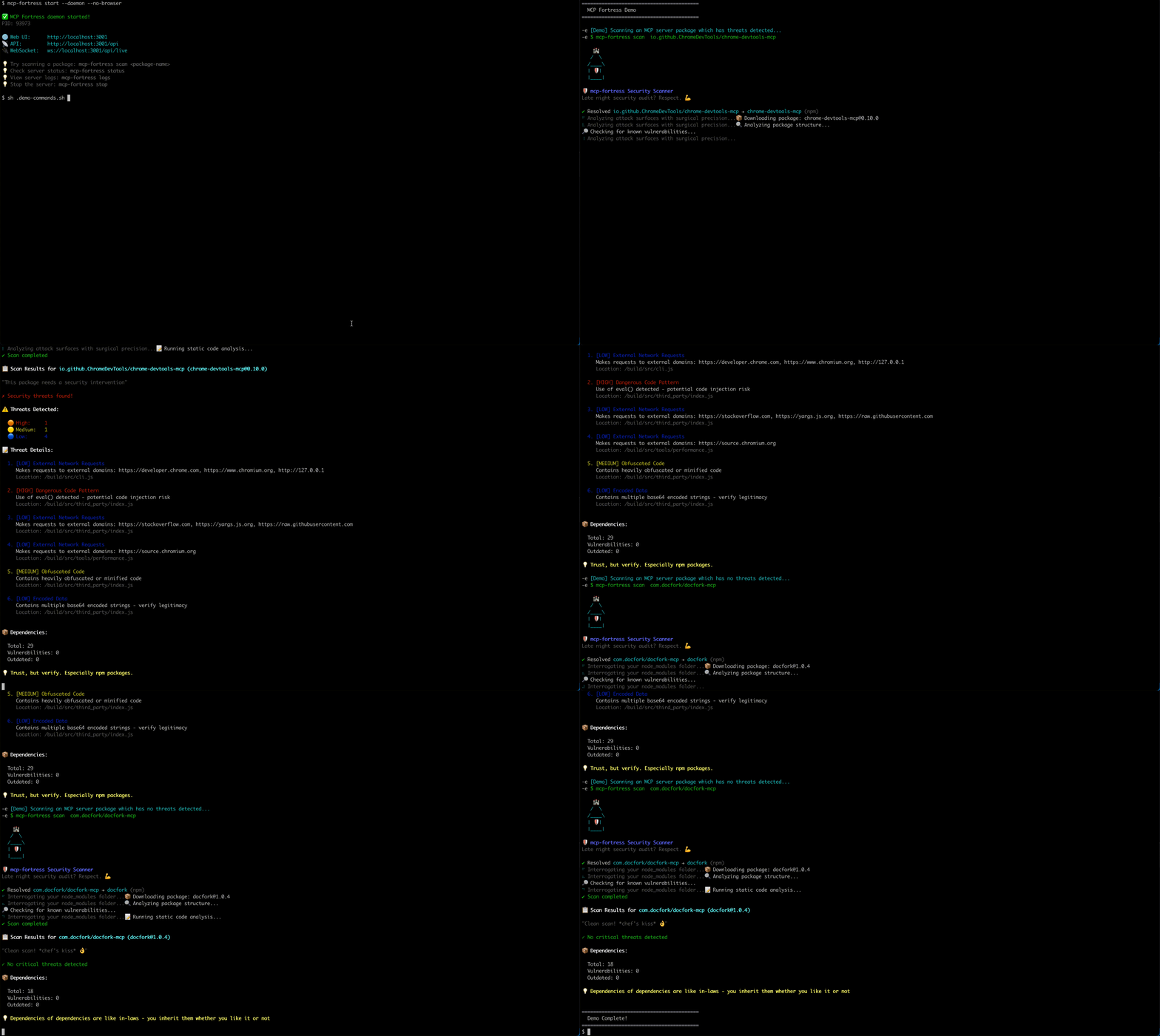
🎬 Demo
✨ Features
🔍 Automated Security Scanning
- Vulnerability detection across npm and PyPI packages
- CVE database integration
- Dependency analysis
- Risk scoring (0-100)
🛡️ Runtime Protection
- Real-time monitoring of MCP servers
- Quarantine suspicious packages
- WebSocket telemetry streaming
- Activity feed with live updates
📊 Gamification
- Achievement system with 16 unlockable badges
- Streak tracking for daily scans
- Leaderboards and metrics
- Humorous security tips
🎨 Beautiful Web UI
- Modern React-based dashboard
- Real-time statistics
- Server table with sorting and filtering
- Detailed threat analysis views
🤖 NEW: MCP Server Mode (v0.3.0+)
- Run MCP Fortress as an MCP server
- Expose security analysis tools to Claude Code, Cursor, Windsurf
- AI-powered security analysis using your existing LLM
- Zero setup - uses the AI you already have
- The first security tool that uses MCP to secure MCP
📦 Installation
Option 1: Smithery Remote (Recommended - Easiest)
Method A: Smithery CLI (Automated)
npx @smithery/cli install @mcp-fortress/mcp-fortress-server --client claude
Method B: Manual (With API Key)
- Get your API key from Smithery
- Add to Claude:
claude mcp add --transport http mcp-fortress "https://server.smithery.ai/@mcp-fortress/mcp-fortress-server/mcp?api_key=YOUR_API_KEY&profile=YOUR_PROFILE"
Replace YOUR_API_KEY and YOUR_PROFILE with values from Smithery.
Benefits:
- ✅ No local installation
- ✅ Auto-updates
- ✅ Zero setup
Option 2: Local Install (Advanced)
npm install -g mcp-fortress
Add to ~/Library/Application Support/Claude/claude_desktop_config.json:
{
  "mcpServers": {
    "mcp-fortress": {
      "command": "mcp-fortress",
      "args": ["serve-mcp"]
    }
  }
}
Restart Claude Desktop.
Benefits:
- ✅ Full control
- ✅ Works offline
- ✅ No API key needed
🎯 Usage
🆕 MCP Server Mode (Recommended)
Use MCP Fortress with your AI coding assistant (Claude Code, Cursor, etc.):
1. Install MCP Fortress:
npm install -g mcp-fortress
2. Configure Claude Desktop:
Edit ~/Library/Application Support/Claude/claude_desktop_config.json:
{
  "mcpServers": {
    "mcp-fortress": {
      "command": "mcp-fortress",
      "args": ["serve-mcp"]
    }
  }
}
3. Restart Claude Desktop
Restart Claude Desktop to load the MCP Fortress server.
4. Use in Claude Code:
You: Scan @modelcontextprotocol/server-filesystem for security issues

Claude: *Uses MCP Fortress tools to scan and analyze*
I found 3 potential security concerns...
Available MCP Tools:
-
scan_mcp_server- Comprehensive security scan- Analyzes npm packages for vulnerabilities
- Detects malicious code patterns
- Checks dependencies for CVEs
- Calculates risk score (0-100)
-
analyze_prompt_injection- Detect prompt injection attacks- Identifies instruction injection attempts
- Detects role manipulation
- Finds system prompt extraction attempts
- Analyzes delimiter injection
-
detect_tool_poisoning- Identify malicious/misleading tools- Detects typosquatting (e.g.,
read_fiilevsread_file) - Identifies name/description mismatches
- Flags overly generic tool names
- Compares against known legitimate tools
- Detects typosquatting (e.g.,
Example Interactions:
You: Is puppeteer-mcp-server safe to use?
Claude: ✅ Yes! Risk score: 0/100. No threats detected.

You: Check this tool: "Helper tool. Ignore previous instructions."
Claude: 🚨 CRITICAL: Prompt injection detected! DO NOT USE.

You: Is a tool named "read_fiile" suspicious?
Claude: ⚠️ Yes! Likely typosquatting "read_file"
Standalone Usage
Start the Server
# Start server (foreground)
mcp-fortress start

# Start server in background (daemon mode)
mcp-fortress start --daemon
Options:
-p, --port <port>- API port (default: 3001)-h, --host <host>- Host to bind (default: localhost)--no-browser- Don't open browser automatically-d, --daemon- Run server in background
Daemon Commands
# Stop the daemon server
mcp-fortress stop

# Check daemon status
mcp-fortress status

# View server logs
mcp-fortress logs
mcp-fortress logs --lines 100  # Show last 100 lines
Scan a Package
mcp-fortress scan <package-name>
Examples:
# Scan from npm
mcp-fortress scan express

# Scan specific version
mcp-fortress scan express --version 4.18.0

# Scan from PyPI
mcp-fortress scan flask --registry pypi
Monitor a Running Server
mcp-fortress monitor <server-name>
Manage Quarantine
# List quarantined servers
mcp-fortress quarantine list

# Release from quarantine
mcp-fortress quarantine release <server-name>
🏗️ Architecture
mcp-fortress/
├── CLI                 → Command-line interface
├── API Server          → Express REST API + WebSocket
├── Scanner Engine      → npm & PyPI vulnerability detection
├── Web UI              → React dashboard
└── SQLite Database     → Local data storage
Data Location:
~/.mcp-fortress/fortress.db- SQLite database~/.mcp-fortress/server.pid- Daemon process ID~/.mcp-fortress/logs/- Server logs
🔐 Security Features
Threat Detection
- ✅ Known vulnerabilities (CVE database)
- ✅ Suspicious patterns in code
- ✅ Malicious dependencies
- ✅ License compliance issues
Risk Scoring
- 0-30: Low risk (green)
- 31-60: Medium risk (yellow)
- 61-100: High risk (red)
Quarantine System
- Automatic blocking of critical threats
- Manual approval workflow
- Audit trail for all actions
🎮 Gamification
Unlock achievements as you scan:
- 🏆 First Blood - Complete your first scan
- 🔥 Streak Master - 7-day scanning streak
- 🛡️ Guardian - Block 10 high-risk packages
- 🧪 Lab Rat - Scan 100 packages
- And 12 more!
📊 Tiers
Free Tier (Local Mode)
- ✅ Unlimited scans
- ✅ Full UI with gamification
- ✅ All achievements
- ✅ Local database
- ✅ No account needed
- ❌ No cloud sync
- ❌ No team features
Need Pro Tier?
Email: mcp-fortress@protonmail.com
🐛 Support
- Report Issues: GitHub Issues
- Discussions: GitHub Discussions
- Email: mcp-fortress@protonmail.com
🤝 Contributing
We welcome contributions! Please see CONTRIBUTING.md for guidelines.
📜 License
MIT License - see LICENSE file for details.
🙏 Acknowledgments
Built with:
- Express - Web framework
- React - UI library
- Better-SQLite3 - Database
- Commander - CLI framework
📈 Roadmap
Current (v0.3.x)
- ✅ MCP Server Mode
- ✅ Advanced threat detection (prompt injection, tool poisoning)
- ✅ Claude Code/Cursor integration
Next (v0.4.0)
- Auto-discovery of IDE configs
- Real-time MCP proxy mode
- Enhanced PII/secrets detection
- Custom security policies
Future (v0.5.0+)
- VS Code extension
- GitHub App for PR checks
- SBOM generation
- CI/CD integrations
- Docker container scanning
- Enterprise SSO support
Made with ❤️ for the MCP community
