MCP Gateway by unrelated.ai
MCP infrastructure for turning existing systems into MCP servers and serving them safely at scale.


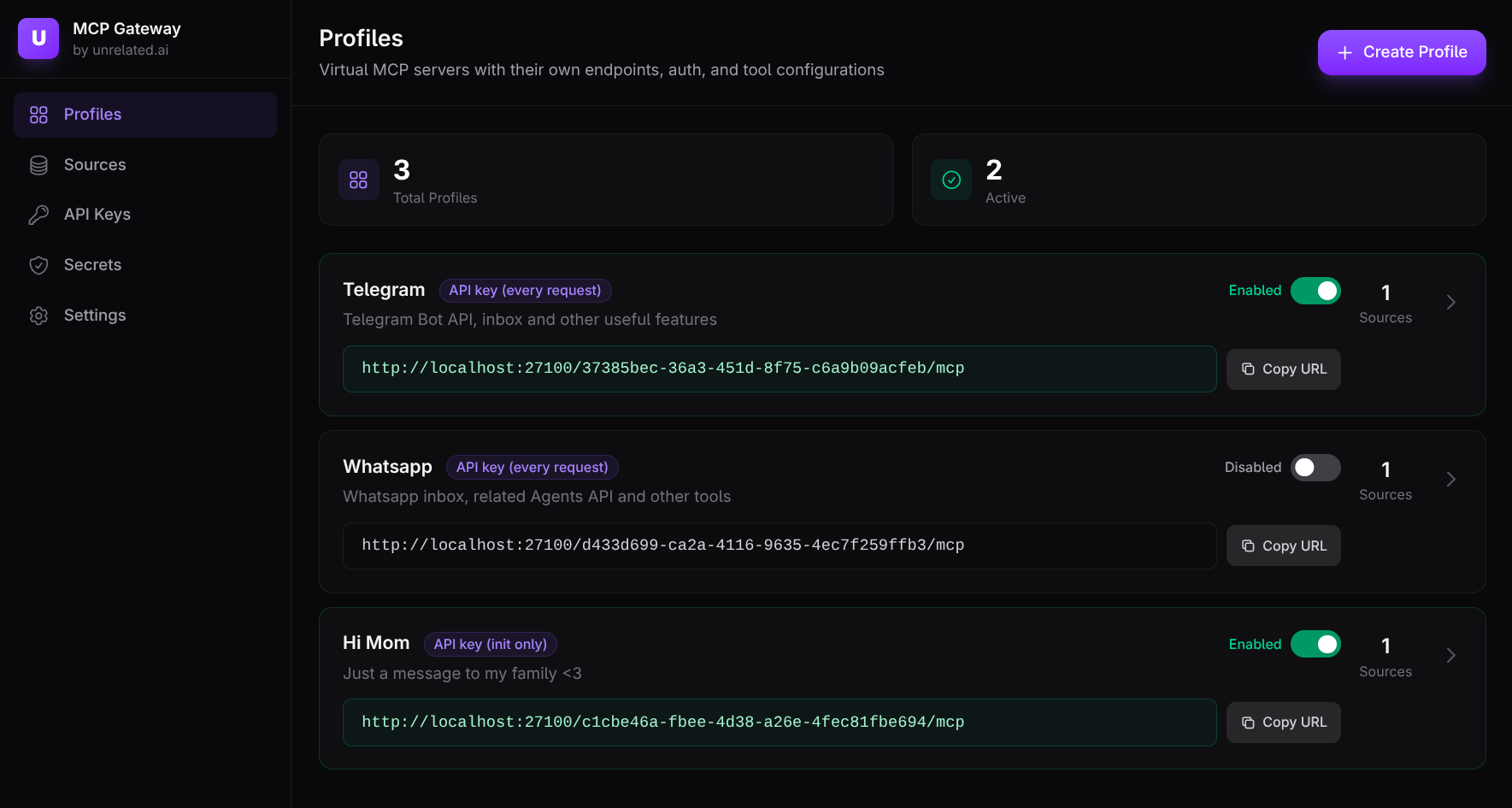
Quick Start (recommended): Docker (published images) + Web UI
If you just want to try the product experience, this is the fastest path (no repo clone needed).
This example pins component versions (adjust as desired):
- Gateway + migrator:
0.8.1 - Web UI:
0.4.2
- Download a Compose file that uses published images:
curl -fsSL -o mcp-gateway-compose.yml \
  https://raw.githubusercontent.com/unrelated-ai/mcp-gateway/main/docker-compose.quickstart.yml
- Start the stack:
GATEWAY_VERSION=0.8.1 UI_VERSION=0.4.2 \
  docker compose -f mcp-gateway-compose.yml up -d
- Open the Web UI:
http://127.0.0.1:27102
On a fresh install (bootstrap enabled + empty DB), onboarding will guide you through creating the first tenant and profile.
- Connect your MCP client to the profile endpoint you created in the UI:
http://127.0.0.1:27100/<PROFILE_ID>/mcp
Useful commands:
docker compose -f mcp-gateway-compose.yml down(stop the stack)docker compose -f mcp-gateway-compose.yml down -v(also wipe the DB volume)
Quick Start (from source): Docker Compose + Web UI
If you're developing this repo locally, the Makefile-driven workflow is convenient:
make up
Useful commands:
make down(stop the stack)make up-reset(wipe the demo DB; deletes all tenants/config; then runmake upagain to re-trigger onboarding)
Tip: this repo uses a Makefile heavily—run make help to see all targets.
Why this exists
MCP clients need to call tools, but most real systems already exist as:
- HTTP APIs
- existing stdio MCP servers (node/python/etc)
- multiple internal services that need to be aggregated into one tool surface
This workspace makes those systems consumable via streamable HTTP MCP without rewriting them into a bespoke MCP server.
What this ships
- Adapter (
unrelated-mcp-adapter): expose HTTP/OpenAPI/stdio MCP as one MCP server at/mcp - Gateway (
unrelated-mcp-gateway): tenant/profile-based MCP proxy at/{profile_id}/mcpwith auth and policy - Admin tooling:
- CLI (
unrelated-gateway-admin) - Tenant-level Web UI (beta)
- CLI (
Key concepts
| Concept | What it is | Why it’s useful |
|---|---|---|
| Adapter | One MCP server at /mcp that aggregates stdio MCP, OpenAPI, and manual HTTP tools | Turn “many backends” into one MCP endpoint (runs well inside a trusted network) |
| Gateway | Public-facing MCP endpoint /{profile_id}/mcp that proxies/aggregates upstream MCP sources and applies auth/policy | Run multi-tenant, policy-driven “virtual MCP servers” without exposing upstreams |
| Tenant | Isolation boundary in Mode 3 (Postgres) | Separate teams/projects/environments with isolated secrets and API keys |
| Profile | One “virtual MCP server” exposed as /{profile_id}/mcp | Create focused tool surfaces per use case (dev vs prod, read-only vs write, etc.) |
What you can build with it
- Expose a REST API as MCP tools:
- OpenAPI → tools, or
- manual HTTP tools DSL → tools
- Publish stdio MCP servers over HTTP by spawning them as child processes and re-exposing the tool surface at
/mcp. - Aggregate multiple tool sources into one MCP endpoint (and keep names stable by collision prefixing when needed).
- Operate a tenant-scoped gateway:
- API keys and optional OIDC/JWT for data-plane auth
- per-profile tool allowlists, transforms (rename/defaults/parameter tuning), and tool-call limits (timeouts/retries/quotas)
- HA-friendly session routing via Gateway session tokens (
Mcp-Session-Id)
Deployment configurations
1. Solo developer
Just the Gateway, no Adapters needed.
Use the Gateway with gateway-native HTTP/OpenAPI sources and connect your MCP client to a single profile endpoint.
flowchart LR
  Client["MCP client"] -->|"streamable HTTP '/{profile_id}/mcp'"| Gateway["Gateway"]
  Gateway -->|"gateway-native HTTP tools"| HttpApi["Your HTTP API"]
  Gateway -->|"gateway-native OpenAPI tools"| OpenApi["OpenAPI (spec or API)"]
2. Team with multiple projects
Gateway with Tenants and Profiles.
Each tenant owns multiple profiles, where each profile is a focused “virtual MCP server” with its own tool surface and data-plane auth/policy.
flowchart LR
  TeamA["Team A MCP clients"] -->|"profile A"| Gateway["Gateway"]
  TeamB["Team B MCP clients"] -->|"profile B"| Gateway

  Gateway --> TenantA["Tenant: team-a"]
  Gateway --> TenantB["Tenant: team-b"]

  TenantA --> ProfileDev["Profile: dev-tools"]
  TenantA --> ProfileProd["Profile: prod-readonly"]
  TenantB --> ProfileDS["Profile: data-science"]

  ProfileDev --> InternalApis["Internal APIs"]
  ProfileProd --> ProdApis["Prod APIs (GET only)"]
  ProfileDS --> MlApis["ML APIs + data tools"]
3. Complex / company-wide
Gateway + Adapters for aggregation and splitting.
Use Adapters to bundle related systems into upstream MCP endpoints (typically inside a private network), then use Gateway profiles to expose focused tool surfaces to clients.
flowchart LR
  Client2["MCP client"] -->|"streamable HTTP '/{profile_id}/mcp'"| Gateway2["Gateway"]

  Gateway2 -->|"proxy to upstream MCP"| AdapterA["Adapter A (/mcp)"]
  Gateway2 -->|"proxy to upstream MCP"| AdapterB["Adapter B (/mcp)"]

  AdapterA -->|"aggregates"| Billing["Billing API"]
  AdapterA -->|"aggregates"| Inventory["Inventory API"]
  AdapterA -->|"aggregates"| AuthSvc["Auth service"]

  AdapterB -->|"aggregates"| Mlflow["MLflow"]
  AdapterB -->|"aggregates"| Jupyter["Jupyter"]
Adapter: what it exposes
The Adapter exposes one MCP server over streamable HTTP:
- MCP endpoint:
/mcp - Operational endpoints:
/health,/health/any,/health/all,/ready,/status,/map
Documentation
- Start here (workspace docs index):
docs/INDEX.md - Component docs:
- Adapter:
docs/adapter/INDEX.md - Gateway:
docs/gateway/INDEX.md - Gateway CLI:
docs/gateway-cli/INDEX.md - Web UI:
docs/ui/INDEX.md
- Adapter:
- CI/CD + releases:
docs/CICD.md - Workspace layout:
docs/WORKSPACE.md
Other ways to run (local dev)
This section shows a few common ways to run pieces locally. Many commands have convenient Make targets (see make help).
Local (cargo)
- Build + run the adapter with the example config (recommended):
make adapter-run
- Or build a static release binary:
make build-release-adapter
Equivalent raw cargo commands:
-
cargo build --release -p unrelated-mcp-adapter -
cargo run -p unrelated-mcp-adapter --bin unrelated-mcp-adapter -- --config ./tests/fixtures/test-config.yaml --bind 127.0.0.1:8080 -
More example configs (and a handy playground) live under
tests/fixtures/— these are used by the demo stack and integration tests, and some are intentionally invalid to demonstrate validation errors.
Docker
- Build the adapter image:
make docker-build-adapter
- Run the adapter container (standalone, without compose):
make docker-run-adapter
Docker Compose (Gateway + multiple Adapters)
The default docker-compose.yml now spins up:
- Postgres for Mode 3 (
gateway_db) + a migrator job (gateway_db_migrate) - a Mode 3 Gateway (
gateway) exposing:- data plane:
http://127.0.0.1:27100 - admin/control plane:
http://127.0.0.1:27101(token:dev-admin-tokenin compose)
- data plane:
- a Web UI (
gateway_ui) onhttp://127.0.0.1:27102 - 3 adapters (
adapter_http_tools,adapter_openapi,adapter_stdio_aggregation) plus example backends (httpbin,petstore)
Run:
make up
Then create a tenant + profile (preferably via the Web UI) and connect your MCP client to:
- Gateway data plane:
http://127.0.0.1:27100/<PROFILE_ID>/mcp
Notes:
- The compose stack sets a dev-only default
UNRELATED_GATEWAY_SECRET_KEYSso Mode 3 tenant secrets can be encrypted at rest (override this in real deployments). - Adapters are still exposed individually on their mapped ports for debugging.
Gateway admin CLI:
- Run:
make cli-dev CLI_ARGS="--help"(docs:docs/gateway-cli/INDEX.md)
Web UI:
- Open
http://127.0.0.1:27102 - On a fresh install (bootstrap enabled + empty DB), onboarding will guide creating the first tenant.
Install options
- Docker image:
ghcr.io/unrelated-ai/mcp-adapter- Stable tags publish
:latest+:X.Y.Z - Pre-release tags publish
:X.Y.Z-rc.N
- Stable tags publish
- GitHub Release binaries: static Linux build (
x86_64-unknown-linux-musl)
If your stdio MCP servers require extra runtimes (node/python/etc), build your own image and copy the adapter binary from the published image:
FROM alpine:3.20
RUN apk add --no-cache ca-certificates nodejs npm
COPY --from=ghcr.io/unrelated-ai/mcp-adapter:latest /app/unrelated-mcp-adapter /app/unrelated-mcp-adapter
ENTRYPOINT ["/app/unrelated-mcp-adapter"]
The published adapter image is a minimal image containing a static adapter binary, so it can be copied into Alpine/Debian/etc (same CPU architecture).
Examples
Each example below is a complete YAML config file (you can also use JSON). The key part is the servers: map.
Once running, the adapter serves the resulting MCP tools over streamable HTTP (/mcp). Tool names are usually the tool key (like create_invoice); if two servers define the same tool name, the adapter prefixes on collision (serverName:toolName).
HTTP tools (manual HTTP DSL)
imports: []
servers:
  billing_api:
    type: http
    baseUrl: http://billing-api:8080
    tools:
      create_invoice:
        method: POST
        path: /v1/invoices/{customerId}
        description: Create an invoice for a customer and return the created invoice JSON.
        params:
          customerId:
            in: path
            required: true
            schema:
              type: string
          dryRun:
            in: query
            schema:
              type: boolean
          body:
            in: body
            required: true
            schema:
              type: object
              properties:
                amountCents:
                  type: integer
                currency:
                  type: string
              required:
                - amountCents
                - currency
Result: exposes an MCP tool named create_invoice (or billing_api:create_invoice on collision). It takes customerId (string, path), dryRun (boolean, query), and body (JSON object).
OpenAPI (auto-discover tools from a spec)
imports: []
servers:
  orders_api:
    type: openapi
    spec: ./openapi/orders.yaml
    baseUrl: https://api.example.com
    autoDiscover:
      include:
        - "GET *"
      exclude:
        - "DELETE *"
Result: exposes one MCP tool per discovered OpenAPI operation (here: all GET operations except DELETE). Tool names come from operationId when present; tool parameters come from the OpenAPI schema (path/query/header/body).
MCP stdio (spawn a local MCP server process)
imports: []
servers:
  local_mcp:
    type: stdio
    command: /usr/local/bin/my-mcp-server
    args:
      - "--mode"
      - "prod"
    env:
      API_TOKEN: "${API_TOKEN}"
Result: spawns the process and re-exposes whatever tools/prompts/resources that MCP server provides (through the adapter’s MCP endpoint, /mcp). env values support ${VAR} expansion.
Project meta
- Changelog:
CHANGELOG.md - Contributing:
CONTRIBUTING.md - Security policy:
SECURITY.md