MCP Link - Convert Any OpenAPI V3 API to MCP Server

🧩 Architecture
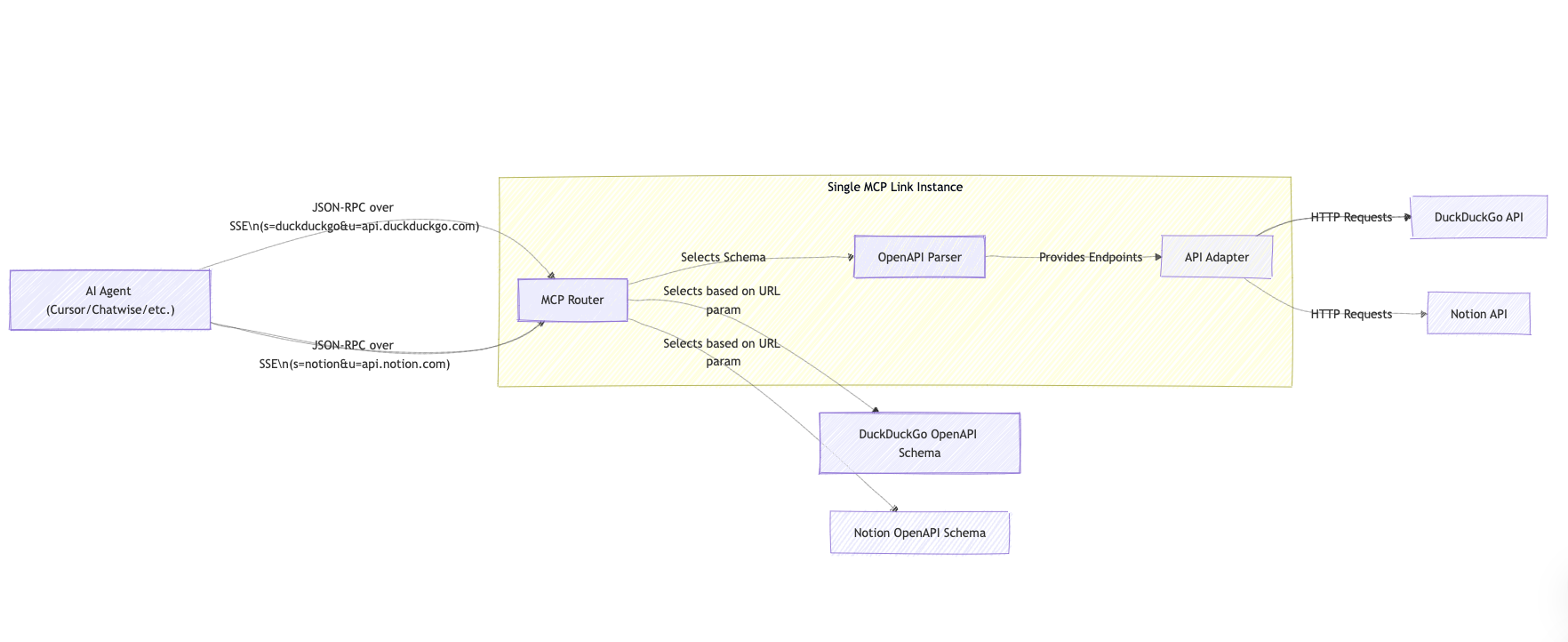
🤔 Why MCP Link?
There is a notable gap in the current AI Agent ecosystem:
- Most MCP Servers are simple wrappers around Web APIs
- Functionality interfaces may not be complete, depending on developer implementation
- Manual creation of MCP interfaces is time-consuming and error-prone
- Lack of standardized conversion processes
MCP Link solves these issues through automation and standardization, allowing any API to easily join the AI-driven application ecosystem.
🌟 Key Features
- Automatic Conversion: Generate complete MCP Servers based on OpenAPI Schema
- Seamless Integration: Make existing RESTful APIs immediately compatible with AI Agent calling standards
- Complete Functionality: Ensure all API endpoints and features are correctly mapped
- Zero Code Modification: Obtain MCP compatibility without modifying the original API implementation
- Open Standard: Follow the MCP specification to ensure compatibility with various AI Agent frameworks
🌐 Online Version
Try our hosted version at mcp-link.vercel.app to quickly convert and test your APIs without installation.
🚀 Quick Start
Installation
# Clone repository
git clone https://github.com/automation-ai-labs/mcp-link.git
cd mcp-openapi-to-mcp-adapter

# Install dependencies
go mod download
Running
# Specify port
go run main.go serve --port 8080 --host 0.0.0.0
Parameter Description
s=- URL of the OpenAPI specification fileu=- Base URL of the target APIh=- Authentication header format, in the format ofheader-name:value-prefixf=- Path filter expressions to include or exclude API endpoints. Syntax:+/path/**- Include all endpoints under /path/-/path/**- Exclude all endpoints under /path/+/users/*:GET- Include only GET endpoints for /users/{id}- Multiple filters can be separated by semicolons:
+/**:GET;-/internal/** - Wildcards:
*matches any single path segment,**matches zero or more segments
Examples
| _ | API | MCP Link URL | Authentication Method |
|---|---|---|---|
 | Brave Search | https://mcp-link.vercel.app/links/brave | API Key |
 | DuckDuckGo | https://mcp-link.vercel.app/links/duckduckgo | None |
 | Figma | https://mcp-link.vercel.app/links/figma | API Token |
 | GitHub | https://mcp-link.vercel.app/links/github | Bearer Token |
 | Home Assistant | https://mcp-link.vercel.app/links/homeassistant | Bearer Token |
 | Notion | https://mcp-link.vercel.app/links/notion | Bearer Token |
 | Slack | https://mcp-link.vercel.app/links/slack | Bearer Token |
 | Stripe | https://mcp-link.vercel.app/links/stripe | Bearer Token |
 | TMDB | https://mcp-link.vercel.app/links/tmdb | Bearer Token |
 | YouTube | https://mcp-link.vercel.app/links/youtube | Bearer Token |
Usage in AI Agents
{
  "mcpServers": {
    "@service-name": {
      "url": "http://localhost:8080/sse?s=[OpenAPI-Spec-URL]&u=[API-Base-URL]&h=[Auth-Header]:[Value-Prefix]"
    }
  }
}
These URLs allow any API with an OpenAPI specification to be immediately converted into an MCP-compatible interface accessible to AI Agents.
📋 Future Development
- MCP Protocol OAuthflow: Implement OAuth authentication flow support for MCP Protocol
- Resources Support: Add capability to handle resource-based API interactions
- MIME Types: Enhance support for various MIME types in API requests and responses