
OpenChrome
Smart. Fast. Parallel.
Browser automation MCP server that uses your real Chrome.




What is OpenChrome?
Imagine 20+ parallel Playwright sessions — but already logged in to everything, invisible to bot detection, and sharing one Chrome process at 300MB. That's OpenChrome.
Search across 20 sites simultaneously. Crawl authenticated dashboards in seconds. Debug production UIs with real user sessions. Connect to OpenClaw and give your AI agent browser superpowers across Telegram, Discord, or any chat platform.
You: oc compare "AirPods Pro" prices across Amazon, eBay, Walmart,
     Best Buy, Target, Costco, B&H, Newegg — find the lowest

AI:  [8 parallel workers, all sites simultaneously]
     Best Buy:  $179 ← lowest (sale)
     Amazon:    $189
     Costco:    $194 (members)
     ...
     Time: 2.8s | All prices from live pages, already logged in.
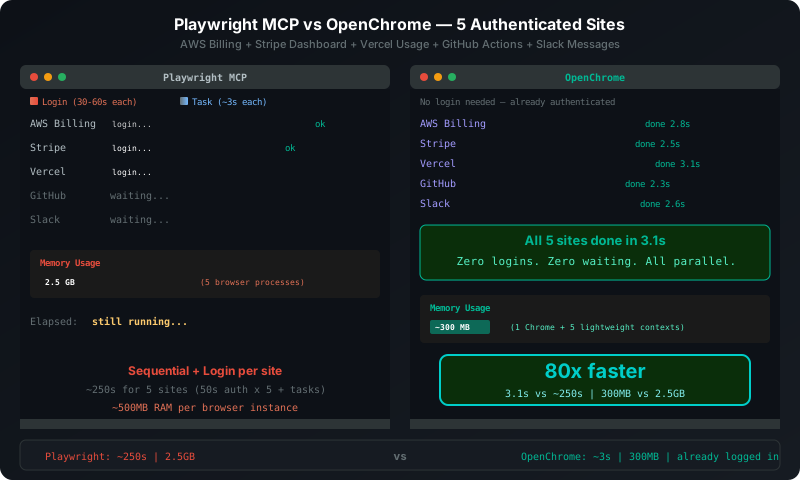
| Traditional | OpenChrome | |
|---|---|---|
| 5-site task | ~250s (login each) | ~3s (parallel) |
| Memory | ~2.5 GB (5 browsers) | ~300 MB (1 Chrome) |
| Auth | Every time | Never |
| Bot detection | Flagged | Invisible |
Guided, Not Guessing
The bottleneck in browser automation isn't the browser — it's the LLM thinking between each step. Every tool call costs 5–15 seconds of inference time. When an AI agent guesses wrong, it doesn't just fail — it spends another 10 seconds thinking about why, then another 10 seconds trying something else.
Playwright agent checking prices on 5 sites:

  Site 1:  launch browser           3s
           navigate                  2s
           ⚡ bot detection          LLM thinks... 12s → retry with UA
           ⚡ CAPTCHA                LLM thinks... 10s → stuck, skip
           navigate to login         2s
           ⚡ no session             LLM thinks... 12s → fill credentials
           2FA prompt               LLM thinks... 10s → stuck
           ...
           finally reaches product   after ~20 LLM calls, ~4 minutes

  × 5 sites, sequential  =  ~100 LLM calls,  ~20 minutes,  ~$2.00

  Actual work: 5 calls.  Wasted on wandering: 95 calls.
OpenChrome eliminates this entirely — your Chrome is already logged in, and the hint engine corrects mistakes before they cascade:
OpenChrome agent checking prices on 5 sites:

  All 5 sites in parallel:
    navigate (already authenticated)     1s
    read prices                          2s
    ⚡ stale ref on one site
      └─ Hint: "Use read_page for fresh refs"    ← no guessing
    read_page → done                     1s

  = ~20 LLM calls,  ~15 seconds,  ~$0.40
The hint engine watches every tool call across 6 layers — error recovery, composite suggestions, repetition detection, sequence detection, learned patterns, and success guidance. When it sees the same error→recovery pattern 3+ times, it promotes it to a permanent rule across sessions.
| Playwright | OpenChrome | Savings | |
|---|---|---|---|
| LLM calls | ~100 | ~20 | 80% fewer |
| Wall time | ~20 min | ~15 sec | 80x faster |
| Token cost | ~$2.00 | ~$0.40 | 5x cheaper |
| Wasted calls | ~95% | ~0% |
Quick Start
npx openchrome-mcp setup
That's it. Say oc to your AI agent.
Manual config
Claude Code:
claude mcp add openchrome -- npx -y openchrome-mcp serve --auto-launch
VS Code / Copilot (.vscode/mcp.json):
{
  "servers": {
    "openchrome": {
      "type": "stdio",
      "command": "npx",
      "args": ["-y", "openchrome-mcp", "serve", "--auto-launch"]
    }
  }
}
Cursor / Windsurf / Other MCP clients:
{
  "mcpServers": {
    "openchrome": {
      "command": "npx",
      "args": ["-y", "openchrome-mcp", "serve", "--auto-launch"]
    }
  }
}
Examples
Parallel monitoring:
oc screenshot AWS billing, GCP console, Stripe, and Datadog — all at once
→ 4 workers, 3.1s, already authenticated everywhere
Multi-account:
oc check orders on personal and business Amazon accounts simultaneously
→ 2 workers, isolated sessions, same site different accounts
Competitive intelligence:
oc compare prices for "AirPods Pro" across Amazon, eBay, Walmart, Best Buy
→ 4 workers, 4 sites, 2.4s, works past bot detection
47 Tools
| Category | Tools |
|---|---|
| Navigate & Interact | navigate, click_element, fill_form, wait_and_click, find, computer |
| Read & Extract | read_page, page_content, javascript_tool, selector_query, xpath_query |
| Environment | emulate_device, geolocation, user_agent, network |
| Storage & Debug | cookies, storage, console_capture, performance_metrics, request_intercept |
| Parallel Workflows | workflow_init, workflow_collect, worker_create, batch_execute |
| Memory | memory_record, memory_query, memory_validate |
Full tool list (47)
navigate computer read_page find click_element wait_and_click form_input fill_form javascript_tool page_reload page_content page_pdf wait_for user_agent geolocation emulate_device network selector_query xpath_query cookies storage console_capture performance_metrics request_intercept drag_drop file_upload http_auth worker_create worker_list worker_update worker_complete worker_delete tabs_create_mcp tabs_context_mcp tabs_close workflow_init workflow_status workflow_collect workflow_collect_partial workflow_cleanup execute_plan batch_execute lightweight_scroll memory_record memory_query memory_validate oc_stop
CLI
oc setup                    # Auto-configure
oc serve --auto-launch      # Start server
oc serve --headless-shell   # Headless mode
oc doctor                   # Diagnose issues
Cross-Platform
| Platform | Status |
|---|---|
| macOS | Full support |
| Windows | Full support (taskkill process cleanup) |
| Linux | Full support (Snap paths, CHROME_PATH env, --no-sandbox for CI) |
DOM Mode (Token Efficient)
read_page supports three output modes:
| Mode | Output | Tokens | Use Case |
|---|---|---|---|
ax (default) | Accessibility tree with ref_N IDs | Baseline | Screen readers, semantic analysis |
dom | Compact DOM with backendNodeId | ~5-10x fewer | Click, fill, extract — most tasks |
css | CSS diagnostic info (variables, computed styles, framework detection) | Minimal | Debugging styles, Tailwind detection |
DOM mode example:
read_page tabId="tab1" mode="dom"

[page_stats] url: https://example.com | title: Example | scroll: 0,0 | viewport: 1920x1080

[142]<input type="search" placeholder="Search..." aria-label="Search"/>
[156]<button type="submit"/>Search
[289]<a href="/home"/>Home
[352]<h1/>Welcome to Example
DOM mode outputs [backendNodeId] as stable identifiers — they persist for the lifetime of the DOM node, unlike ref_N IDs which are cleared on each AX-mode read_page call.
Stable Selectors
Action tools that accept a ref parameter (form_input, computer, etc.) support three identifier formats:
| Format | Example | Source |
|---|---|---|
ref_N | ref_5 | From read_page AX mode (ephemeral) |
| Raw integer | 142 | From read_page DOM mode (stable) |
node_N | node_142 | Explicit prefix form (stable) |
Backward compatible — existing ref_N workflows work unchanged. DOM mode's backendNodeId eliminates "ref not found" errors caused by stale references.
Session Persistence
Headless mode (--headless-shell) doesn't persist cookies across restarts. Enable storage state persistence to maintain authenticated sessions:
oc serve --persist-storage                         # Enable persistence
oc serve --persist-storage --storage-dir ./state    # Custom directory
Cookies and localStorage are saved atomically every 30 seconds and restored on session creation.
Benchmarks
Measure token efficiency and parallel performance:
npm run benchmark                                    # Stub mode: AX vs DOM token efficiency (interactive)
npm run benchmark:ci                                 # Stub mode: AX vs DOM with JSON + regression detection
npm run benchmark -- --mode real                     # Real mode: actual MCP server (requires Chrome)
npx ts-node tests/benchmark/run-parallel.ts          # Stub mode: all parallel benchmark categories
npx ts-node tests/benchmark/run-parallel.ts --mode real --category batch-js --runs 1  # Real mode
npx ts-node tests/benchmark/run-parallel.ts --mode real --category realworld --runs 1  # Real-world benchmarks
By default, benchmarks run in stub mode — measuring protocol correctness and tool-call counts with mock responses. Use --mode real to spawn an actual MCP server subprocess and measure real performance (requires Chrome to be available).
Parallel benchmark categories:
| Category | What It Measures |
|---|---|
| Multi-step interaction | Form fill + click sequences across N parallel pages |
| Batch JS execution | N × javascript_tool vs 1 × batch_execute |
| Compiled plan execution | Sequential agent tool calls vs single execute_plan |
| Streaming collection | Blocking vs workflow_collect_partial |
| Init overhead | Sequential tabs_create vs batch workflow_init |
| Fault tolerance | Circuit breaker recovery speed |
| Scalability curve | Speedup efficiency at 1–50x concurrency |
| Real-world | Multi-site crawl, heavy JS, pipeline, scalability with public websites (httpbin.org, jsonplaceholder, example.com) — NOT included in all, requires network |
Development
git clone https://github.com/shaun0927/openchrome.git
cd openchrome
npm install && npm run build && npm test
License
MIT