plugged.in 🔌

Turn your AI conversations into permanent organizational memory




🚀 Get Started • 📚 Documentation • 🌟 Features • 💬 Community
🧩 Now Multi‑Arch Ready!
Plugged.in Docker images support both amd64 and arm64 architectures via a unified manifest.
🧠 Beyond Proxy Mode — Full AI Platform:
Plugged.in is no longer just a proxy; it’s a unified AI infrastructure layer combining web app, memory, and tool orchestration.
🎯 The Problem We Solve
Every day, you have brilliant conversations with AI - strategy sessions with GPT-4, code reviews with Claude, analysis with Gemini. But when you close that chat window, all that knowledge vanishes. This is the "AI knowledge evaporation" problem.
💡 The Solution
plugged.in is the world's first AI Content Management System (AI-CMS) - a platform that transforms ephemeral AI interactions into persistent, versioned, and searchable organizational knowledge.
Think of it as "Git for AI-generated content" meets "WordPress for AI interactions".
✨ What Makes plugged.in Special
🧠 AI Memory That Persists
Your AI conversations become permanent assets. Every document is versioned, attributed, and searchable.
🤝 Multi-Model Collaboration
Claude writes v1, GPT-4 adds technical specs in v2, Gemini refines in v3 - all tracked and attributed.
🔌 Universal MCP Integration
Works with 1,500+ MCP servers. Connect any tool, any AI, any workflow - all through one interface.
🔒 Enterprise-Grade Security
End-to-end encryption, OAuth 2.1, rate limiting, and sandboxed execution for your peace of mind.
📊 Real Platform Statistics
Documents Managed: 90+ (72% AI-generated)
Integrated MCP Servers: 1,568
Active Versioning: Documents with up to 4 iterations
Model Attributions: 17 different AI models tracked
Search Performance: Sub-second RAG queries
Security: AES-256-GCM encryption, Redis rate limiting
🚀 Quick Start
Docker (Recommended - 2 minutes)
Supported Architectures
Plugged.in Docker images are multi-architecture (amd64 and arm64) and will automatically select the correct platform for your system.
Important Notes:
- ✅ Docker Compose automatically pulls the correct architecture - no manual configuration needed
- ✅ Works seamlessly on mixed architectures - run the same
docker-compose.ymlon any platform - ✅ No performance penalty - native builds for both AMD64 and ARM64
To verify which platforms are available, run:
docker manifest inspect veriteknik/pluggedin:latest --verbose | jq '.manifests[].platform'
# Clone and setup
git clone https://github.com/VeriTeknik/pluggedin-app.git
cd pluggedin-app
cp .env.example .env

# Start with Docker (includes PostgreSQL 18-alpine)
docker compose up --build -d

# Visit http://localhost:12005
What's included:
- ✅ PostgreSQL 18 (latest stable) with automatic migrations
- ✅ Next.js 15 web application with optimized production build
- ✅ Persistent volumes for database, uploads, and logs
- ✅ Health checks and automatic restarts
- ✅ Migrator container (288 MB) for database setup
Docker Architecture:
Services:
  - pluggedin-app: Main web application (port 12005)
  - pluggedin-postgres: PostgreSQL 18-alpine database (port 5432)
  - drizzle-migrate: One-time migration runner (auto-stops)

Volumes:
  - pluggedin-postgres: Database data (persistent)
  - app-uploads: User uploaded files (persistent)
  - app-logs: Application logs (persistent)
  - mcp-cache: MCP package cache (persistent)
Upgrading from older versions:
# If upgrading from PostgreSQL 16 or earlier
# Option 1: Fresh start (data loss)
docker compose down -v && docker compose up --build -d

# Option 2: Migrate existing data
docker exec pluggedin-postgres pg_dump -U pluggedin pluggedin > backup.sql
docker compose down -v
docker compose up -d
docker exec -i pluggedin-postgres psql -U pluggedin -d pluggedin < backup.sql
Cloud Version
Visit plugged.in for instant access - no installation required.
🌟 Key Features
📚 Document Management & Versioning
- Version Control: Track every change with Git-style history
- Model Attribution: Know which AI contributed what
- Smart Search: Semantic search across all documents
- Multiple Formats: PDF, Markdown, Code, Images, and more
- Dual Storage Display: View both file and RAG vector storage usage
🔧 MCP Server Hub
- 1,500+ Integrations: Connect to any MCP-compatible tool
- Advanced Multi-Select Filtering: Filter by multiple package types simultaneously (npm, PyPI, Docker, MCPB, NuGet)
- Smart Search: Intelligent filtering with real-time result counts and validation
- Auto-Discovery: Find and configure servers from GitHub, npm, Smithery
- Registry Integration: Claim and manage servers with GitHub credentials
- Unified Interface: One API key, all your tools
- Tool Prefixing: Automatic namespace management prevents conflicts
- OAuth Support: Server-side OAuth handling for MCP servers
🎮 Interactive Playground
- Test Any Model: Claude, GPT-4, Gemini, and more
- Live Debugging: See real-time MCP interactions
- RAG Integration: Use your documents as context
- Custom Instructions: Per-server configuration
- Extensive Logging: Detailed debugging capabilities
🔔 Real-Time Intelligence
- Activity Tracking: Monitor all MCP operations
- Email Notifications: Stay informed about important events
- Trending Analytics: See what tools are popular
- Audit Logs: Complete activity history
- Bidirectional Notifications: Send, receive, mark as read
🔐 Security First
- End-to-End Encryption: AES-256-GCM for all sensitive data
- Per-Profile Encryption: Isolated encryption keys per workspace
- OAuth 2.1: Modern authentication flows
- Sandboxed Execution: Firejail isolation on Linux
- Redis Rate Limiting: Advanced DDoS protection with fallback
- LRU Cache: Memory-efficient caching with automatic eviction
- Enhanced Password Security: Bcrypt cost factor 14 (16,384 iterations)
- Dynamic CSP Nonces: Cryptographically secure Content Security Policy
- Security Headers: HSTS, X-Frame-Options, X-Content-Type-Options
🏢 Hub & Workspace Management
- Multi-Hub Architecture: Organize projects into separate hubs
- Workspace Isolation: Each hub contains multiple isolated workspaces
- Smart Hub Switching: Automatic workspace selection when switching hubs
- Data Scoping: Hub-level and workspace-level data isolation
- Current Hub Display: Dashboard shows active hub for context awareness
📋 Clipboard & Memory System
- Named Entries: Store key-value pairs with semantic names (e.g.,
customer_context,last_analysis) - Indexed Entries: Array-like storage with auto-incrementing indices for ordered data
- Stack Operations: Push/pop functionality for LIFO workflows and pipelines
- Rich Content Support: Store text, JSON, images (base64), and any content type up to 2MB
- TTL Expiration: Optional time-to-live for automatic cleanup of temporary data
- Visibility Controls: Private, workspace, or public visibility per entry
- Model Attribution: Track which AI model created each clipboard entry
- MCP Integration: Access clipboard via 6 built-in MCP tools from any AI client
🏗️ Architecture
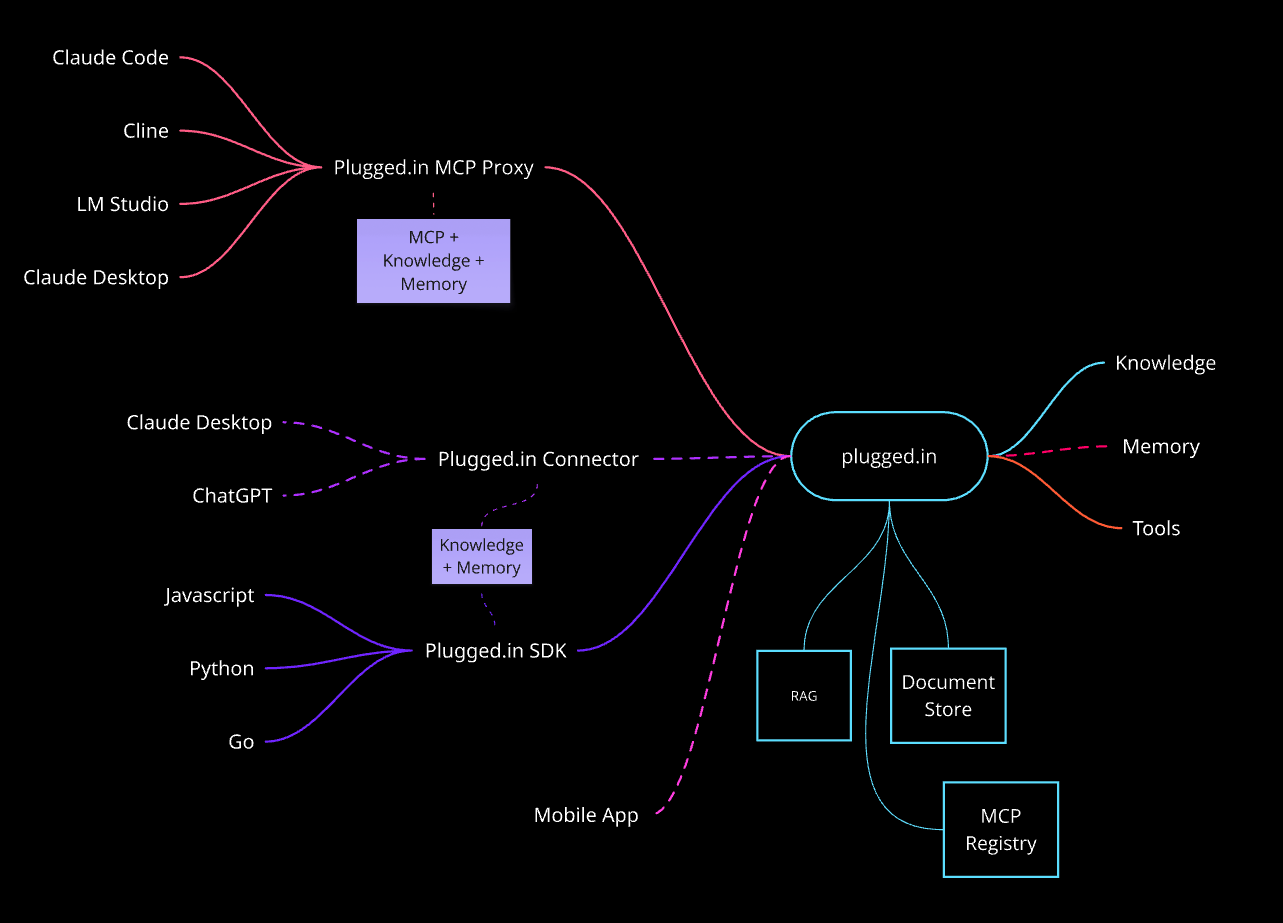
Architecture Overview
plugged.in acts as the central hub connecting various AI clients, development tools, and programming languages with your knowledge base and the broader MCP ecosystem. The architecture is designed for maximum flexibility and extensibility.
🟢 Production-Ready Integrations (Solid Lines)
MCP Proxy Interface
The MCP Proxy serves as a unified gateway that aggregates multiple MCP servers into a single interface:
- Claude Code - Official Anthropic CLI for Claude with native MCP support
- Cline - VS Code extension for AI-assisted development
- LM Studio - Local model execution with MCP integration
- Claude Desktop - Anthropic's desktop application
How it works: Each AI client connects via STDIO, receiving access to all your configured MCP servers through one connection. The proxy handles:
- Tool prefixing to prevent namespace conflicts
- OAuth authentication for MCP servers
- Activity logging and notifications
- Unified error handling
SDK Support - Multi-Language Integration
Direct programmatic access through official SDKs:
- JavaScript/TypeScript SDK (
@pluggedin/sdk) - Full-featured SDK for Node.js and browser - Python SDK (
pluggedin-sdk) - Pythonic interface for AI workflows - Go SDK (
pluggedin-go) - High-performance Go implementation
Use Cases:
// Create documents programmatically
const doc = await client.documents.create({
  title: "API Analysis",
  content: "...",
  source: "api"
});

// Query RAG knowledge base
const results = await client.rag.query("How do we handle auth?");
Platform Core Features
The plugged.in web platform provides:
-
Knowledge Base (RAG)
- Semantic search across all documents
- AI-powered question answering
- Project-scoped isolation
- Sub-second query performance
-
Document Store
- Version control for AI-generated content
- Multi-model attribution tracking
- Content hash deduplication
- Support for uploads, AI-generated, and API sources
-
MCP Registry
- 1,500+ curated MCP servers
- GitHub verification and claiming
- Install tracking and trending
- Auto-discovery from npm, GitHub, Smithery
-
Tools Management
- Discover tools from all connected servers
- Test tools in interactive playground
- Custom instructions per server
- Real-time debugging logs
🟡 In Development (Dashed Lines)
Native Connectors
Direct integrations bypassing the MCP Proxy for enhanced performance:
- Plugged.in Connector for Claude Desktop - Native plugin architecture
- Plugged.in Connector for ChatGPT - OpenAI plugin integration
- Mobile App - iOS and Android native apps
Why Native Connectors?
- Faster response times (no proxy overhead)
- Richer UI integration
- Platform-specific features
- Offline capabilities
Advanced Memory System
Persistent memory across sessions:
- Knowledge + Memory boxes in the diagram represent:
- Session continuity across different AI clients
- Automatic context injection based on conversation history
- Cross-model memory sharing (Claude remembers what GPT discussed)
- Smart context pruning to stay within token limits
Example Workflow:
- Discuss architecture with Claude Desktop → Memory saved
- Switch to ChatGPT connector → Previous context automatically available
- Mobile app accesses same conversation history
- RAG provides relevant documents automatically
📊 Data Flow Example
User Request Flow:
1. User asks question in Claude Desktop
2. MCP Proxy receives request
3. Proxy checks RAG for relevant context
4. Combines context + user question
5. Routes to appropriate MCP servers
6. Aggregates responses
7. Logs activity to database
8. Returns enriched response to user
Document Creation Flow:
1. AI generates document via SDK
2. Content processed and sanitized
3. Model attribution recorded
4. Version created in Document Store
5. Vectors generated for RAG
6. Document searchable immediately
🔒 Security Architecture
All connections use:
- End-to-end encryption (AES-256-GCM)
- Per-profile encryption keys (workspace isolation)
- Redis rate limiting with memory fallback
- Sandboxed execution (Firejail on Linux)
- OAuth 2.1 for external services
📈 Scalability
The architecture supports:
- Horizontal scaling of MCP Proxy instances
- Database connection pooling for PostgreSQL
- Redis caching for frequently accessed data
- CDN integration for static assets
- Background job processing for heavy operations
📚 Documentation
Visit our comprehensive documentation at docs.plugged.in
For Users
- Getting Started - Platform overview and quick start
- Installation Guide - Step-by-step setup instructions
- Document Library - Managing your AI knowledge base
- RAG Knowledge Base - Setting up RAG for AI context
- Team Collaboration - Working with your team
For Developers
- API Reference - Complete API documentation
- API Authentication - API key and authentication guide
- Self-Hosting Guide - Deploy your own instance
- Docker Deployment - Container-based deployment
- Security Overview - Security best practices
MCP Integration
- MCP Proxy Overview - Understanding the proxy architecture
- MCP Proxy Installation - Setting up the proxy
- Custom MCP Servers - Building your own servers
🛠️ Installation Options
Requirements
- Node.js 18+ (20+ recommended)
- PostgreSQL 15+ (18+ recommended)
- Redis (optional, for rate limiting)
- Docker & Docker Compose (for containerized deployment)
Environment Variables
Create a .env file with:
# Core (Required)
DATABASE_URL=postgresql://user:pass@localhost:5432/pluggedin
NEXTAUTH_URL=http://localhost:12005
NEXTAUTH_SECRET=your-secret-key # Generate: openssl rand -base64 32

# Security (Required)
NEXT_SERVER_ACTIONS_ENCRYPTION_KEY= # Generate: openssl rand -base64 32

# Features (Optional)
ENABLE_RAG=true
ENABLE_NOTIFICATIONS=true
ENABLE_EMAIL_VERIFICATION=true
REDIS_URL=redis://localhost:6379  # For Redis rate limiting

# Email (For notifications)
EMAIL_SERVER_HOST=smtp.example.com
EMAIL_SERVER_PORT=587
EMAIL_FROM=noreply@example.com

# Performance (Optional)
RAG_CACHE_TTL_MS=60000  # Cache TTL in milliseconds
Manual Installation
# Install dependencies
pnpm install

# Setup database
pnpm db:migrate:auth
pnpm db:generate
pnpm db:migrate

# Build for production
NODE_ENV=production pnpm build

# Start the server
pnpm start
🔌 MCP Proxy Integration
Connect your AI clients to plugged.in:
Claude Desktop
{
  "mcpServers": {
    "pluggedin": {
      "command": "npx",
      "args": ["-y", "@pluggedin/pluggedin-mcp-proxy@latest"],
      "env": {
        "PLUGGEDIN_API_KEY": "YOUR_API_KEY"
      }
    }
  }
}
Cursor IDE
npx -y @pluggedin/pluggedin-mcp-proxy@latest --pluggedin-api-key YOUR_API_KEY
🎯 Use Cases
For Developers
- Code Review Memory: Keep AI code reviews across sessions
- Documentation Generation: Auto-generate and version technical docs
- Bug Analysis Archive: Store AI debugging sessions for future reference
For Teams
- Knowledge Base: Build institutional memory from AI interactions
- Meeting Summaries: AI-generated summaries with full attribution
- Strategy Documents: Collaborative AI-assisted planning with version control
For Enterprises
- Compliance Tracking: Full audit trail of AI-generated content
- Multi-Model Workflows: Orchestrate different AIs for complex tasks
- Secure Deployment: Self-host with complete data control
📊 Why Teams Choose plugged.in
| Feature | plugged.in | Traditional AI Chat | MCP Clients Alone |
|---|---|---|---|
| Persistent Memory | ✅ Full versioning | ❌ Session only | ❌ No storage |
| Multi-Model Support | ✅ All models | ⚠️ Single vendor | ✅ Multiple |
| Document Management | ✅ Complete CMS | ❌ None | ❌ None |
| Attribution Tracking | ✅ Full audit trail | ❌ None | ❌ None |
| Team Collaboration | ✅ Built-in | ❌ None | ❌ Limited |
| Self-Hostable | ✅ Yes | ⚠️ Varies | ✅ Yes |
| RAG Integration | ✅ Native | ⚠️ Limited | ❌ None |
🤝 Community & Support
- GitHub Discussions: Join the conversation
- GitHub Issues: Bug reports and feature requests
- Reddit: r/plugged_in
- Twitter/X: @PluggedIntoAI
- Email: team@plugged.in
Contributing
We love contributions! See our Contributing Guide for details.
# Fork the repo, then:
git clone https://github.com/YOUR_USERNAME/pluggedin-app.git
cd pluggedin-app
pnpm install
pnpm dev
📜 License
MIT License - see LICENSE for details.
🙏 Acknowledgments
Built on top of these amazing projects:
- Model Context Protocol by Anthropic
- Next.js for the web framework
- PostgreSQL for reliable data storage
- All the MCP server creators in our community
📝 Release Notes
Latest Release: v2.17.0 - Multi-Architecture Docker Support & Self-Hosted Fixes
🎯 What's New in v2.17.0
🐳 Multi-Architecture Docker Support (Major Feature!)
- AMD64 + ARM64 Support: Native builds for both Intel/AMD and ARM processors
- Apple Silicon Ready: M1/M2/M3 Macs now run natively without performance issues
- AWS Graviton Support: Cost-effective cloud deployments on ARM instances
- Official Docker Hub Images: Pre-built multi-arch images at
veriteknik/pluggedin:latest - Automatic Platform Detection: Docker pulls the correct architecture for your system
- Build Times: 5-10 minutes (single arch), 15-25 minutes (multi-arch)
🐛 Critical Bug Fixes
- Fixed Self-Hosted Registration (#61): New users can now register successfully on self-hosted instances
- Username Column Migration: Robust migration (
0066_fix_missing_username.sql) works for fresh and existing installs - Platform Detection: Reliable platform detection using
docker version -f - Error Handling: Improved Docker login and build error messages
🔒 Security Enhancements
- Pinned GitHub Actions: All third-party actions use commit SHAs to prevent supply chain attacks
- Input Validation: Workflow inputs validated (version must match
latestorvX.Y.Z) - Manifest Verification: Automatic verification that both architectures are present after build
⚡ Infrastructure Improvements
- Ephemeral CI Builders: Auto-cleanup prevents state pollution between builds
- Optimized Caching: Changed from
mode=maxtomode=minfor sustainable builds - Docker Hub README Sync: Automated workflow keeps Docker Hub description up to date
📚 Documentation Updates
- Multi-Arch Deployment Guide: Complete guide in
/deployment/docker - Updated Installation Guide: Docker Hub pre-built images option added
- Rollback Procedures: Documented recovery strategy if builds fail
View the full changelog and release notes at docs.plugged.in/releases
Ready to give your AI permanent memory?
🚀 Start Now • ⭐ Star on GitHub
If this project inspires you, please ⭐ Star it —
stars power the community and keep development momentum alive!