Proxmox-mcp
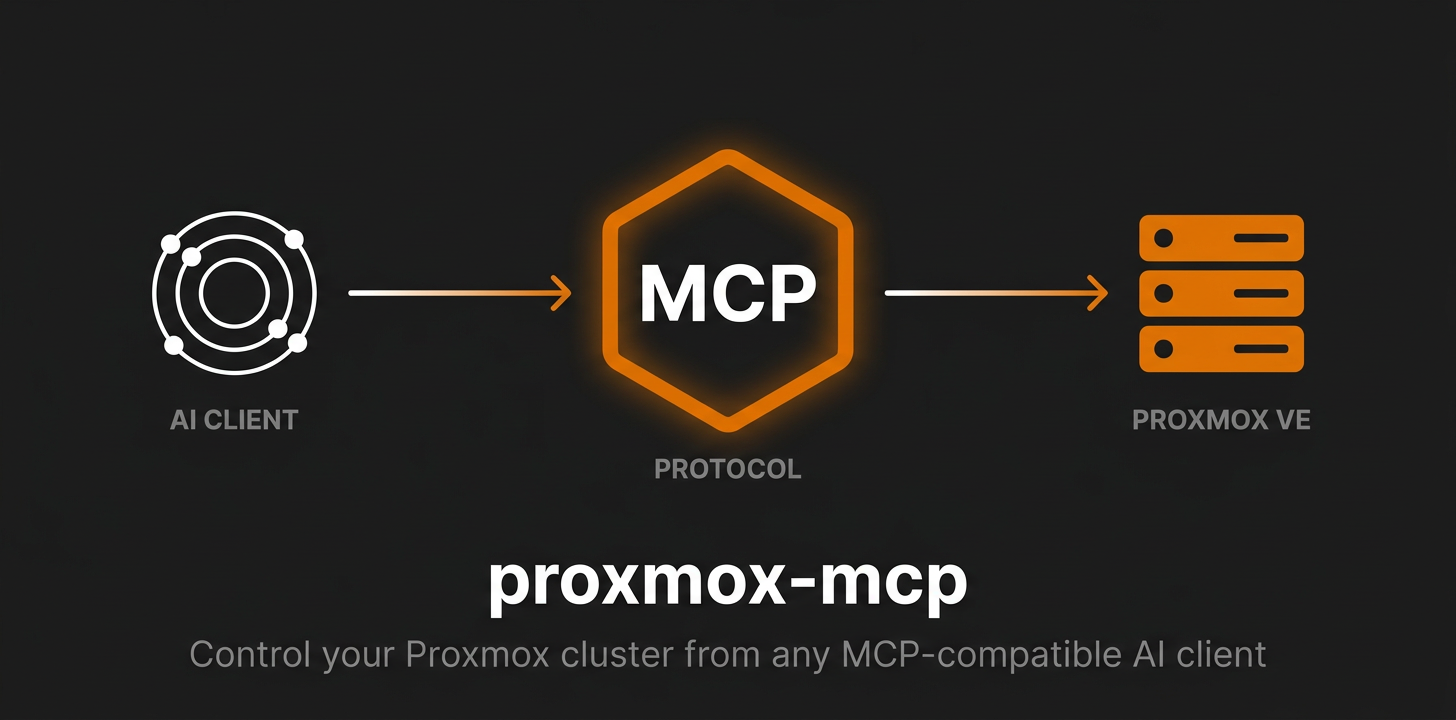





Simple Proxmox MCP
MCP server for managing Proxmox VE
38 tools — nodes, QEMU VMs, LXC containers, storage, cluster, snapshots.
Why this one?
- One image, multi-arch —
docker run ghcr.io/akmalovaa/proxmox-mcp:latestand you're done - Just env vars — no config files, no database, no state
- Read-only by default — destructive ops are gated behind an explicit
PROXMOX_RISK_LEVEL - Tiny codebase — pure stdio MCP over Proxmoxer, no HTTP server, no auth layer, no extras
- Raw JSON out — no formatting, no emoji; LLM gets clean data
Quick start
Image: ghcr.io/akmalovaa/proxmox-mcp:latest (multi-arch: amd64 + arm64).
1. Export credentials in your shell profile (~/.zprofile, ~/.zshrc or ~/.bashrc):
# base environment:
export PROXMOX_HOST=192.168.1.100
export PROXMOX_USER=root@pam
export PROXMOX_PASSWORD=your-password

# or use token auth (recommended):
export PROXMOX_TOKEN_NAME=mcp
export PROXMOX_TOKEN_VALUE=xxxxxxxx-xxxx-xxxx-xxxx-xxxxxxxxxxxx

# optional:
export PROXMOX_RISK_LEVEL=read
Reload: source ~/.zprofile (or restart the shell).
2. Add to ~/.claude/settings.json (Claude Code) or claude_desktop_config.json (Claude Desktop):
{
  "mcpServers": {
    "proxmox": {
      "command": "docker",
      "args": ["run", "-i", "--rm",
        "-e", "PROXMOX_HOST",
        "-e", "PROXMOX_USER",
        "-e", "PROXMOX_PASSWORD",
        "ghcr.io/akmalovaa/proxmox-mcp:latest"]
    }
  }
}
or token auth:
{
  "mcpServers": {
    "proxmox": {
      "command": "docker",
      "args": ["run", "-i", "--rm",
        "-e", "PROXMOX_HOST",
        "-e", "PROXMOX_USER",
        "-e", "PROXMOX_TOKEN_NAME",
        "-e", "PROXMOX_TOKEN_VALUE",
        "ghcr.io/akmalovaa/proxmox-mcp:latest"]
    }
  }
}
docker run -e VAR without a value passes the host variable through — no secrets in the config file. Restart the client — 38 Proxmox tools become available.
For password auth, swap the token vars for PROXMOX_PASSWORD.
Note: Claude Desktop on macOS is launched via launchd and does not inherit
~/.zprofile/~/.zshrc. Either put the exports in~/.zshenv, or fall back to an inline"env": { ... }block in the config.
Configuration
All settings are environment variables — set them in your shell profile, pass them inline to docker run -e, or declare them in your MCP client's env block.
| Variable | Default | Description |
|---|---|---|
PROXMOX_HOST | — | Proxmox host (IP or hostname) |
PROXMOX_USER | root@pam | API user |
| Auth | — | token or password — see below |
PROXMOX_PORT | 8006 | API port |
PROXMOX_VERIFY_SSL | false | Verify TLS certificate |
PROXMOX_RISK_LEVEL | read | read / lifecycle / all |
Authentication: token or password
Pick one. If both are set, the token wins.
Token (recommended) — create in Proxmox UI: Datacenter → Permissions → API Tokens → Add (uncheck Privilege Separation). Then:
export PROXMOX_TOKEN_NAME=mcp
export PROXMOX_TOKEN_VALUE=xxxxxxxx-xxxx-xxxx-xxxx-xxxxxxxxxxxx
Password (fallback):
export PROXMOX_PASSWORD=your-password
Risk levels
PROXMOX_RISK_LEVEL gates destructive operations:
| Level | Adds |
|---|---|
read (default) | read-only tools |
lifecycle | + start / stop / reboot / suspend / clone / create-snapshot |
all | + delete-snapshot / rollback-snapshot |
Every elevated call is logged to stderr (ALLOW / DENY + tool + tier).
Tools
Nodes (7)
| Tool | Description |
|---|---|
list_nodes | List all cluster nodes with status, CPU, memory, uptime |
get_node_status | Detailed node metrics (CPU, memory, disk, load, kernel) |
get_node_networks | Network interfaces on a node |
get_node_disks | Physical disks on a node |
get_node_tasks | Recent tasks on a node |
get_task_status | Status of a specific task by UPID |
get_task_log | Log output from a task |
QEMU VMs (14)
| Tool | Tier | Description |
|---|---|---|
list_vms | read | List all VMs, optionally filter by node |
get_vm_status | read | Current VM status (running/stopped, CPU, memory) |
get_vm_config | read | VM configuration (hardware, disks, network) |
list_vm_snapshots | read | List all snapshots of a VM |
start_vm | lifecycle | Start a VM |
stop_vm | lifecycle | Force-stop a VM |
shutdown_vm | lifecycle | Graceful ACPI shutdown with timeout |
reboot_vm | lifecycle | Reboot via ACPI |
suspend_vm | lifecycle | Suspend a VM |
resume_vm | lifecycle | Resume a suspended VM |
clone_vm | lifecycle | Full or linked clone |
create_vm_snapshot | lifecycle | Create a snapshot |
delete_vm_snapshot | all | Delete a snapshot |
rollback_vm_snapshot | all | Rollback to a snapshot |
LXC Containers (11)
| Tool | Tier | Description |
|---|---|---|
list_containers | read | List all LXC containers, optionally filter by node |
get_container_status | read | Current container status |
get_container_config | read | Container configuration |
list_container_snapshots | read | List all snapshots |
start_container | lifecycle | Start a container |
stop_container | lifecycle | Force-stop a container |
shutdown_container | lifecycle | Graceful shutdown with timeout |
reboot_container | lifecycle | Reboot a container |
create_container_snapshot | lifecycle | Create a snapshot |
delete_container_snapshot | all | Delete a snapshot |
rollback_container_snapshot | all | Rollback to a snapshot |
Storage (2)
| Tool | Description |
|---|---|
list_storage | Storage pools with usage, optionally filter by node |
get_storage_content | Contents of a storage pool (ISOs, backups, images, templates) |
Cluster (4)
| Tool | Description |
|---|---|
get_cluster_status | Cluster health, quorum, node membership |
get_cluster_resources | All resources (VMs, containers, storage, nodes) |
get_cluster_backups | Configured backup jobs |
get_next_vmid | Next available VM/container ID |
Architecture
src/proxmox_mcp/
├── server.py    # FastMCP instance + entry point
├── config.py    # Pydantic Settings (PROXMOX_ prefix)
├── client.py    # Proxmoxer connection via lifespan
└── tools/       # nodes, vms, containers, storage, cluster
- Read-only by default — elevated tools gated by
PROXMOX_RISK_LEVEL - Single connection — Proxmoxer client created once at startup, shared via lifespan
- Raw JSON output — no formatting; LLM consumes data directly
Development
Run standalone (testing)
export PROXMOX_HOST=192.168.1.100
export PROXMOX_USER=root@pam
export PROXMOX_TOKEN_NAME=mcp
export PROXMOX_TOKEN_VALUE=xxxxxxxx-xxxx-xxxx-xxxx-xxxxxxxxxxxx

docker run -i --rm \
  -e PROXMOX_HOST -e PROXMOX_USER \
  -e PROXMOX_TOKEN_NAME -e PROXMOX_TOKEN_VALUE \
  ghcr.io/akmalovaa/proxmox-mcp:latest
Without Docker (UV)
git clone https://github.com/akmalovaa/proxmox-mcp.git && cd proxmox-mcp && uv sync
MCP client config:
{
  "mcpServers": {
    "proxmox": {
      "command": "uv",
      "args": ["run", "--directory", "/path/to/proxmox-mcp", "proxmox-mcp"],
      "env": {
        "PROXMOX_HOST": "192.168.1.100",
        "PROXMOX_TOKEN_NAME": "mcp",
        "PROXMOX_TOKEN_VALUE": "xxxxxxxx-xxxx-xxxx-xxxx-xxxxxxxxxxxx"
      }
    }
  }
}
Build from source
git clone https://github.com/akmalovaa/proxmox-mcp.git
cd proxmox-mcp
docker build -t proxmox-mcp .
License
MIT