Queue Pilot





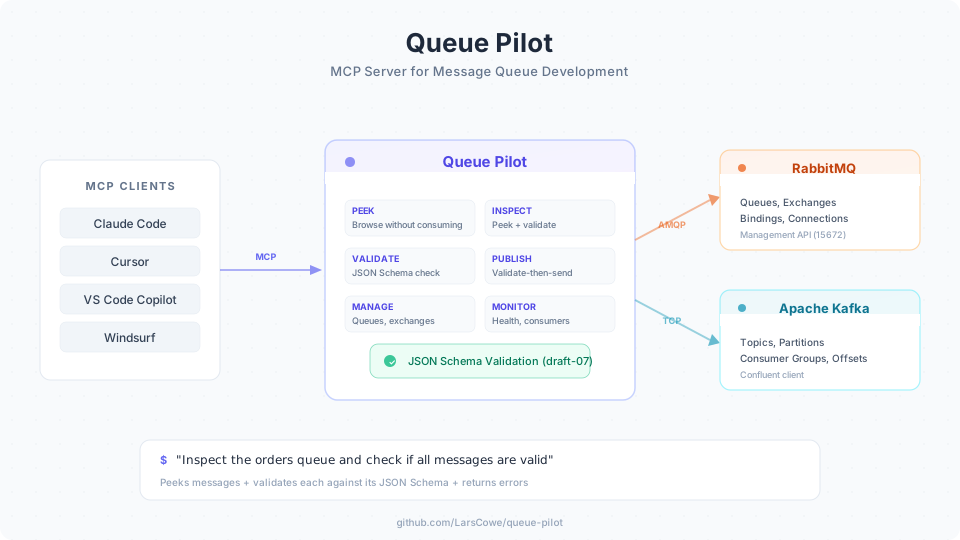
MCP server for message queue development — combines message inspection with JSON Schema validation. Supports RabbitMQ and Kafka.
Designed for integration projects where multiple teams communicate via message brokers: inspect queues/topics, view messages, and validate payloads against agreed-upon schemas — all from your AI assistant.
Features
- Multi-broker support — RabbitMQ and Apache Kafka via a unified adapter interface
- Message Inspection — Browse queues/topics, peek at messages without consuming them
- Schema Validation — Validate message payloads against JSON Schema definitions
- Combined Inspection —
inspect_queuepeeks messages AND validates each against its schema - Validated Publishing —
publish_messagevalidates against a schema before sending — invalid messages never hit the broker - Queue Management — Create queues/topics, bindings, and purge messages for dev/test workflows
- Broker Info — List exchanges, bindings, consumer groups, and partition details
Prerequisites
- Node.js >= 22 — Required runtime (check with
node --version) - A message broker:
- RabbitMQ with the management plugin enabled (HTTP API on port 15672), or
- Apache Kafka (requires
@confluentinc/kafka-javascriptas peer dependency)
- An MCP-compatible client — Claude Code, Claude Desktop, Cursor, VS Code (Copilot), Windsurf, etc.
Quick Start
1. Define your schemas
Create JSON Schema files in a directory:
schemas/order.created.json:
{
  "$id": "order.created",
  "$schema": "http://json-schema.org/draft-07/schema#",
  "title": "Order Created",
  "description": "Emitted when a new order is placed",
  "version": "1.0.0",
  "type": "object",
  "required": ["orderId", "amount"],
  "properties": {
    "orderId": { "type": "string" },
    "amount": { "type": "number" }
  }
}
2. Add to your MCP client
Generate the config for your client with queue-pilot init:
npx queue-pilot init --schemas /absolute/path/to/your/schemas --client <name>
Supported clients: claude-code, claude-desktop, vscode, cursor, windsurf. Omit --client for generic JSON.
For Kafka, add --broker kafka. The generated config automatically includes the required @confluentinc/kafka-javascript peer dependency.
Non-default credentials are included as environment variables to avoid exposing secrets in ps output:
npx queue-pilot init --schemas ./schemas --rabbitmq-user admin --rabbitmq-pass secret
Run npx queue-pilot init --help for all options including Kafka SASL authentication.
Windows note: If
npxfails to resolve the package, trycmd /c npx queue-pilot init ....
Manual configuration (without init)
Add the following server configuration to your MCP client:
RabbitMQ:
{
  "mcpServers": {
    "queue-pilot": {
      "command": "npx",
      "args": [
        "-y",
        "queue-pilot",
        "--schemas", "/absolute/path/to/your/schemas"
      ]
    }
  }
}
Kafka:
{
  "mcpServers": {
    "queue-pilot": {
      "command": "npx",
      "args": [
        "-y",
        "--package=@confluentinc/kafka-javascript",
        "--package=queue-pilot",
        "queue-pilot",
        "--schemas", "/absolute/path/to/your/schemas",
        "--broker", "kafka"
      ],
      "env": {
        "KAFKA_BROKERS": "localhost:9092"
      }
    }
  }
}
Schema path tip: Use an absolute path for
--schemas. Relative paths resolve from the MCP client's working directory, which may not be your project root.
| Client | Config file |
|---|---|
| Claude Code | .mcp.json (project) or ~/.claude.json (user) |
| Claude Desktop | claude_desktop_config.json |
| Cursor | .cursor/mcp.json |
| VS Code (Copilot) | .vscode/mcp.json (uses "servers" instead of "mcpServers") |
| Windsurf | ~/.codeium/windsurf/mcp_config.json |
Development (running from source)
{
  "mcpServers": {
    "queue-pilot": {
      "command": "npx",
      "args": [
        "tsx",
        "src/index.ts",
        "--schemas", "./schemas"
      ],
      "cwd": "/path/to/queue-pilot"
    }
  }
}
3. Use it
Ask your assistant things like:
- "Which queues are there and how many messages do they have?"
- "Show me the messages in the orders queue"
- "Inspect the registration queue and check if all messages are valid"
- "What schemas are available?"
- "Validate this message against the order.created schema"
- "Publish an order.created event to the events exchange"
- "Create a queue called dead-letters and bind it to the events exchange"
- "Purge all messages from the orders queue"
- "List all consumer groups" (Kafka)
- "Show me the partition details for the orders topic" (Kafka)
MCP Tools
Universal tools (all brokers)
| Tool | Description |
|---|---|
list_schemas | List all loaded message schemas |
get_schema | Get the full definition of a specific schema |
validate_message | Validate a JSON message against a schema |
list_queues | List all queues/topics with message counts |
peek_messages | View messages in a queue/topic without consuming them |
inspect_queue | Peek messages + validate each against its schema |
get_overview | Get broker cluster overview |
check_health | Check broker health status |
get_queue | Get detailed information about a specific queue/topic |
list_consumers | List consumers (RabbitMQ) or consumer groups (Kafka) |
publish_message | Publish a message with optional schema validation gate |
purge_queue | Remove all messages from a queue/topic |
create_queue | Create a new queue/topic |
delete_queue | Delete a queue/topic |
RabbitMQ-specific tools
| Tool | Description |
|---|---|
list_exchanges | List all RabbitMQ exchanges |
create_exchange | Create a new exchange |
delete_exchange | Delete an exchange |
list_bindings | List bindings between exchanges and queues |
create_binding | Bind a queue to an exchange with a routing key |
delete_binding | Delete a binding |
list_connections | List all client connections to the broker |
Kafka-specific tools
| Tool | Description |
|---|---|
list_consumer_groups | List all consumer groups with their state |
describe_consumer_group | Show members, assignments, and state of a consumer group |
list_partitions | Show partition details for a topic (leader, replicas, ISR) |
get_offsets | Show earliest/latest offsets per partition |
MCP Prompts & Resources
Prompts
Pre-built workflow templates that guide your AI assistant through multi-step operations.
| Prompt | Parameters | Description |
|---|---|---|
debug-flow | exchange, queue | Trace bindings from exchange to queue, peek messages, and validate each against its schema |
health-report | (none) | Check broker health, get cluster overview, flag queues with backed-up messages |
schema-compliance | queue (optional) | Peek messages and validate each against its schema — for one queue or all queues |
Usage example (in any MCP-compatible client):
"Use the debug-flow prompt for exchange 'events' and queue 'orders'"
Resources
Each loaded schema is exposed as a readable MCP resource at schema:///<schema-name>.
Clients that support MCP resources can read schema definitions directly without calling tools. For example, a schema loaded from order.created.json is available at schema:///order.created.
Schema Format
Schemas follow JSON Schema draft-07 with a few conventions:
$id— Message type identifier (matches thetypeproperty on messages)version— Schema version (custom field, not validated by JSON Schema)- Standard JSON Schema validation including
required,properties,formatetc.
Schema matching: when inspecting a queue, the message's type property is used to find the corresponding schema by $id.
Configuration
CLI arguments take priority over environment variables, which take priority over defaults.
| Setting | CLI flag | Env var | Default |
|---|---|---|---|
| Schema directory | --schemas | — | (required) |
| Broker type | --broker | — | rabbitmq |
| RabbitMQ URL | --rabbitmq-url | RABBITMQ_URL | http://localhost:15672 |
| RabbitMQ user | --rabbitmq-user | RABBITMQ_USER | guest |
| RabbitMQ password | --rabbitmq-pass | RABBITMQ_PASS | guest |
| Kafka brokers | --kafka-brokers | KAFKA_BROKERS | localhost:9092 |
| Kafka client ID | --kafka-client-id | KAFKA_CLIENT_ID | queue-pilot |
| SASL mechanism | --kafka-sasl-mechanism | KAFKA_SASL_MECHANISM | (none) |
| SASL username | --kafka-sasl-username | KAFKA_SASL_USERNAME | (none) |
| SASL password | --kafka-sasl-password | KAFKA_SASL_PASSWORD | (none) |
Use environment variables in MCP client env blocks to avoid exposing credentials in ps output.
Development
npm install
npm test                    # Unit tests
npm run test:coverage       # Coverage report
npm run build               # TypeScript compilation
npm run typecheck           # Type check

# Integration tests (requires RabbitMQ)
docker compose up -d --wait
npm run test:integration
Tech Stack
- TypeScript (strict mode, ESM)
- MCP SDK v1.26.0
- Ajv for JSON Schema validation
- Zod for MCP tool parameter definitions
- Vitest for testing
- RabbitMQ Management HTTP API
- Confluent Kafka JavaScript (optional, for Kafka support)
License
MIT