robinhood-for-agents




Robinhood for AI agents — an MCP server with 18 structured tools and a standalone TypeScript client, in a single package.
- 18 MCP tools for any MCP-compatible AI agent
- Unified trading skill for guided workflows (Claude Code, OpenClaw, ClawHub)
- Standalone API client (~50 async methods) for programmatic use
Compatible with Claude Code, Codex, OpenClaw, and any MCP-compatible agent.
Prerequisites
- Bun v1.0+
- Google Chrome (used by
playwright-corefor browser-based login — no bundled browser) - A Robinhood account
Quick Start
Guided setup (recommended)
# Requires Bun runtime — see Prerequisites
npx robinhood-for-agents onboard
The interactive setup detects your agent, registers the MCP server, installs skills (where supported), and walks you through Robinhood login.
You can also specify your agent directly:
robinhood-for-agents onboard --agent claude-code
robinhood-for-agents onboard --agent codex
robinhood-for-agents onboard --agent openclaw
From source
git clone https://github.com/kevin1chun/robinhood-for-agents.git
cd robinhood-for-agents
bun install
bun bin/robinhood-for-agents.ts onboard
Manual setup
Claude Code
# Register MCP server (global — available in all projects)
claude mcp add -s user robinhood-for-agents -- bun run /path/to/bin/robinhood-for-agents.ts

# Install skills (per-project, optional)
cd your-project
robinhood-for-agents install --skills
Restart Claude Code to pick up the changes. Claude Code supports the unified trading skill in addition to the 18 MCP tools — see Skill.
Codex
codex mcp add robinhood-for-agents -- bun run /path/to/bin/robinhood-for-agents.ts
Restart Codex to pick up the changes. Codex uses all 18 MCP tools directly.
OpenClaw
Via ClawHub (recommended):
clawhub install robinhood-for-agents
Via onboard CLI:
robinhood-for-agents onboard --agent openclaw
Both install the unified robinhood-for-agents skill to ~/.openclaw/workspace/skills/. No MCP server required — the skill uses the TypeScript client API directly via bun.
Other MCP clients (Claude Desktop, etc.)
Add to your MCP client's config (e.g. ~/Library/Application Support/Claude/claude_desktop_config.json for Claude Desktop):
{
  "mcpServers": {
    "robinhood-for-agents": {
      "command": "bun",
      "args": ["run", "/absolute/path/to/robinhood-for-agents/bin/robinhood-for-agents.ts"]
    }
  }
}
Example
"Buy 1 50-delta SPX call expiring tomorrow"
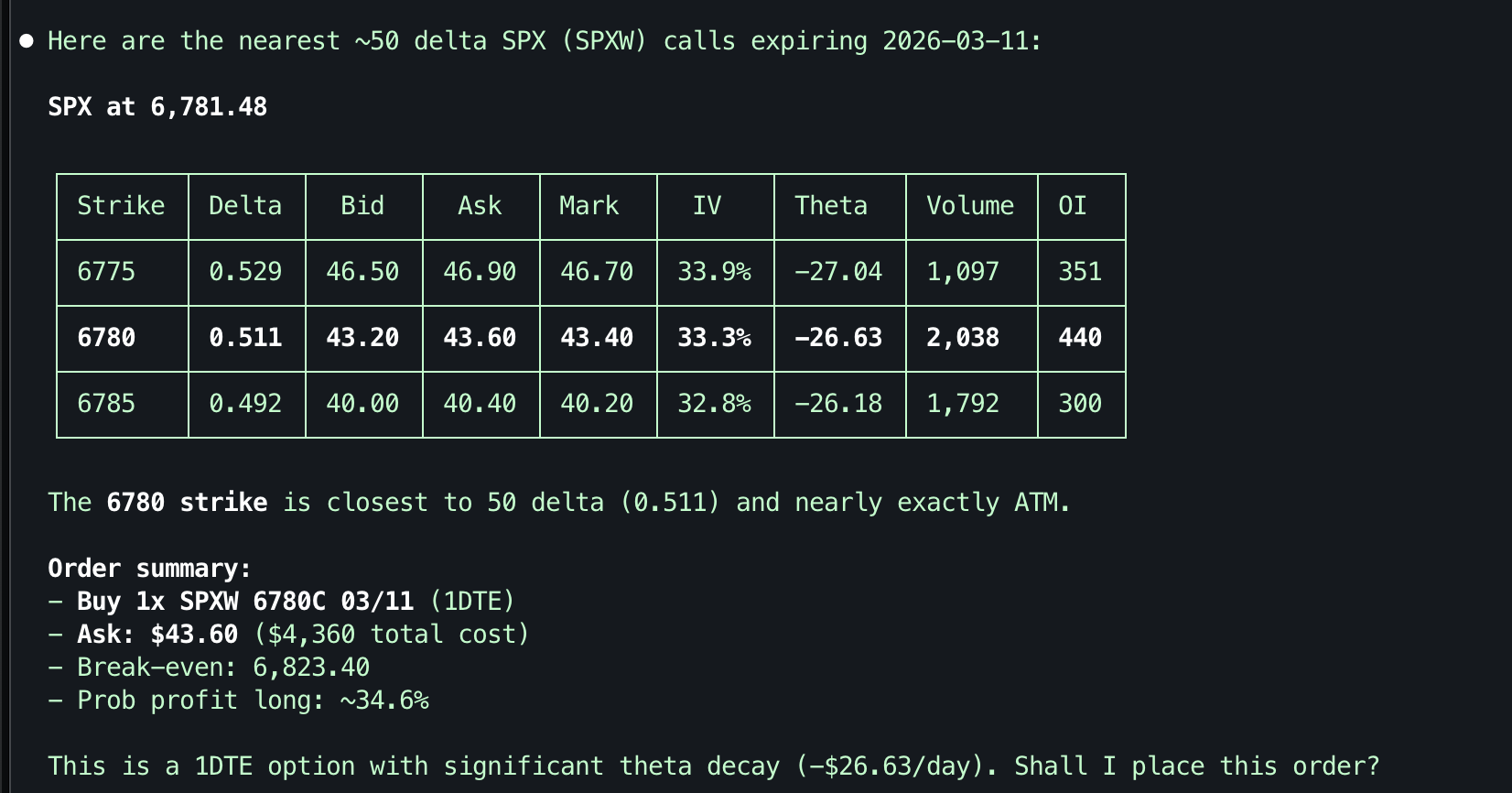
Authenticate
Start your agent and say "setup robinhood" (or call robinhood_browser_login directly). Chrome will open to the real Robinhood login page — log in with your credentials and MFA. The session is cached and auto-restores for ~24 hours.
MCP Tools (18)
All 18 tools work with every MCP-compatible agent.
| Tool | Description |
|---|---|
robinhood_browser_login | Authenticate via Chrome browser |
robinhood_check_session | Check if cached session is valid |
robinhood_get_portfolio | Portfolio: positions, P&L, equity, cash |
robinhood_get_accounts | List all brokerage accounts |
robinhood_get_account | Account details and profile |
robinhood_get_stock_quote | Stock quotes and fundamentals |
robinhood_get_historicals | OHLCV price history |
robinhood_get_news | News, analyst ratings, earnings |
robinhood_get_movers | Market movers and popular stocks |
robinhood_get_options | Options chain with greeks |
robinhood_get_crypto | Crypto quotes, history, positions |
robinhood_place_stock_order | Place stock orders (market/limit/stop/trailing) |
robinhood_place_option_order | Place option orders |
robinhood_place_crypto_order | Place crypto orders |
robinhood_get_orders | View order history |
robinhood_cancel_order | Cancel an order by ID |
robinhood_get_order_status | Get status of a specific order by ID |
robinhood_search | Search stocks or browse categories |
Skill
A single unified skill (robinhood-for-agents) provides guided workflows for auth, portfolio, research, trading, and options. Available on ClawHub and supported by Claude Code and OpenClaw.
# Install via ClawHub
clawhub install robinhood-for-agents
| Domain | Example Triggers |
|---|---|
| Setup | "setup robinhood", "connect to robinhood" |
| Portfolio | "show my portfolio", "my holdings" |
| Research | "research AAPL", "analyze TSLA" |
| Trading | "buy 10 AAPL", "sell my position" |
| Options | "show AAPL options", "SPX calls" |
Dual-mode: The skill works with MCP tools (Claude Code) or standalone via the TypeScript client API and bun (OpenClaw, any agent with shell access). No MCP server required.
The skill uses progressive disclosure — SKILL.md is the compact router, with domain-specific files (portfolio.md, trade.md, etc.) and a full client-api.md reference loaded on demand.
Agent Compatibility
| Feature | Claude Code | Codex | OpenClaw | Other MCP |
|---|---|---|---|---|
| 18 MCP tools | Yes | Yes | — | Yes |
| Trading skill | Yes | — | Yes | — |
| ClawHub install | — | — | Yes | — |
onboard setup | Yes | Yes | Yes | — |
| Browser auth | Yes | Yes | Yes | Yes |
Client Library (standalone)
import { RobinhoodClient } from "robinhood-for-agents";

const client = new RobinhoodClient();
await client.restoreSession();

const quotes = await client.getQuotes("AAPL");
const portfolio = await client.buildHoldings();
Safety
- Tokens are never exposed to the AI agent — authentication is handled entirely within the MCP server process; the agent only sees tool results, never access tokens or credentials
- Fund transfers and bank operations are blocked — never exposed
- Bulk cancel operations are blocked
- All order placements require explicit parameters (no dangerous defaults)
- Skills always confirm with the user before placing orders
- See ACCESS_CONTROLS.md for the full risk matrix
Authentication
MCP: Call robinhood_browser_login to open Chrome and log in (works with all agents). After that, all tools auto-restore the cached session.
Skills: Say "setup robinhood" to trigger the guided browser login (Claude Code and OpenClaw).
Full Auth Flow
┌─────────────────────────────────────────────────────────────────────────┐
│                                                                         │
│  robinhood_browser_login              restoreSession()                  │
│  (first-time / expired)               (every tool call)                │
│          │                                    │                         │
│          ▼                                    ▼                         │
│  ┌───────────────────┐               loadTokens()                      │
│  │ Playwright launches│               Bun.secrets.get() from           │
│  │ system Chrome      │               OS keychain                      │
│  │ (headless: false)  │               (macOS Keychain Services)        │
│  └────────┬──────────┘                        │                        │
│           │                                   │                         │
│           ▼                                   ▼                         │
│  ┌───────────────────┐               Set Authorization header          │
│  │ Navigate to        │               Validate: GET /positions/        │
│  │ robinhood.com/login│                       │                         │
│  └────────┬──────────┘                  ┌─────┴─────┐                  │
│           │                           Valid?      Invalid?             │
│           ▼                             │           │                   │
│  ┌───────────────────┐            return        ┌──┘                   │
│  │ User logs in       │           "cached"       │                      │
│  │ (email, password,  │                          ▼                      │
│  │  MFA push/SMS)     │              POST /oauth2/token/               │
│  └────────┬──────────┘              (grant_type: refresh_token,        │
│           │                          expires_in: 734000)               │
│           ▼                                 │                           │
│  ┌───────────────────────────┐       ┌──────┴──────┐                   │
│  │ Robinhood frontend calls   │    Success?      Failure?             │
│  │ POST /oauth2/token         │       │              │                  │
│  │                            │  saveTokens()     throw                │
│  │ Playwright intercepts:     │  return          AuthError             │
│  │  request  → device_token   │  "refreshed"     "Use browser_login"  │
│  │  response → access_token,  │                                        │
│  │             refresh_token   │                                        │
│  └────────┬──────────────────┘                                         │
│           │                                                             │
│           ▼                                                             │
│  saveTokens() ──► token-store.ts                                       │
│           │       Bun.secrets.set() → OS keychain                      │
│           │       (tokens never written to disk)                       │
│           │                                                            │
│           │                                                             │
│           ▼                                                             │
│  restoreSession() ──► client ready                                     │
│  getAccountProfile() → account_hint                                    │
│  Close browser                                                         │
│                                                                         │
└─────────────────────────────────────────────────────────────────────────┘
The left path is the initial login (browser-based, user-interactive). The right path is the session restore (automatic, every tool call). When the cached access token is invalid, it attempts a silent refresh using the stored refresh_token (with expires_in: 734000 ~8.5 days). If refresh also fails, the user is directed back to browser login.
Why Browser-Based Auth
The browser login is purely passive — Playwright never clicks buttons, fills forms, or predicts the login flow. It opens a real Chrome window, the user completes login entirely on their own (including whatever MFA Robinhood requires), and Playwright only intercepts the network traffic:
page.on("request")capturesdevice_tokenfrom POST body to/oauth2/tokenpage.on("response")capturesaccess_token+refresh_tokenfrom the 200 response
This design is resilient to Robinhood UI changes — it doesn't depend on any DOM selectors, page structure, or login step ordering. As long as the OAuth token endpoint exists, the interception works. playwright-core is used (not playwright) so no browser binary is bundled — it drives the user's system Chrome.
Encrypted Token Storage
┌─ token-store.ts ──────────────────────────────────────────────────┐
│                                                                    │
│  SAVE                                                              │
│  ────                                                              │
│  TokenData (JSON):                                                 │
│  {access_token, refresh_token, token_type, device_token, saved_at} │
│         │                                                          │
│         ▼                                                          │
│  JSON.stringify()                                                  │
│         │                                                          │
│         ▼                                                          │
│  Bun.secrets.set("robinhood-for-agents", "session-tokens", json)         │
│  → OS encrypts and stores in keychain                              │
│  → No file written to disk                                         │
│                                                                    │
│                                                                    │
│  LOAD                                                              │
│  ────                                                              │
│  Bun.secrets.get("robinhood-for-agents", "session-tokens")               │
│         │                                                          │
│         ▼                                                          │
│  JSON.parse() → TokenData                                          │
│                                                                    │
│                                                                    │
│  STORAGE                                                           │
│  ───────                                                           │
│  OS Keychain via Bun.secrets (no plaintext fallback)               │
│  ├── macOS: Keychain Services                                      │
│  ├── Linux: libsecret (GNOME Keyring, KWallet)                    │
│  └── Windows: Credential Manager                                   │
│  Tokens never touch the filesystem.                                │
└────────────────────────────────────────────────────────────────────┘
Bun.secrets stores tokens directly in the OS keychain — no intermediate encryption layer needed since the keychain itself provides encryption, access control, and tamper resistance. There is no plaintext fallback; Bun.secrets is required.
Critically, the AI agent never sees authentication tokens. Token storage and HTTP authorization happen entirely within the MCP server process. The agent only receives structured tool results (quotes, positions, order confirmations) — never raw tokens, headers, or credentials. Even if the agent's conversation is logged or leaked, no secrets are exposed.
Development
bun install                    # Install deps
bun run typecheck              # tsc --noEmit
bun run check                  # Biome lint + format
npx vitest run                 # Run all tests
Architecture
See docs/ARCHITECTURE.md for full system design, authentication flow, HTTP pipeline, and exception hierarchy.
Contributing
See docs/CONTRIBUTING.md for how to add new tools, create skills, and run tests.
Disclaimer
This project is not affiliated with, endorsed by, or sponsored by Robinhood Markets, Inc. "Robinhood" is a trademark of Robinhood Markets, Inc. This software interacts with Robinhood's services through publicly accessible interfaces but is an independent, third-party tool.
USE AT YOUR OWN RISK. This software enables AI agents to read data from and place orders on your Robinhood brokerage account. Automated and AI-assisted trading carries inherent risks, including but not limited to:
- Unintended order execution due to AI misinterpretation
- Financial losses from erroneous trades
- Stale or inaccurate market data
- Software bugs or unexpected behavior
You are solely responsible for all activity on your brokerage account, whether initiated manually or through this software. The authors and contributors assume no liability for any financial losses, damages, or other consequences arising from the use of this software. Review all AI-proposed actions before confirming, and never grant unsupervised trading authority to any automated system.
This software is provided "as is" without warranty of any kind. See LICENSE for full terms.
License
MIT — see LICENSE.