Scraper MCP



A context-optimized MCP server for web scraping. Reduces LLM token usage by 70-90% through server-side HTML filtering, markdown conversion, and CSS selector targeting.
Quick Start
# Run with Docker (GitHub Container Registry)
docker run -d -p 8000:8000 --name scraper-mcp ghcr.io/cotdp/scraper-mcp:latest

# Add to Claude Code
claude mcp add --transport http scraper http://localhost:8000/mcp --scope user
Try it:
> scrape https://example.com
> scrape and filter .article-content from https://blog.example.com/post
Endpoints:
- MCP:
http://localhost:8000/mcp - Dashboard:
http://localhost:8000/
Features
Web Scraping
- 4 scraping modes: Raw HTML, markdown, plain text, link extraction
- JavaScript rendering: Optional Playwright-based rendering for SPAs and dynamic content
- CSS selector filtering: Extract only relevant content server-side
- Batch operations: Process multiple URLs concurrently
- Smart caching: Three-tier cache system (realtime/default/static)
- Retry logic: Exponential backoff for transient failures
Perplexity AI Integration
- Web search: AI-powered search with citations (
perplexitytool) - Reasoning: Complex analysis with step-by-step reasoning (
perplexity_reasontool) - Requires
PERPLEXITY_API_KEYenvironment variable
Monitoring Dashboard
- Real-time request statistics and cache metrics
- Interactive API playground for testing tools
- Runtime configuration without restarts
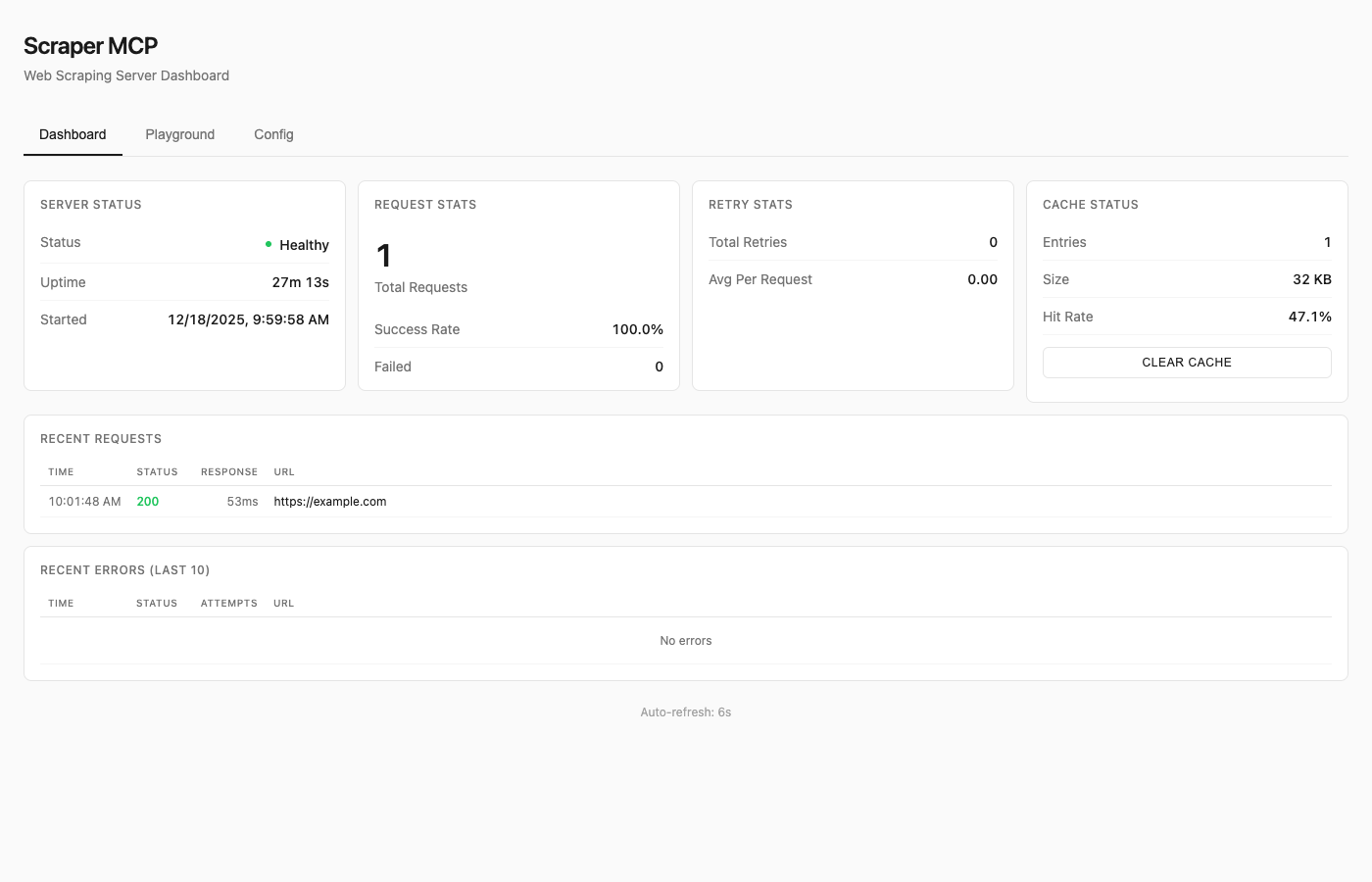
See Dashboard Guide for details.
Available Tools
| Tool | Description |
|---|---|
scrape_url | HTML converted to markdown (best for LLMs) |
scrape_url_html | Raw HTML content |
scrape_url_text | Plain text extraction |
scrape_extract_links | Extract all links with metadata |
perplexity | AI web search with citations |
perplexity_reason | Complex reasoning tasks |
All tools support:
- Single URL or batch operations (pass array)
timeoutandmax_retriesparameterscss_selectorfor targeted extractionrender_jsfor JavaScript rendering (SPAs, dynamic content)
Resources
Note: Resources are disabled by default to reduce context overhead. Enable with
--enable-resourcesflag orENABLE_RESOURCES=trueenvironment variable.
MCP resources provide read-only data access via URI-based addressing:
| URI | Description |
|---|---|
cache://stats | Cache hit rate, size, entry counts |
cache://requests | List of recent request IDs |
cache://request/{id} | Retrieve cached result by ID |
config://current | Current runtime configuration |
config://scraping | Timeout, retries, concurrency |
server://info | Version, uptime, capabilities |
server://metrics | Request counts, success rates |
Prompts
Note: Prompts are disabled by default to reduce context overhead. Enable with
--enable-promptsflag orENABLE_PROMPTS=trueenvironment variable.
MCP prompts provide reusable workflow templates:
| Prompt | Description |
|---|---|
analyze_webpage | Structured webpage analysis |
summarize_content | Generate content summaries |
extract_data | Extract specific data types |
seo_audit | Comprehensive SEO check |
link_audit | Analyze internal/external links |
research_topic | Multi-source research |
fact_check | Verify claims across sources |
See API Reference for complete documentation.
JavaScript Rendering
For SPAs (React, Vue, Angular) and pages with dynamic content, enable JavaScript rendering:
# Enable JS rendering with render_js=True
scrape_url(["https://spa-example.com"], render_js=True)

# Combine with CSS selector for targeted extraction
scrape_url(["https://react-app.com"], render_js=True, css_selector=".main-content")
When to use render_js=True:
- Single-page applications (SPAs) - React, Vue, Angular, etc.
- Sites with lazy-loaded content
- Pages requiring JavaScript execution
- Dynamic content loaded via AJAX/fetch
When NOT needed:
- Static HTML pages (most blogs, news sites, documentation)
- Server-rendered content
- Simple websites without JavaScript dependencies
How it works:
- Uses Playwright with headless Chromium
- Single browser instance with pooled contexts (~300MB base + 10-20MB per context)
- Lazy initialization (browser only starts when first JS render is requested)
- Semaphore-controlled concurrency (default: 5 concurrent contexts)
Memory considerations:
- Base requests provider: ~50MB
- With Playwright active: ~300-500MB depending on concurrent contexts
- Recommend minimum 1GB container memory when using JS rendering
Testing JS rendering:
Use the dashboard playground at http://localhost:8000/ to test JavaScript rendering interactively with the toggle switch.
Docker Deployment
Quick Run
# Using GitHub Container Registry (recommended)
docker run -d -p 8000:8000 --name scraper-mcp ghcr.io/cotdp/scraper-mcp:latest

# With JavaScript rendering (requires more memory)
docker run -d -p 8000:8000 --memory=1g --name scraper-mcp ghcr.io/cotdp/scraper-mcp:latest

# With Perplexity AI
docker run -d -p 8000:8000 -e PERPLEXITY_API_KEY=your_key ghcr.io/cotdp/scraper-mcp:latest
Docker Compose
For persistent storage and custom configuration:
# docker-compose.yml
services:
  scraper-mcp:
    image: ghcr.io/cotdp/scraper-mcp:latest
    ports:
      - "8000:8000"
    volumes:
      - cache:/app/cache
    environment:
      - PERPLEXITY_API_KEY=${PERPLEXITY_API_KEY:-}
      - PLAYWRIGHT_MAX_CONTEXTS=5
    deploy:
      resources:
        limits:
          memory: 1G  # Recommended for JS rendering
    restart: unless-stopped

volumes:
  cache:
docker-compose up -d
Production deployment (pre-built image from GHCR):
docker-compose -f docker-compose.prod.yml up -d
Upgrading
To upgrade an existing deployment to the latest version:
# Pull the latest image
docker pull ghcr.io/cotdp/scraper-mcp:latest

# Restart with new image (docker-compose)
docker-compose down && docker-compose up -d

# Or for production deployments
docker-compose -f docker-compose.prod.yml pull
docker-compose -f docker-compose.prod.yml up -d

# Or restart a standalone container
docker stop scraper-mcp && docker rm scraper-mcp
docker run -d -p 8000:8000 --name scraper-mcp ghcr.io/cotdp/scraper-mcp:latest
Your cache data persists in the named volume across upgrades.
Available Tags
| Tag | Description |
|---|---|
latest | Latest stable release |
main | Latest build from main branch |
v0.4.0 | Specific version |
Configuration
Create a .env file for custom settings:
# Perplexity AI (optional)
PERPLEXITY_API_KEY=your_key_here

# JavaScript rendering (optional, requires Playwright)
PLAYWRIGHT_MAX_CONTEXTS=5       # Max concurrent browser contexts
PLAYWRIGHT_TIMEOUT=30000        # Page load timeout in ms
PLAYWRIGHT_DISABLE_GPU=true     # Reduce memory in containers

# MCP features (disabled by default to reduce context overhead)
ENABLE_RESOURCES=true           # Enable MCP resources
ENABLE_PROMPTS=true             # Enable MCP prompts

# Proxy (optional)
HTTP_PROXY=http://proxy.example.com:8080
HTTPS_PROXY=http://proxy.example.com:8080

# ScrapeOps proxy service (optional)
SCRAPEOPS_API_KEY=your_key_here
SCRAPEOPS_RENDER_JS=true
See Configuration Guide for all options.
Claude Desktop
Add to your MCP settings:
{
  "mcpServers": {
    "scraper": {
      "url": "http://localhost:8000/mcp"
    }
  }
}
Claude Code Skills
This project includes Agent Skills that provide Claude Code with specialized knowledge for using the scraper tools effectively.
| Skill | Description |
|---|---|
| web-scraping | CSS selectors, batch operations, retry configuration |
| perplexity | AI search, reasoning tasks, conversation patterns |
Install Skills
Copy the skills to your Claude Code skills directory:
# Clone or download this repo, then:
cp -r .claude/skills/web-scraping ~/.claude/skills/
cp -r .claude/skills/perplexity ~/.claude/skills/
Or install directly:
# web-scraping skill
mkdir -p ~/.claude/skills/web-scraping
curl -o ~/.claude/skills/web-scraping/SKILL.md \
  https://raw.githubusercontent.com/cotdp/scraper-mcp/main/.claude/skills/web-scraping/SKILL.md

# perplexity skill
mkdir -p ~/.claude/skills/perplexity
curl -o ~/.claude/skills/perplexity/SKILL.md \
  https://raw.githubusercontent.com/cotdp/scraper-mcp/main/.claude/skills/perplexity/SKILL.md
Once installed, Claude Code will automatically use these skills when performing web scraping or Perplexity AI tasks.
Documentation
| Document | Description |
|---|---|
| API Reference | Complete tool documentation, parameters, CSS selectors |
| Configuration | Environment variables, proxy setup, ScrapeOps |
| Dashboard | Monitoring UI, playground, runtime config |
| Development | Local setup, architecture, contributing |
| Testing | Test suite, coverage, adding tests |
Local Development
# Install
uv pip install -e ".[dev]"

# Run
python -m scraper_mcp

# Test
pytest

# Lint
ruff check . && mypy src/
See Development Guide for details.
License
MIT License
Last updated: December 23, 2025