Stacklit
108,000 lines of code. 4,000 tokens of index.
One command makes any repo AI-agent-ready. No server, no setup.


Install and run
npx stacklit init
That is it. Downloads the binary, scans your codebase, generates the index, opens the visual map. One command.
Other install options:
npm install -g stacklit              # install globally, then run: stacklit init
go install github.com/glincker/stacklit/cmd/stacklit@latest
Or grab a binary from GitHub Releases (macOS, Linux, Windows).

What happens when you run it
$ stacklit init
[stacklit] found 342 files
[stacklit] parsed 342 files (0 errors)
[stacklit] done in 89ms -- wrote stacklit.json, DEPENDENCIES.md, stacklit.html

Opening visual map...
Three files appear in your project:
| File | What it is | Commit it? |
|---|---|---|
stacklit.json | Codebase index for AI agents | Yes |
DEPENDENCIES.md | Mermaid dependency diagram | Yes (renders on GitHub) |
stacklit.html | Interactive visual map (4 views) | No (gitignored, regenerates) |
git add stacklit.json DEPENDENCIES.md
git commit -m "add stacklit codebase index"
Done. Every AI agent that opens this repo can now read stacklit.json instead of scanning files.
Why
AI coding agents burn most of their context window figuring out where things live. Reading one large file to find a function signature costs thousands of tokens. Five agents on the same repo each rebuild the same mental model from scratch.
Without stacklit: Agent reads 8-12 files. ~400,000 tokens. 45 seconds before writing a line.
With stacklit: Agent reads stacklit.json. ~4,000 tokens. Knows the structure instantly.
Token efficiency (measured on real projects)
| Project | Language | Lines of code | Index tokens |
|---|---|---|---|
| Express.js | JavaScript | 21,346 | 3,765 |
| FastAPI | Python | 108,075 | 4,142 |
| Gin | Go | 23,829 | 3,361 |
| Axum | Rust | 43,997 | 14,371 |
See examples/ for full outputs.
What is in stacklit.json
{
  "modules": {
    "src/auth": {
      "purpose": "Authentication and session management",
      "files": 8, "lines": 1200,
      "exports": ["AuthProvider", "useSession()", "loginAction()"],
      "depends_on": ["src/db", "src/config"],
      "activity": "high"
    }
  },
  "hints": {
    "add_feature": "Create handler in src/api/, add route in src/index.ts",
    "test_command": "npm test"
  }
}
Modules, dependencies, exports with signatures, type definitions, git activity heatmap, framework detection, and hints for where to add features and how to run tests.
Set up your AI tools
One command (recommended)
stacklit setup
Auto-detects Claude Code, Cursor, and Aider. For each:
- Injects a compact ~250-token codebase map into the tool's config file
- Configures MCP server integration
- Installs a git hook to keep the map fresh on every commit
Or configure a specific tool:
stacklit setup claude   # updates CLAUDE.md + .mcp.json
stacklit setup cursor   # updates .cursorrules + .cursor/mcp.json
stacklit setup aider    # updates .aider.conf.yml
Compact navigation map
stacklit derive # print to stdout
Generates a ~250-token navigation map that replaces 3,000-8,000 tokens of agent exploration:
myapp | go | 14 modules | 8,420 lines
entry: cmd/api/main.go | test: go test ./...

modules:
  cmd/api/          entrypoint, routes, middleware
  internal/auth/    jwt, session | depends: store, config
  internal/store/   postgres | depended-by: auth, handler
Manual setup
Configure manually instead
Claude Code — add to CLAUDE.md:
Read stacklit.json before exploring files. Use modules to locate code, hints for conventions.
Claude Desktop / Cursor (MCP) — add to MCP config:
{
  "mcpServers": {
    "stacklit": {
      "command": "stacklit",
      "args": ["serve"]
    }
  }
}
MCP server exposes 7 tools: get_overview, get_module, find_module, list_modules, get_dependencies, get_hot_files, get_hints.
Any other agent — stacklit.json is a plain JSON file. Any tool that reads files can use it.
Keep it updated
stacklit init --hook
Installs a git hook that regenerates the index on every commit. Uses Merkle hashing to skip regeneration when only docs or configs changed.
Other ways to keep it fresh:
stacklit generate          # manual regeneration
stacklit generate --quiet  # silent (for scripts/CI)
stacklit diff              # check if the index is stale
GitHub Action for auto-updates
name: Update stacklit index
on:
  push:
    branches: [main]
    paths-ignore: ['stacklit.json', 'DEPENDENCIES.md', '**.md']

jobs:
  stacklit:
    runs-on: ubuntu-latest
    steps:
      - uses: actions/checkout@v4
      - uses: actions/setup-go@v5
        with:
          go-version: '1.25'
      - run: go install github.com/glincker/stacklit/cmd/stacklit@latest
      - run: stacklit generate --quiet
      - uses: stefanzweifel/git-auto-commit-action@v5
        with:
          commit_message: "chore: update stacklit index"
          file_pattern: "stacklit.json DEPENDENCIES.md"
Visual map
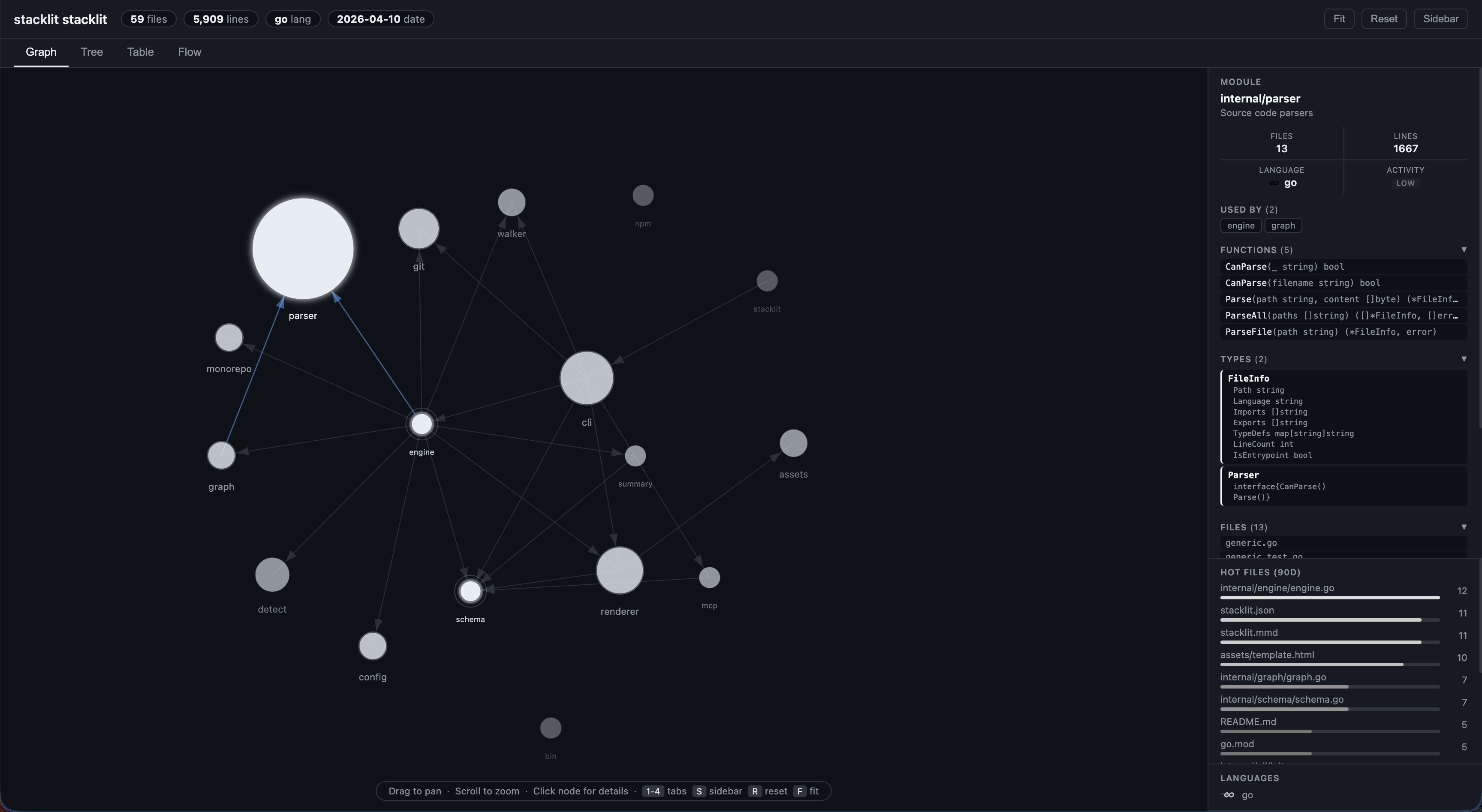
stacklit view opens the interactive HTML. Four views:
- Graph -- Force-directed dependency map. Click a node to see exports, types, files.
- Tree -- Collapsible directory hierarchy with file and line counts.
- Table -- Sortable module table with search filter.
- Flow -- Top-down dependency flow from entrypoints to leaves.
11 languages via tree-sitter
| Language | Extracts |
|---|---|
| Go | imports, exports with signatures, struct fields, interface methods |
| TypeScript/JS | imports (ESM, CJS, dynamic), classes, interfaces, type aliases |
| Python | imports, classes with methods, type hints, decorators |
| Rust | use/mod/crate, pub items with generics, trait methods |
| Java | imports, public classes, method signatures with types |
| C# | using directives, public types, method signatures |
| Ruby | require, classes, modules, methods |
| PHP | namespace use, classes, traits, public methods |
| Kotlin | imports, classes, objects, functions |
| Swift | imports, structs, classes, protocols |
| C/C++ | includes, functions, structs, typedefs |
Any other language gets basic support (line count + language detection).
All CLI commands
stacklit init                    # scan, generate, open HTML
stacklit init --hook             # also install git post-commit hook
stacklit init --multi repos.txt  # polyrepo: scan multiple repos
stacklit generate                # regenerate from current source
stacklit view                    # regenerate HTML, open in browser
stacklit diff                    # check if index is stale
stacklit serve                   # start MCP server
stacklit derive                  # print compact nav map (~250 tokens)
stacklit derive --inject claude  # inject map into CLAUDE.md
stacklit setup                   # auto-configure all detected AI tools
stacklit setup claude            # configure Claude Code + MCP
stacklit setup cursor            # configure Cursor + MCP
Configuration (stacklit.toml)
ignore = ["vendor/", "generated/"]
max_depth = 3

[output]
json = "stacklit.json"
mermaid = "DEPENDENCIES.md"
html = "stacklit.html"
Compared to alternatives
| Stacklit | Repomix | Aider repo-map | Codebase Memory MCP | |
|---|---|---|---|---|
| Output | ~4k token index | 500k+ token dump | Ephemeral text | SQLite DB |
| Committed to repo | Yes | Too large | No | No |
| Dependency graph | Yes | No | Yes | Yes |
| Visual output | HTML (4 views) | No | No | No |
| MCP server | Yes (7 tools) | No | No | Yes |
| Monorepo aware | Yes | No | No | No |
| Languages | 11 (tree-sitter) | N/A | Many | 66 |
| Runtime needed | No | No | Yes (Python) | Yes (C server) |
Monorepo support
Auto-detects: pnpm, npm, yarn workspaces, Go workspaces, Turborepo, Nx, Lerna, Cargo workspaces, and convention directories (apps/, packages/, services/).
How does Stacklit compare to Repomix?
Repomix concatenates all files into one prompt (50k-500k tokens). Stacklit parses code structure and generates a ~250-token navigation map. Use Repomix for small repos and one-shot chats. Use Stacklit for daily AI-assisted development on larger codebases. See the full comparison table.
FAQ
Does Stacklit read my code?
Yes, locally. It parses source files with tree-sitter to extract structure (imports, exports, types). No code is sent anywhere unless you use the optional --summary flag (which calls the Claude API).
What if my language isn't supported? Stacklit falls back to basic support (line count + language detection) for any language not in the tree-sitter list. The module map, dependency graph, and git activity still work.
Does the git hook slow down commits? No. Stacklit uses Merkle hashing to skip regeneration when only docs or configs changed. On a 10k-line repo, regeneration takes ~50ms.
Can I use Stacklit with GitHub Copilot?
Yes. Run stacklit derive --inject claude and rename the output to .github/copilot-instructions.md, or just commit stacklit.json and reference it in your Copilot instructions.
Documentation
- USAGE.md -- full usage guide, command reference, MCP tools, configuration
- COMPARISON.md -- head-to-head comparison with Repomix, code2prompt, Codebase-Memory
- SKILL.md -- instructions for AI agents on how to use stacklit.json
- examples/ -- real stacklit.json outputs from Express.js, FastAPI, Gin, Axum
- Discussions -- guides, Q&A, feature requests
Contributing
make build   # build binary
make test    # run all tests
Contributions welcome. See open issues or start a discussion.
License
MIT