
SuperLocalMemory V3
Information-Geometric Agent Memory with Mathematical Guarantees
The first agent memory system with mathematically grounded retrieval, lifecycle management, and consistency verification. Four-channel hybrid retrieval. Three operating modes. EU AI Act compliant.









What is SuperLocalMemory?
SuperLocalMemory gives AI assistants persistent, structured memory that survives across sessions. Unlike simple vector stores, V3 uses information geometry to provide mathematically grounded retrieval, automatic contradiction detection, and self-organizing memory lifecycle management.
Works with: Claude, Cursor, Windsurf, VS Code Copilot, Continue, Cody, ChatGPT Desktop, Gemini CLI, JetBrains, Zed, and 17+ AI tools via MCP.
Upgrading from V2 (2.8.6)? V3 is a complete architectural reinvention — new mathematical engine, new retrieval pipeline, new storage schema. Your existing data is preserved but requires migration. After installing V3, run
slm migrateto upgrade your data. Read the Migration Guide before upgrading. Backup is created automatically.
Key Results
| Metric | Score | Context |
|---|---|---|
| LoCoMo (Mode C, full power) | 87.7% | On conv-30, 81 scored questions |
| LoCoMo (Mode A, zero-LLM) | 62.3% | Highest zero-LLM score. No cloud dependency. |
| Math layer improvement | +12.7pp | Average gain from mathematical foundations |
| Multi-hop improvement | +12pp | 50% vs 38% (math on vs off) |
Three Operating Modes
| Mode | What | LLM Required? | EU AI Act | Best For |
|---|---|---|---|---|
| A | Local Guardian | No | Compliant | Privacy-first, air-gapped, enterprise |
| B | Smart Local | Local only (Ollama) | Compliant | Enhanced quality, data stays local |
| C | Full Power | Cloud (optional) | Partial | Maximum accuracy, research |
Mode A is the only agent memory that operates with zero cloud dependency while achieving competitive retrieval accuracy. All data stays on your device. No API keys required.
Architecture
Query  ──►  Strategy Classifier  ──►  4 Parallel Channels:
                                       ├── Semantic (Fisher-Rao graduated similarity)
                                       ├── BM25 (keyword matching, k1=1.2, b=0.75)
                                       ├── Entity Graph (spreading activation, 3 hops)
                                       └── Temporal (date-aware retrieval)
                                                    │
                                       RRF Fusion (k=60)
                                                    │
                                       Scene Expansion + Bridge Discovery
                                                    │
                                       Cross-Encoder Reranking
                                                    │
                                       ◄── Top-K Results with channel scores
Mathematical Foundations (Novel Contributions)
-
Fisher-Rao Retrieval Metric — Similarity scoring derived from the Fisher information structure of diagonal Gaussian families. Graduated ramp from cosine to Fisher-information-weighted scoring over the first 10 accesses per memory.
-
Sheaf Cohomology for Consistency — Algebraic topology detects contradictions between facts by computing coboundary norms on the knowledge graph. Non-trivial restriction maps amplify disagreements along discriminative subspaces.
-
Riemannian Langevin Lifecycle — Memory positions evolve on the Poincare ball via a discretized Langevin SDE. Frequently accessed memories stay near the origin (ACTIVE); neglected memories diffuse toward the boundary (ARCHIVED). The potential is modulated by access frequency, age, and importance.
Prerequisites
| Requirement | Version | Why |
|---|---|---|
| Node.js | 14+ | npm package manager |
| Python | 3.11+ | V3 engine runtime |
| pip | Latest | Python dependency installer |
All Python dependencies are installed automatically during
npm install. You don't need to run pip manually. If any dependency fails, the installer shows clear instructions.
What Gets Installed Automatically
| Component | Size | When |
|---|---|---|
| Core math libraries (numpy, scipy, networkx) | ~50MB | During npm install |
| Search engine (sentence-transformers, einops, torch) | ~200MB | During npm install |
| Embedding model (nomic-ai/nomic-embed-text-v1.5) | ~500MB | On first use OR slm warmup |
If any dependency fails during install, the installer prints the exact pip install command to fix it. BM25 keyword search works even without embeddings — you're never fully blocked.
Quick Start
Install via npm (recommended — one command, everything included)
npm install -g superlocalmemory
This single command:
- Installs the V3 engine and CLI
- Auto-installs all Python dependencies (numpy, scipy, networkx, sentence-transformers, einops, torch, etc.)
- Creates the data directory at
~/.superlocalmemory/ - Detects and guides V2 migration if applicable
Then configure and pre-download the embedding model:
slm setup     # Choose mode, configure provider
slm warmup    # Pre-download embedding model (~500MB, optional)
First time? If you skip
slm warmup, the model downloads automatically on firstslm rememberorslm recall. Either way works.
Install via pip
pip install superlocalmemory
# or with all features:
pip install "superlocalmemory[full]"
First Use
# Store a memory
slm remember "Alice works at Google as a Staff Engineer"

# Recall
slm recall "What does Alice do?"

# Check status
slm status

# Switch modes
slm mode a   # Zero-LLM (default)
slm mode b   # Local Ollama
slm mode c   # Full power
MCP Integration (Claude, Cursor, etc.)
Add to your IDE's MCP config:
{
  "mcpServers": {
    "superlocalmemory": {
      "command": "slm",
      "args": ["mcp"]
    }
  }
}
24 MCP tools available: remember, recall, search, fetch, list_recent, get_status, build_graph, switch_profile, health, consistency_check, recall_trace, and more.
Web Dashboard (17 tabs)
slm dashboard # Opens at http://localhost:8765
Dashboard Screenshots (click to collapse)
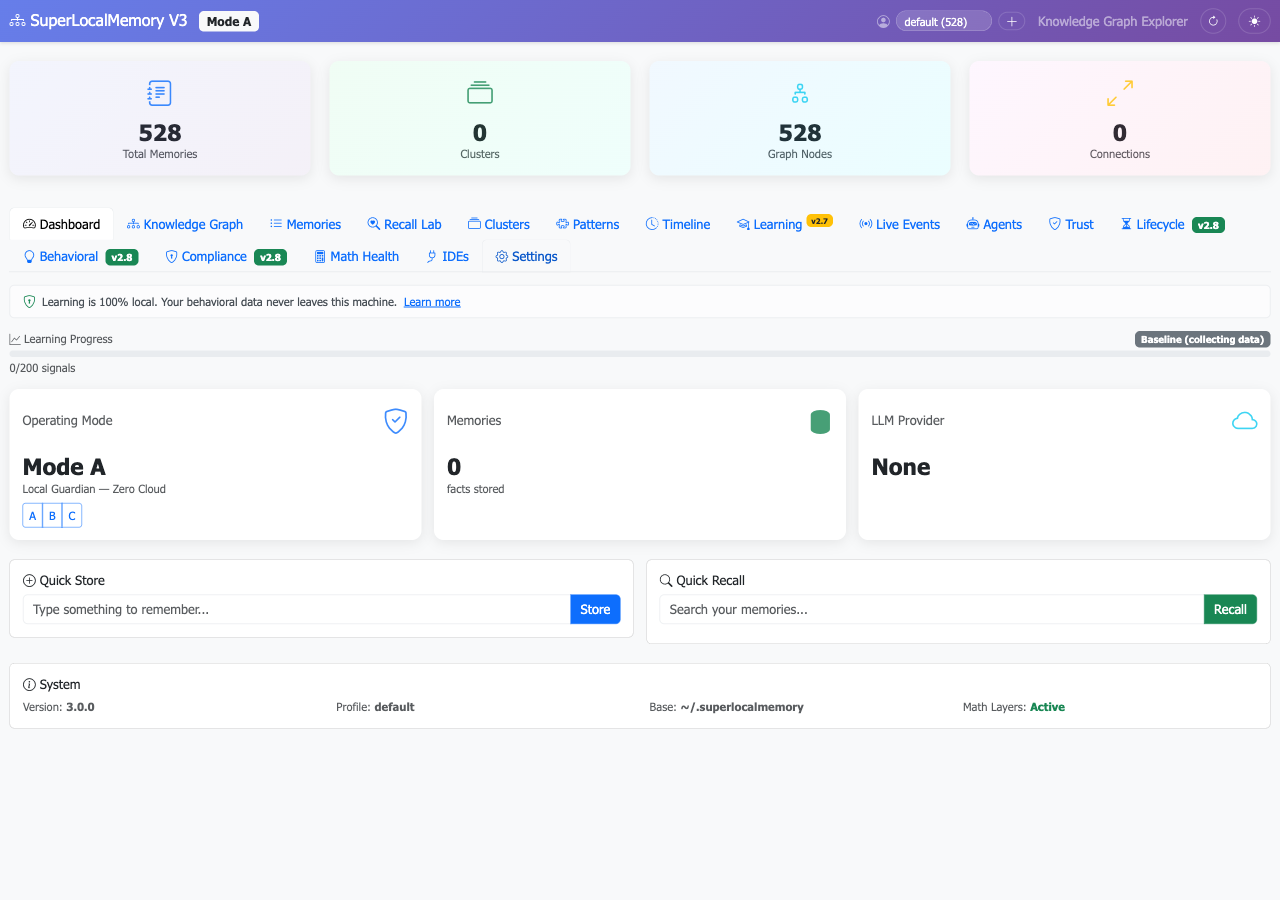
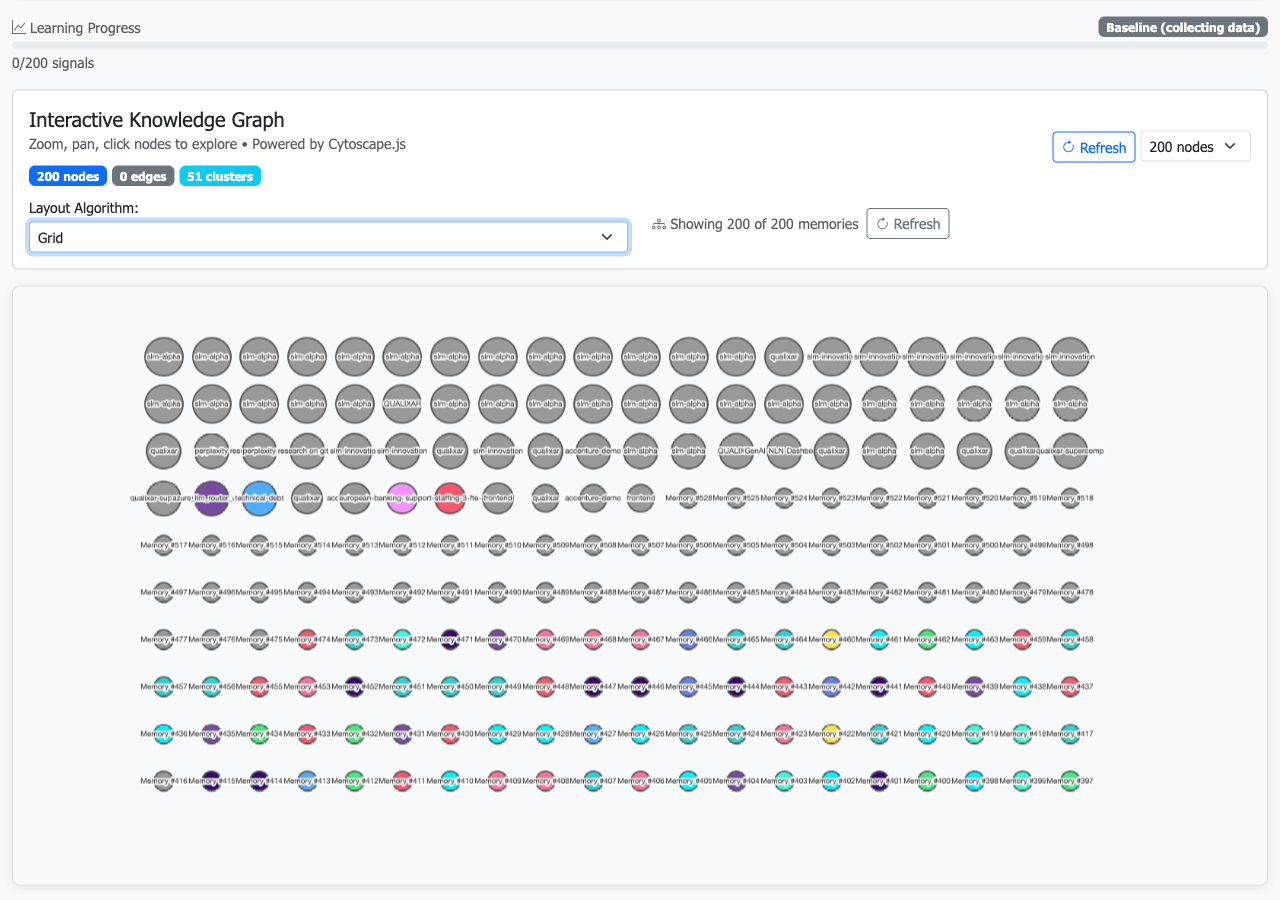
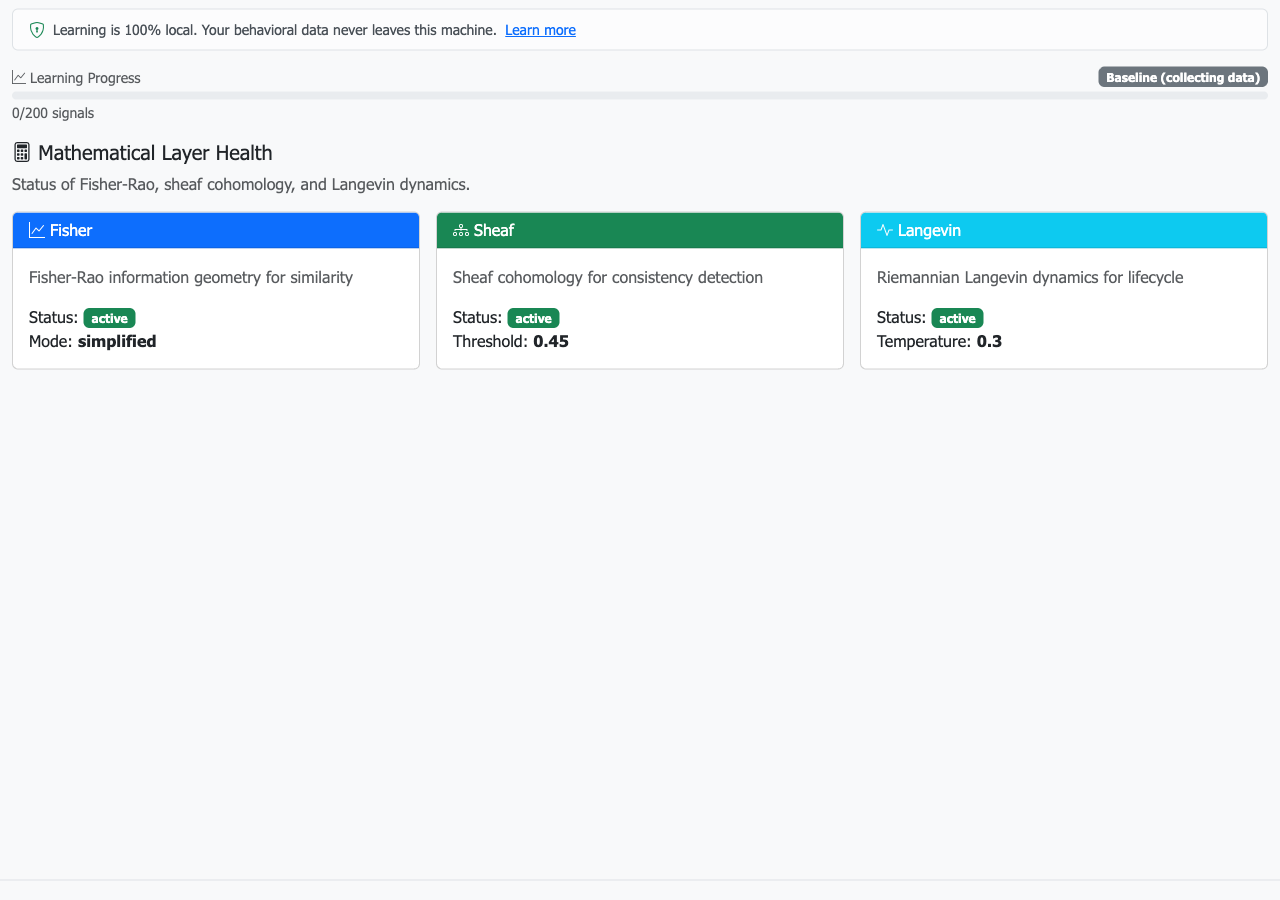
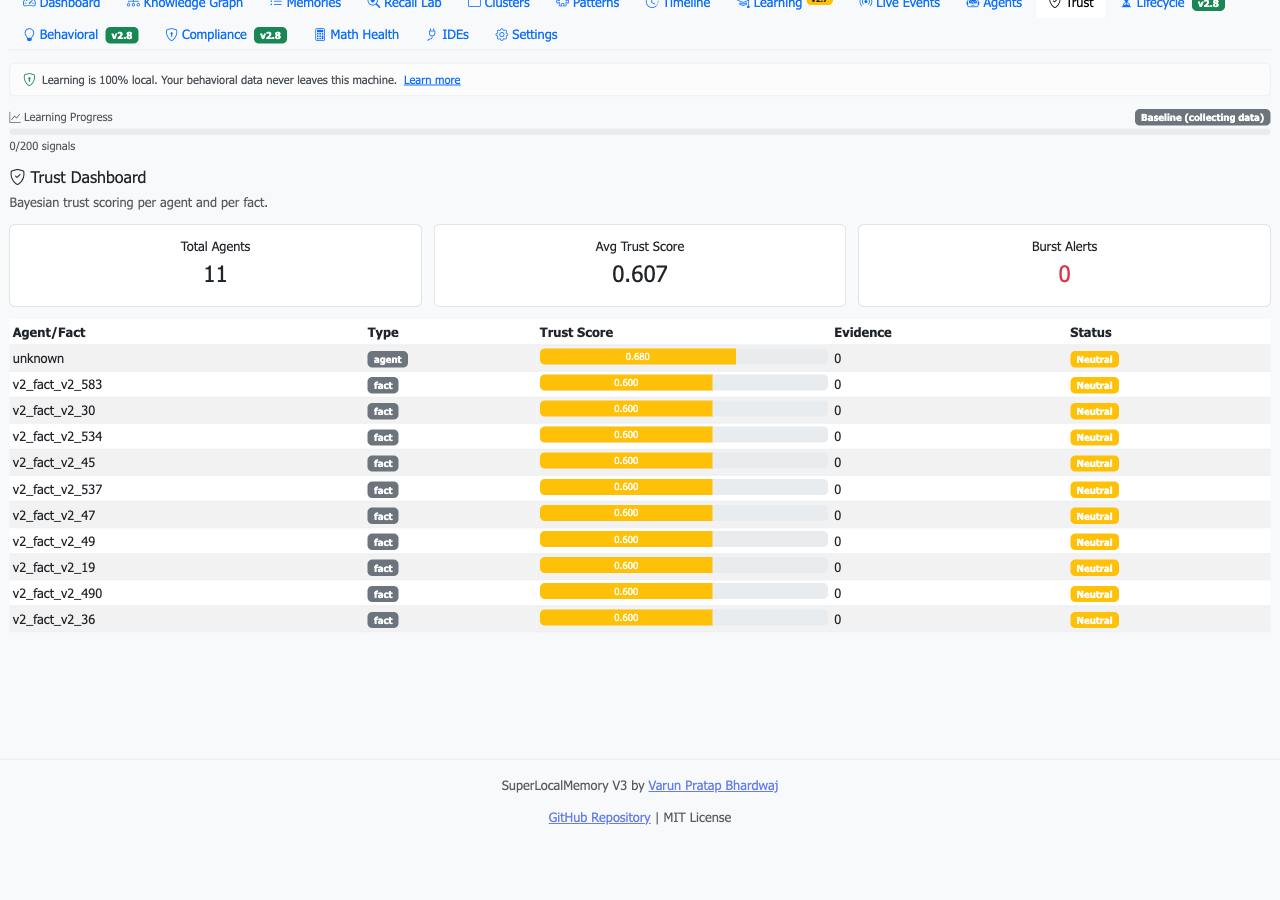
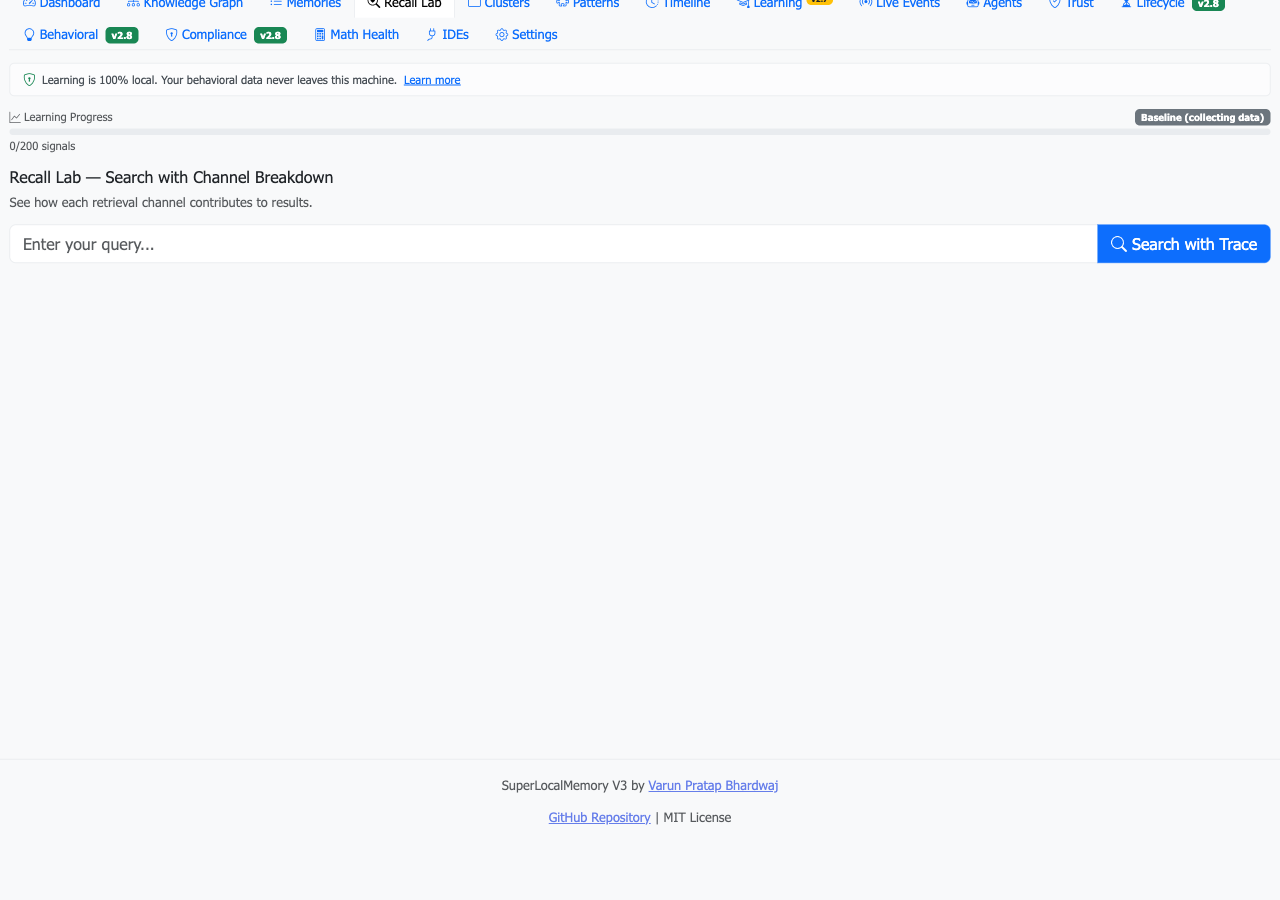
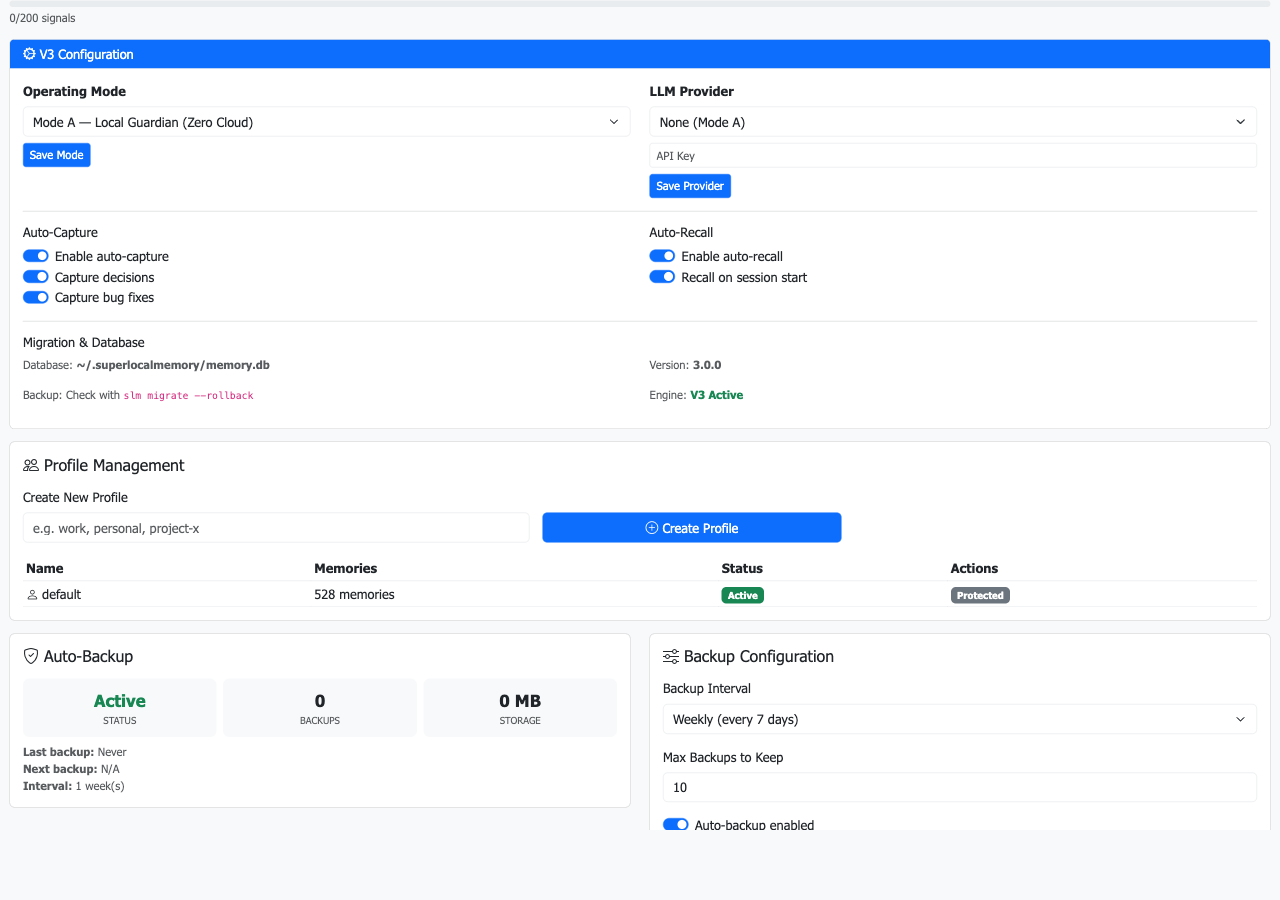
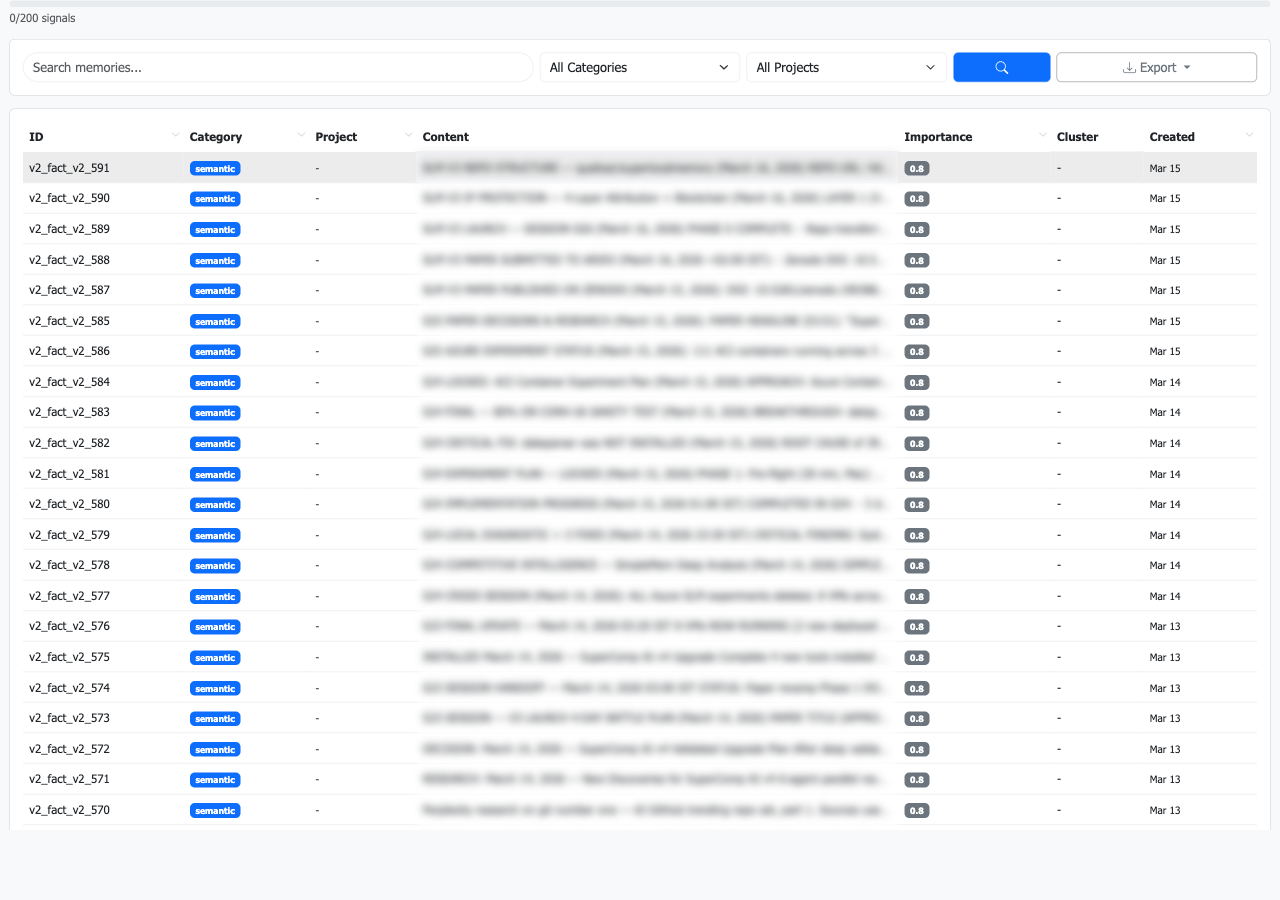
The V3 dashboard provides real-time visibility into your memory system:
- Dashboard — Mode switcher, health score, quick store/recall
- Recall Lab — Search with per-channel score breakdown (Semantic, BM25, Entity, Temporal)
- Knowledge Graph — Interactive entity relationship visualization
- Memories — Browse, search, and manage stored memories
- Trust Dashboard — Bayesian trust scores per agent with Beta distribution visualization
- Math Health — Fisher-Rao confidence, Sheaf consistency, Langevin lifecycle state
- Compliance — GDPR export/erasure, EU AI Act status, audit trail
- Learning — Adaptive ranking progress, behavioral patterns, outcome tracking
- IDE Connections — Connected AI tools status and configuration
- Settings — Mode, provider, auto-capture/recall configuration
The dashboard runs locally at
http://localhost:8765. No data leaves your machine.
V3 Engine Features
Retrieval (4-Channel Hybrid)
- Semantic similarity with Fisher-Rao information geometry
- BM25 keyword matching (persisted tokens, survives restart)
- Entity graph with spreading activation (3-hop, decay=0.7)
- Temporal date-aware retrieval with interval support
- RRF fusion (k=60) + cross-encoder reranking
Intelligence
- 11-step ingestion pipeline (entity resolution, fact extraction, emotional tagging, scene building, sheaf consistency)
- Adaptive learning with LightGBM-based ranking (3-phase bootstrap)
- Behavioral pattern detection (query habits, entity preferences, active hours)
- Outcome tracking for retrieval feedback loops
Trust & Compliance
- Bayesian Beta distribution trust scoring (per-agent, per-fact)
- Trust gates (block low-trust agents from writing/deleting)
- ABAC (Attribute-Based Access Control) with DB-persisted policies
- GDPR Article 15/17 compliance (full export + complete erasure)
- EU AI Act data sovereignty (Mode A: zero cloud, data stays local)
- Tamper-proof hash-chain audit trail (SHA-256 linked entries)
- Data provenance tracking (who created what, when, from where)
Infrastructure
- 17-tab web dashboard (trust visualization, math health, recall lab)
- 17+ IDE integrations with pre-built configs
- Profile isolation (16+ independent memory spaces)
- V2 to V3 migration tool (zero data loss, rollback support)
- Auto-capture and auto-recall hooks for Claude Code
Benchmarks
Evaluated on the LoCoMo benchmark (Long Conversation Memory):
Mode A Ablation (conv-30, 81 questions, zero-LLM)
| Configuration | Micro Avg | Multi-Hop | Open Domain |
|---|---|---|---|
| Full (all layers) | 62.3% | 50% | 78% |
| Math layers off | 59.3% | 38% | 70% |
| Entity channel off | 56.8% | 38% | 73% |
| BM25 channel off | 53.2% | 23% | 71% |
| Cross-encoder off | 31.8% | 17% | — |
Competitive Landscape
| System | Score | LLM Required | Open Source | EU AI Act |
|---|---|---|---|---|
| EverMemOS | 92.3% | Yes | No | No |
| MemMachine | 91.7% | Yes | No | No |
| Hindsight | 89.6% | Yes | No | No |
| SLM V3 Mode C | 87.7% | Optional | Yes | Partial |
| SLM V3 Mode A | 62.3% | No | Yes | Yes |
| Mem0 ($24M) | 34.2% F1 | Yes | Partial | No |
SLM V3 is the only system offering a fully local mode with mathematical guarantees and EU AI Act compliance.
Research Papers
V3: Information-Geometric Foundations
SuperLocalMemory V3: Information-Geometric Foundations for Zero-LLM Enterprise Agent Memory Varun Pratap Bhardwaj (2026) Zenodo DOI: 10.5281/zenodo.19038659
V2: Architecture & Engineering
SuperLocalMemory: A Structured Local Memory Architecture for Persistent AI Agent Context Varun Pratap Bhardwaj (2026) arXiv:2603.02240 | Zenodo DOI: 10.5281/zenodo.18709670
Project Structure
superlocalmemory/
├── src/superlocalmemory/     # Python package (17 sub-packages)
│   ├── core/                 # Engine, config, modes, profiles
│   ├── retrieval/            # 4-channel retrieval + fusion + reranking
│   ├── math/                 # Fisher-Rao, Sheaf, Langevin
│   ├── encoding/             # 11-step ingestion pipeline
│   ├── storage/              # SQLite with WAL, FTS5, migrations
│   ├── trust/                # Bayesian scoring, gates, provenance
│   ├── compliance/           # GDPR, EU AI Act, ABAC, audit chain
│   ├── learning/             # Adaptive ranking, behavioral patterns
│   ├── mcp/                  # MCP server (24 tools, 6 resources)
│   ├── cli/                  # CLI with setup wizard
│   └── server/               # Dashboard API + UI server
├── tests/                    # 1400+ tests
├── ui/                       # 17-tab web dashboard
├── ide/                      # IDE configs for 17+ tools
├── docs/                     # Documentation
└── pyproject.toml            # Modern Python packaging
Contributing
See CONTRIBUTING.md for guidelines.
License
MIT License. See LICENSE.
Attribution
Part of Qualixar | Author: Varun Pratap Bhardwaj
Built with mathematical rigor. Not in the race — here to help everyone build better AI memory systems.