Telegram Bridge MCP




No Claw? No Problem.
Anthropic restricted Claude Code's native instance API — but this bridge doesn't care. It's a standard Model Context Protocol server. Any IDE, any model, any agent framework that speaks MCP connects out of the box — no proprietary lock-in, no webhooks, no public URL required.
What Is This?
Telegram Bridge MCP connects AI assistants to Telegram bidirectionally. It lets any MCP-compatible client send messages, ask questions, receive voice replies, and run multiple concurrent agent sessions — all through a single bot you control.
Works with: VS Code (GitHub Copilot Chat), Claude Code, Cursor, Windsurf, Copilot CLI, and any MCP-compatible host.
Highlights
| Feature | Description |
|---|---|
| Two-way messaging | Text, Markdown, files, voice notes |
| Interactive controls | Inline buttons, confirmations, questions |
| Super tools | Self-pinning checklists and emoji progress bars that update in-place |
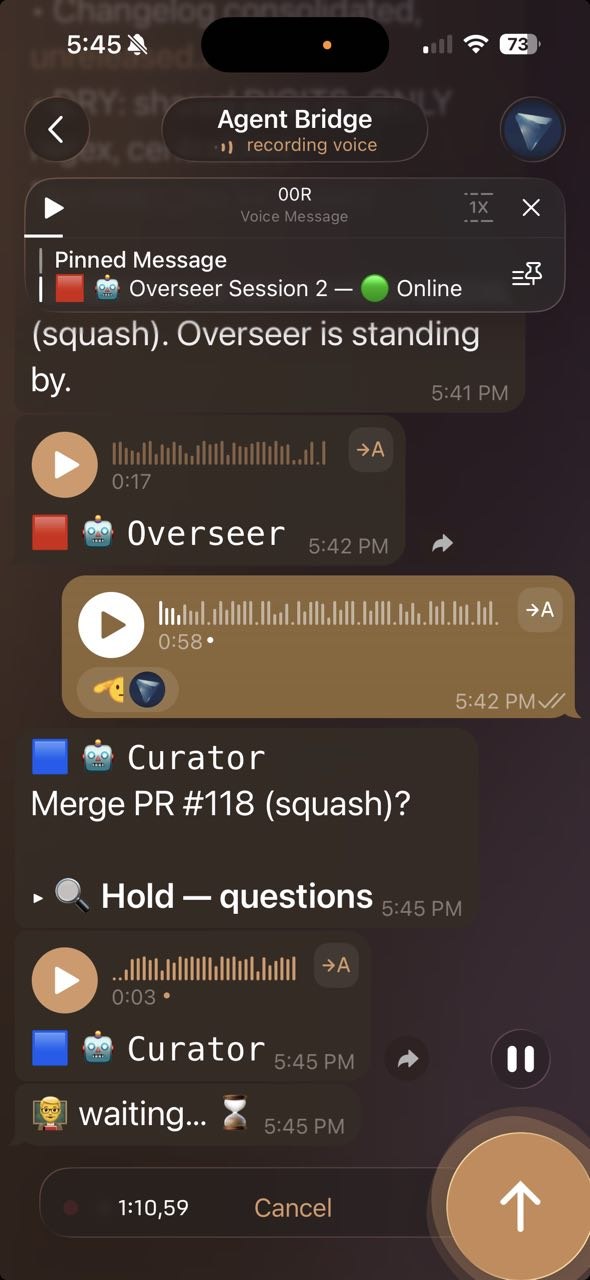
| Voice | Auto-transcription (bundled Whisper ONNX, no ffmpeg) + TTS (local Kokoro, OpenAI, or bundled ONNX) |
| Multi-session | Multiple agents share one bot with isolated queues, token auth, and color identity |
| Animations | Cycling status frames while your agent works |
| Reminders | Scheduled synthetic events delivered via dequeue |
| Slash commands | Dynamic bot menu; commands arrive as structured events |
| No webhooks | Pure long-polling — no public URL, no reverse proxy |
Quick Start
Tip: If your AI has web access, paste this to get started (requires web access):
Set me up: https://github.com/electricessence/Telegram-Bridge-MCP
Manual setup (step by step)
1. Clone and build
git clone https://github.com/electricessence/Telegram-Bridge-MCP.git
cd Telegram-Bridge-MCP
pnpm install && pnpm build
2. Create a bot
Message @BotFather on Telegram:
/newbot
Copy the token it gives you.
3. Pair interactively
pnpm pair
The wizard prompts for your bot token and Telegram user ID, writes a .env file, and verifies connectivity.
4. Configure your MCP host
See docs/setup.md for per-client config snippets (VS Code, Claude Code, Cursor, Docker).
Transports
| Transport | Entry Point | Best For |
|---|---|---|
| Streamable HTTP | pnpm start -- --http | Multiple clients sharing one server (recommended) |
| stdio | node dist/index.js | Single client, no persistent server |
| Launcher bridge | node dist/launcher.js | Auto-starts HTTP if needed, bridges stdio ↔ HTTP |
Streamable HTTP MCP config example
Claude Code / Cursor / other MCP hosts
{
  "mcpServers": {
    "telegram": {
      "type": "streamable-http",
      "url": "http://127.0.0.1:3099/mcp"
    }
  }
}
VS Code (.vscode/mcp.json)
{
  "servers": {
    "telegram": {
      "type": "streamable-http",
      "url": "http://127.0.0.1:3099/mcp"
    }
  }
}
stdio MCP config example
Claude Code / Cursor / other MCP hosts
{
  "mcpServers": {
    "telegram": {
      "command": "node",
      "args": ["/path/to/Telegram-Bridge-MCP/dist/index.js"],
      "env": {
        "BOT_TOKEN": "your-token",
        "ALLOWED_USER_ID": "your-user-id"
      }
    }
  }
}
VS Code (.vscode/mcp.json)
{
  "servers": {
    "telegram": {
      "type": "stdio",
      "command": "node",
      "args": ["/path/to/Telegram-Bridge-MCP/dist/index.js"],
      "env": {
        "BOT_TOKEN": "your-token",
        "ALLOWED_USER_ID": "your-user-id"
      }
    }
  }
}
Tools — The v6 API
Version 6 consolidates the entire API into 4 tools with type-based routing. Call help(topic?) at any time for interactive documentation discovery.
send — Outbound Messaging
All outbound operations flow through a single send call. The type parameter determines behavior.
| Type | Description |
|---|---|
text | Formatted Markdown text; pass audio: "..." to speak via TTS |
file | Photo, document, video, audio, or voice note |
notification | Status notification with severity: info · success · warning · error |
choice | Message with inline buttons (non-blocking) |
question | Blocking prompt — route with ask, confirm, or choose |
dm | DM to another session (target_sid or target alias); "direct" accepted as alias |
append | Append text to an existing message |
animation | Start a cycling status animation |
checklist | Create a self-pinning live checklist; requires title, accepts steps array of {label, status} objects |
progress | Create an emoji progress bar (width configurable) |
Update in-place with
action(type: "checklist/update", message_id: ...)andaction(type: "progress/update", message_id: ...)respectively. Seedocs/super-tools.md.
// Examples — token required for all session-scoped calls; session/start and most help topics work without a token
// token: 1234567 (required for all session-scoped calls)
send({ token: 1234567, type: "text", text: "Hello from your AI agent!" })
send({ token: 1234567, type: "notification", severity: "success", text: "Build passed." })
send({ token: 1234567, type: "question", ask: "Proceed with deployment?" })
send({ token: 1234567, type: "checklist", title: "Pipeline", steps: [{ label: "Design", status: "pending" }, { label: "Implement", status: "pending" }, { label: "Review", status: "pending" }, { label: "Deploy", status: "pending" }] })
send({ token: 1234567, type: "progress", title: "Processing files", percent: 40, subtext: "4 of 10 complete", width: 10 })
dequeue — Receive Inbound Events
Long-poll for the next inbound event: messages, button presses, voice notes, slash commands, reminders.
Note:
tokenis the integer returned byaction(type: "session/start").
dequeue({ token: 1234567 })              // default timeout — idles until event
dequeue({ token: 1234567, timeout: 0 }) // non-blocking drain (coordination gates)
action — Universal Dispatcher
RESTful path routing via type. Supports progressive discovery:
- Omit
type→ list all categories - Pass a category → list sub-paths
- Pass a full path → execute
Full action reference
Session
session/start · session/close · session/list · session/rename · session/idle
Profile
profile/voice · profile/topic · profile/save · profile/load · profile/import · profile/dequeue-default
Reminder
reminder/set · reminder/cancel · reminder/list
Animation
animation/default · animation/cancel
Message
message/edit · message/delete · message/pin · message/route · message/history · message/get
Chat
chat/info
Super Tools
checklist/update · progress/update
Confirm Presets
confirm/ok · confirm/ok-cancel · confirm/yn
Standalone
react · acknowledge · show-typing · commands/set · logging/toggle · transcribe · download
Governor-only
approve · shutdown · shutdown/warn · log/get · log/list · log/roll · log/delete · log/debug
help — Documentation Discovery
help()                    // list all topics
help({ topic: "send" })  // targeted reference for a specific tool or type
Multi-Session
Multiple agents can share one bot simultaneously without cross-talk.
session/start → token (integer) → pass on every session-scoped call
Token format: token = sid * 1_000_000 + pin — a single integer, returned by action(type: "session/start").
| Capability | Description |
|---|---|
| Isolated queues | Per-session routing; no messages bleed between agents |
| Color identity | Outbound messages prefixed with color + name (e.g., 🟩 Worker 1) |
| Governor model | First session is primary; additional sessions require operator approval via color-picker keyboard |
| DMs | Inter-session messaging via send(type: "dm", target_sid: N, ...) (alias: "direct"; target_sid alias: target) |
| Health monitoring | Unresponsive sessions trigger operator prompts to reroute or promote |
| Graceful teardown | Orphaned events rerouted; callback hooks replaced on close |
See docs/multi-session-protocol.md for the full routing protocol.
Voice
Transcription (Inbound)
Voice messages are auto-transcribed before delivery. No external API, no ffmpeg required — the Whisper ONNX model is bundled.
WHISPER_MODEL=onnx-community/whisper-base   # default
WHISPER_CACHE_DIR=/path/to/cache            # optional
Text-to-Speech (Outbound)
Triggered by send(type: "text", audio: "..."). Provider is selected automatically:
| Environment Variable | Provider |
|---|---|
TTS_HOST | Any OpenAI-compatible /v1/audio/speech endpoint |
OPENAI_API_KEY | api.openai.com |
| Neither set | Bundled ONNX model (zero config) |
Kokoro (recommended local TTS)
High-quality local TTS with 25+ voices. No API key, no cost.
docker run -d --name kokoro -p 8880:8880 ghcr.io/hexgrad/kokoro-onnx-server:latest
TTS_HOST=http://localhost:8880
TTS_FORMAT=ogg
TTS_VOICE=af_heart
Send /voice in Telegram to browse and sample voices live.
Per-session voice override: action(type: "profile/voice") or /voice in Telegram.
MCP Resources
Five resources are available to any connected client — no tool call required:
| URI | Contents |
|---|---|
telegram-bridge-mcp://agent-guide | Behavioral guide for AI agents |
telegram-bridge-mcp://communication-guide | Communication patterns and loop rules |
telegram-bridge-mcp://quick-reference | Hard rules + compact tool table |
telegram-bridge-mcp://setup-guide | Setup walkthrough |
telegram-bridge-mcp://formatting-guide | Markdown / MarkdownV2 / HTML reference |
Docker
ghcr.io/electricessence/telegram-bridge-mcp:latest
Before running Docker: Create your
.envfile first by runningpnpm pairon a machine with Node.js, or copy.env.exampleand fill it in manually.
Streamable HTTP (recommended) — run as a long-lived service:
docker run -d --name telegram-mcp \
  --env-file /absolute/path/to/.env \
  -e MCP_PORT=3099 \
  -p 3099:3099 \
  -v telegram-mcp-cache:/home/node/.cache \
  ghcr.io/electricessence/telegram-bridge-mcp:latest
Connect MCP hosts to http://127.0.0.1:3099/mcp.
stdio mode (per-host process, no persistent server)
{
  "command": "docker",
  "args": [
    "run", "--rm", "-i",
    "--env-file", "/absolute/path/to/.env",
    "-v", "telegram-mcp-cache:/home/node/.cache",
    "ghcr.io/electricessence/telegram-bridge-mcp:latest"
  ]
}
The cache volume persists Whisper and TTS model weights across container restarts.
Development
pnpm build      # Compile TypeScript
pnpm dev        # Watch mode
pnpm test       # Run tests
pnpm coverage   # Coverage report
pnpm pair       # Re-run pairing wizard
Agent Setup
To keep agents reliably in the Telegram dequeue loop, install the loop-guard hook for your host. The hook prevents agents from dropping out of the loop on idle or forced stop.
See docs/agent-setup.md for installation instructions for VS Code (GitHub Copilot Chat) and Claude Code.
Documentation
| Doc | Contents |
|---|---|
docs/setup.md | Full setup walkthrough with per-client config |
docs/multi-session-protocol.md | Multi-session routing and governor model |
docs/super-tools.md | Checklist and progress bar reference |
docs/agent-setup.md | Loop-guard hooks for VS Code and Claude Code |
docs/migration-v5-to-v6.md | v5 → v6 tool name mapping |
docs/git-index-safety.md | Git index safety notes for multi-agent environments |