🎵 TIDAL MCP (Community Maintained Fork)
📢 Active Maintenance Notice: This is an actively maintained community fork of yuhuacheng/tidal-mcp. The original repository appears unmaintained since May 2025. Contributions, issues, and PRs are welcome here!




Most music platforms offer recommendations — Daily Discovery, Top Artists, New Arrivals, etc. — but even with the state-of-the-art system, they often feel too "aggregated". I wanted something more custom and context-aware.
With TIDAL MCP, you can ask for things like:
"Based on my last 10 favorites, find similar tracks — but only ones from recent years."
"Find me tracks like those in this playlist, but slower and more acoustic."
The LLM filters and curates results using your input, finds similar tracks via TIDAL's API, and builds new playlists directly in your account.
🆕 What's New in This Fork
This community fork includes significant improvements over the original:
- ✅ Docker Support: Full Docker and docker-compose setup for easy deployment
- ✅ Search Functionality: Search for tracks, albums, artists, and playlists across TIDAL
- ✅ Pagination: Fetch all tracks from large playlists (no more 50-track limit!)
- ✅ Complete Playlist Editing: Add, remove, reorder tracks, and update metadata
- ✅ Refactored Codebase: ~60% smaller files with better organization and maintainability
- ✅ DRY Pagination Helper: Reusable pagination utilities across all endpoints
See the full changelog and contribute at: https://github.com/ibeal/tidal-mcp
Features
- 🌟 Music Recommendations: Get personalized track recommendations based on your listening history plus your custom criteria
- 🎵 Full Playlist Management: Create, view, edit, and delete playlists with complete control
- 🔍 Advanced Search: Search across tracks, albums, artists, and playlists
- 📄 Smart Pagination: Automatically fetch all tracks from playlists of any size
- 🎛️ Playlist Editing: Add, remove, reorder tracks, and update metadata
- 🐳 Docker Ready: Easy deployment with Docker and docker-compose support
- 🔐 OAuth Authentication: Secure browser-based TIDAL login flow
Quick Start
Prerequisites
- Python 3.10+ OR Docker
- uv (Python package manager) - only needed for non-Docker installation
- TIDAL subscription
Installation
Option 1: Docker (Recommended)
-
Clone this repository:
git clone https://github.com/ibeal/tidal-mcp.git cd tidal-mcp -
Build and run with Docker Compose:
docker-compose up -dOr with Docker directly:
docker build -t tidal-mcp .
docker run -d -p 5050:5050 --name tidal-mcp tidal-mcp
The server will be available at
http://localhost:5050. -
To customize the port, edit the
TIDAL_MCP_PORTenvironment variable indocker-compose.ymlor pass it to docker run:docker run -d -p 5100:5100 -e TIDAL_MCP_PORT=5100 --name tidal-mcp tidal-mcp
Option 2: Local Python Installation
-
Clone this repository:
git clone https://github.com/ibeal/tidal-mcp.git cd tidal-mcp -
Create a virtual environment and install dependencies using uv:
uv venv source .venv/bin/activate # On Windows: .venv\Scripts\activate -
Install the package with all dependencies from the pyproject.toml file:
uv pip install --editable .This will install all dependencies defined in the pyproject.toml file and set up the project in development mode.
MCP Client Configuration
Claude Desktop Configuration
To add this MCP server to Claude Desktop, you need to update the MCP configuration file.
Option 1: Docker Configuration (if using Docker)
{
  "mcpServers": {
    "TIDAL Integration": {
      "command": "docker",
      "args": [
        "run",
        "--rm",
        "-i",
        "--network",
        "host",
        "-v",
        "/tmp:/tmp",
        "tidal-mcp"
      ],
      "env": {
        "TIDAL_MCP_PORT": "5050"
      }
    }
  }
}
Setup:
-
Build the Docker image:
docker build -t tidal-mcp . -
Authenticate with TIDAL (run this once):
docker-compose -f docker-compose.auth.yml run --rm tidal-authYou'll see the OAuth URL in the output:
============================================================
TIDAL LOGIN REQUIRED
Please open this URL in your browser:

https://link.tidal.com/XXXXX

Expires in 300 seconds
============================================================
Open the URL in your browser, log in to TIDAL, and the session will be saved to
/tmp/tidal-session-oauth.json. -
Update your Claude Desktop config (see above) and restart Claude Desktop.
Configuration details:
--network host- Allows the container to use the host's network directly-v /tmp:/tmp- Mounts the host's /tmp directory so the TIDAL session persists across container restarts
To use a custom port:
{
  "mcpServers": {
    "TIDAL Integration": {
      "command": "docker",
      "args": [
        "run",
        "--rm",
        "-i",
        "--network",
        "host",
        "-v",
        "/tmp:/tmp",
        "-e",
        "TIDAL_MCP_PORT=5100",
        "tidal-mcp"
      ]
    }
  }
}
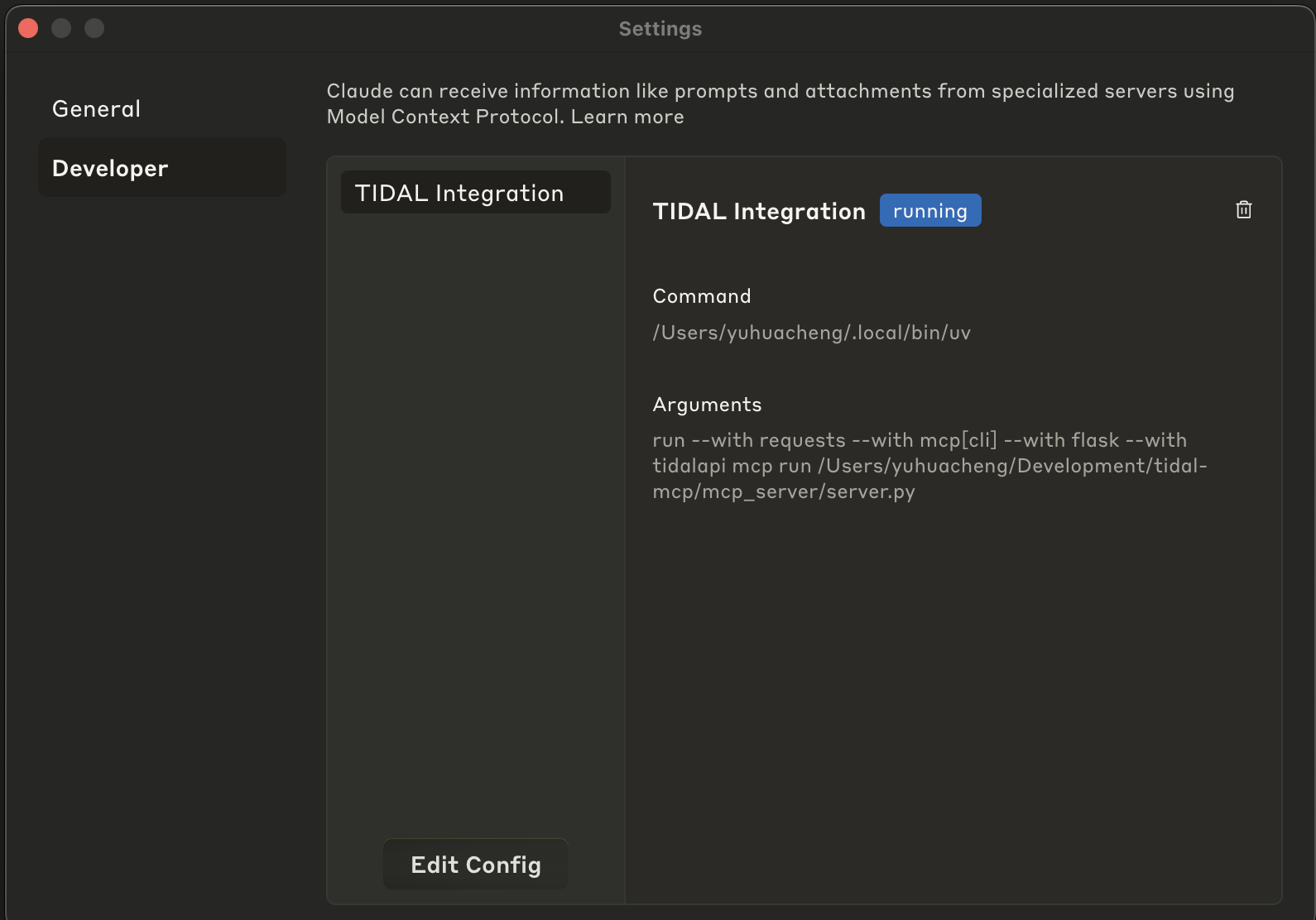
Option 2: Local Python Configuration (if not using Docker)
{
  "mcpServers": {
    "TIDAL Integration": {
      "command": "/path/to/your/uv",
      "env": {
        "TIDAL_MCP_PORT": "5100"
      },
      "args": [
        "run",
        "--with",
        "requests",
        "--with",
        "mcp[cli]",
        "--with",
        "flask",
        "--with",
        "tidalapi",
        "mcp",
        "run",
        "/path/to/your/project/tidal-mcp/mcp_server/server.py"
      ]
    }
  }
}
Example scrrenshot of the MCP configuration in Claude Desktop:
Cursor Configuration
For Cursor users, add this configuration to your MCP settings file (~/.cursor/mcp.json):
{
  "mcpServers": {
    "TIDAL Integration": {
      "command": "/path/to/your/project/tidal-mcp/.venv/bin/python",
      "env": {
        "TIDAL_MCP_PORT": "5100"
      },
      "args": ["/path/to/your/project/tidal-mcp/start_mcp.py"]
    }
  }
}
Important: Replace /path/to/your/project/tidal-mcp with the actual path to your project directory.
Steps to Install MCP Configuration in Cursor
- Create or edit the MCP configuration file at
~/.cursor/mcp.json - Add the TIDAL Integration configuration above
- Update the paths to match your actual project location
- Save the file
- Restart Cursor to load the new MCP server
Steps to Install MCP Configuration in Claude Desktop
- Open Claude Desktop
- Go to Settings > Developer
- Click on "Edit Config"
- Paste the modified JSON configuration
- Save the configuration
- Restart Claude Desktop
Suggested Prompt Starters
Once configured, you can interact with your TIDAL account through a LLM by asking questions like:
- “Recommend songs like those in this playlist, but slower and more acoustic.”
- “Create a playlist based on my top tracks, but focused on chill, late-night vibes.”
- “Find songs like these in playlist XYZ but in languages other than English.”
💡 You can also ask the model to:
- Use more tracks as seeds to broaden the inspiration.
- Return more recommendations if you want a longer playlist.
- Or delete a playlist if you’re not into it — no pressure!
Available Tools
The TIDAL MCP integration provides the following tools:
Authentication & Core Features
tidal_login: Authenticate with TIDAL through browser login flowget_favorite_tracks: Retrieve your favorite tracks from TIDALrecommend_tracks: Get personalized music recommendations
Playlist Management
create_tidal_playlist: Create a new playlist in your TIDAL accountget_user_playlists: List all your playlists on TIDALget_playlist_tracks: Retrieve all tracks from a specific playlist (with automatic pagination)delete_tidal_playlist: Delete a playlist from your TIDAL accountadd_tracks_to_playlist: Add tracks to an existing playlistremove_tracks_from_playlist: Remove tracks by ID or position indexupdate_playlist_metadata: Update playlist title and/or descriptionreorder_playlist_tracks: Move tracks to different positions within a playlist
Search & Discovery
search_tidal: Comprehensive search across all TIDAL content typessearch_tracks: Search specifically for tracks/songssearch_albums: Search specifically for albumssearch_artists: Search specifically for artistssearch_playlists: Search specifically for playlists
License
Contributing
This is an actively maintained community fork. Contributions are welcome!
- Fork the repository
- Create a feature branch (
git checkout -b feature/amazing-feature) - Commit your changes (
git commit -m 'Add amazing feature') - Push to the branch (
git push origin feature/amazing-feature) - Open a Pull Request
Acknowledgements
Original Project:
- yuhuacheng/tidal-mcp - Original TIDAL MCP implementation
Contributors:
- ra100 - Search functionality features
Libraries & Frameworks: