unreal-api-mcp





MCP server that gives AI agents accurate Unreal Engine C++ API documentation. Saves tokens, context, and time — prevents hallucinated signatures, wrong #include paths, and deprecated API usage.
Supports UE 5.5, 5.6, and 5.7 with separate databases for each version. Works with Claude Code, Cursor, Windsurf, or any MCP-compatible AI tool. No Unreal Engine installation required.
Quick Start
pip install unreal-api-mcp
Add to your MCP config (.mcp.json, mcp.json, or your tool's MCP settings), setting UNREAL_VERSION to match your project:
{
  "mcpServers": {
    "unreal-api": {
      "command": "unreal-api-mcp",
      "args": [],
      "env": {
        "UNREAL_VERSION": "5.5"
      }
    }
  }
}
Valid values: "5.5", "5.6", or "5.7". On Windows, use unreal-api-mcp.exe.
On first run the server downloads the correct database (~43-48 MB) to ~/.unreal-api-mcp/.
How It Works
- Version detection. The server figures out which UE version to serve:
| Priority | Source | Example |
|---|---|---|
| 1 | UNREAL_VERSION env var | "5.5", "5.6", "5.7" |
| 2 | UNREAL_PROJECT_PATH | Reads .uproject EngineAssociation field, maps 5.5.1 to "5.5" |
| 3 | Default | "5.7" |
-
Database download. If the database for that version isn't cached locally, it downloads from GitHub (one time).
-
Serve. All tool calls query the version-specific SQLite database. Exact lookups return in <1ms, searches in <5ms.
Each version has its own database with the correct signatures, deprecation warnings, and member lists for that release.
Tools
| Tool | Purpose | Example |
|---|---|---|
search_unreal_api | Find APIs by keyword | "character movement", "spawn actor" |
get_function_signature | Exact signature with parameters and return type | AActor::GetActorLocation |
get_include_path | Resolve #include for a type | "ACharacter" -> #include "GameFramework/Character.h" |
get_class_reference | Full class reference card | "APlayerController" -> all functions/properties/delegates |
get_deprecation_warnings | Check if an API is obsolete | "K2_AttachRootComponentTo" -> Use AttachToComponent() instead |
Coverage
All Engine Runtime, Editor, Developer modules, plus built-in plugins (Enhanced Input, Gameplay Abilities, Common UI, Niagara, Chaos, and hundreds more).
| Version | Records | Deprecated | Modules | DB Size |
|---|---|---|---|---|
| UE 5.5 | 99,591 | 3,689 | 860 | 43 MB |
| UE 5.6 | 109,530 | 4,205 | 981 | 48 MB |
| UE 5.7 | 114,724 | 4,409 | 1,019 | 50 MB |
Record breakdown (UE 5.7):
| Type | Count | Source |
|---|---|---|
| Classes (UCLASS) | 10,075 | AActor, ACharacter, UGameplayStatics, ... |
| Structs (USTRUCT) | 9,014 | FHitResult, FVector, FTransform, ... |
| Enums (UENUM) | 3,475 | EMovementMode, ECollisionChannel, ... |
| Functions (UFUNCTION) | 23,414 | Signatures with params, return types, specifiers |
| Properties (UPROPERTY) | 66,340 | Types, specifiers, doc comments |
| Delegates | 2,406 | Dynamic multicast, delegate declarations |
Does not cover third-party plugins or marketplace assets. For those, rely on project source.
Benchmarks
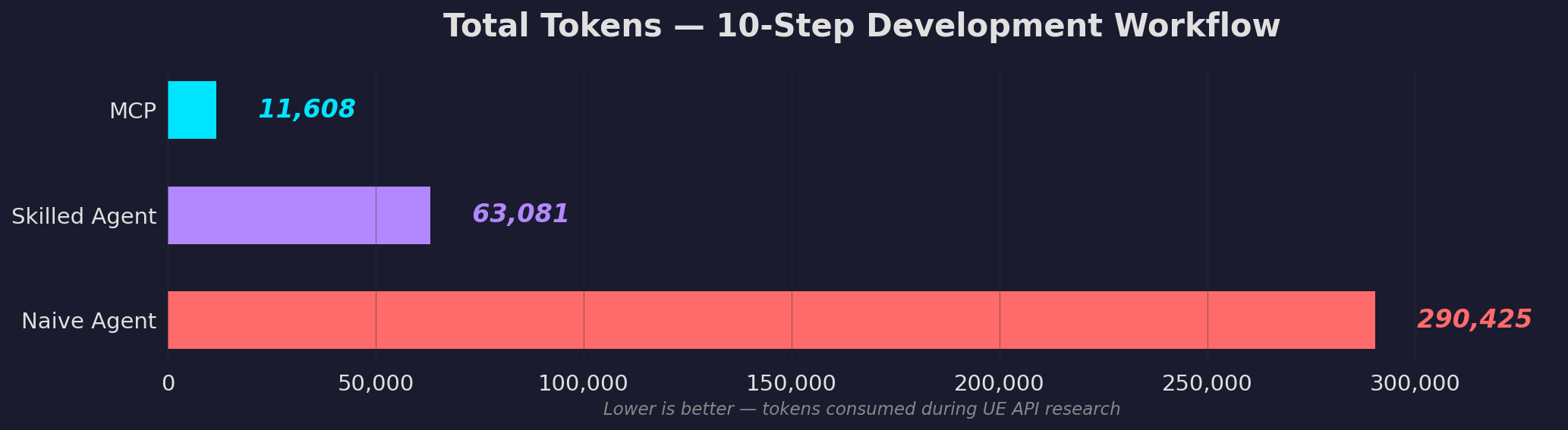
In a 10-step character movement development workflow, MCP consistently uses far fewer tokens than agents working with grep and file reads:
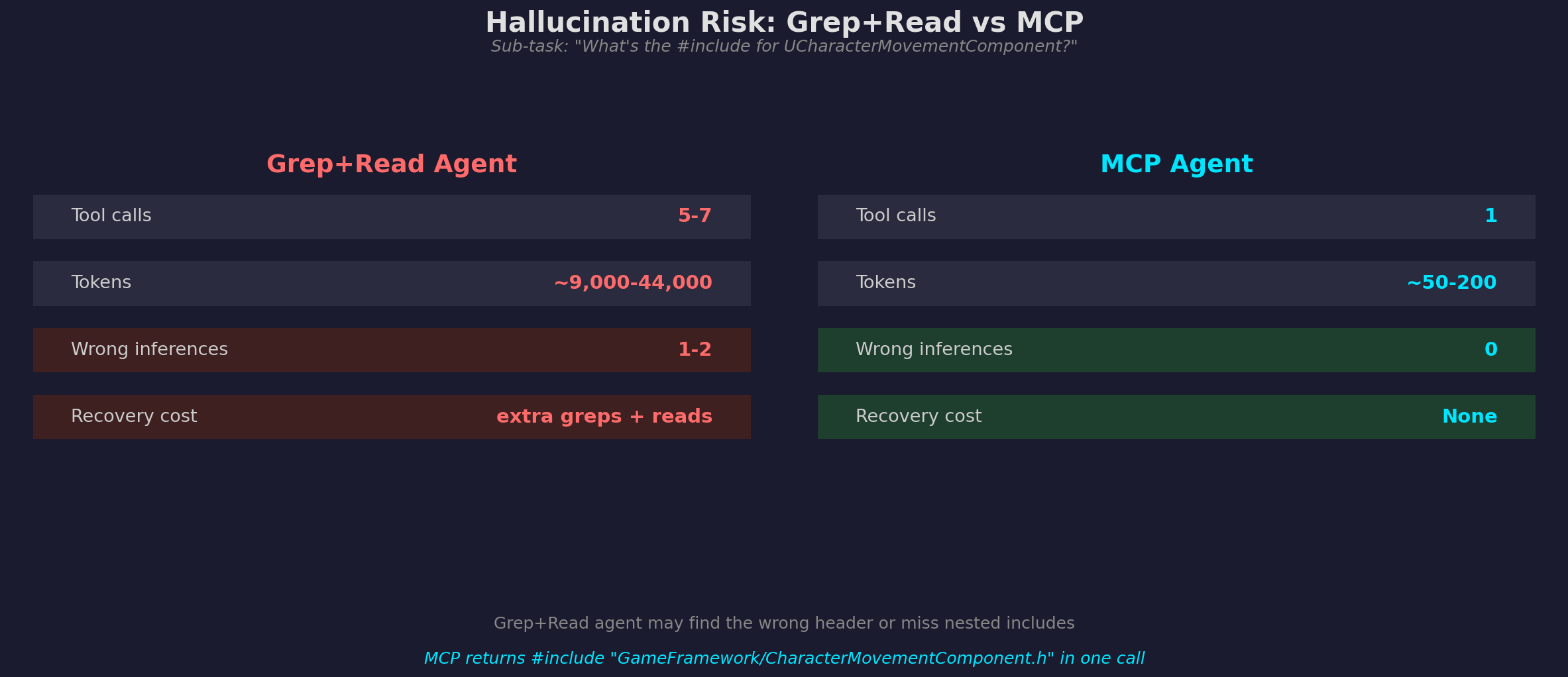
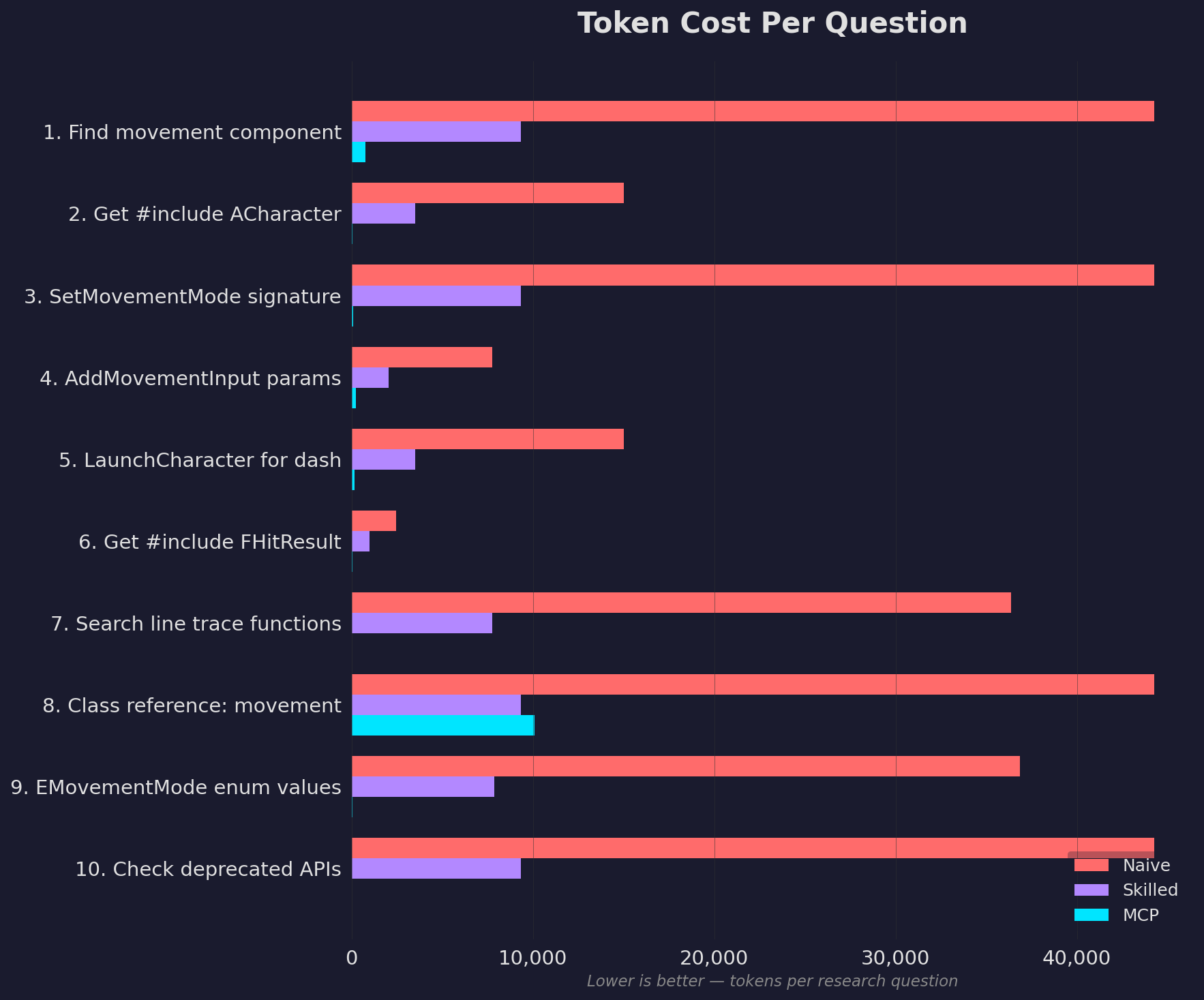
The gap holds across every question type. MCP wins on simple include lookups and complex class references alike:
Even in a realistic hybrid workflow where MCP results are followed up with targeted file reads, it still uses significantly fewer tokens than a skilled agent working without MCP:
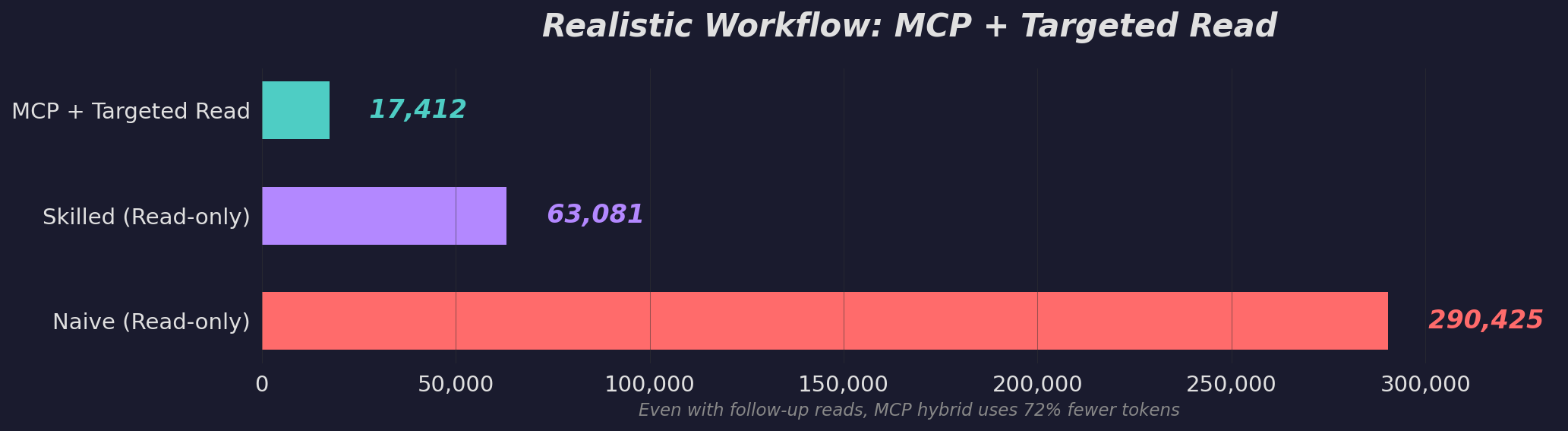
"Without MCP" estimates assume full or partial file reads. A skilled agent with good tooling may use fewer tokens than shown. What MCP guarantees is a correct, structured answer in one call every time.
Per-question breakdown
Query latency
Measured on UE 5.7 database (114,724 records), 50 iterations per query:
| Query | Median | p95 |
|---|---|---|
Exact FQN lookup (get_function_signature) | <1ms | <1ms |
| FTS search: specific function name | <1ms | <1ms |
| FTS search: keyword ("spawn actor") | 1ms | 1ms |
| Include path resolution | 2ms | 2ms |
| Class reference (full member list) | 22ms | 23ms |
| Deprecation check | 24ms | 25ms |
Accuracy
| Test | Result |
|---|---|
| Search top-1 relevance (8 common queries) | 100% |
| Include path resolution (6 key classes) | 100% |
| Function signature accuracy (3 common functions) | 100% |
| Class reference completeness (2 classes) | 100% |
| Deprecation detection (1 deprecated API) | 100% |
Ranking uses BM25 with tuned column weights (member name 10x, class name 5x) plus core module boosting to ensure AActor::GetActorLocation ranks above niche plugin APIs.
CLAUDE.md Snippet
Add this to your project's CLAUDE.md (or equivalent instructions file). This step is important. Without it, the AI has the tools but won't know when to reach for them.
## Unreal Engine API Lookup (unreal-api MCP)

Use the `unreal-api` MCP tools to verify UE C++ API usage instead of guessing. **Do not hallucinate signatures or #include paths.**

| When | Tool | Example |
|------|------|---------|
| Unsure about a function's parameters or return type | `get_function_signature` | `get_function_signature("AActor::GetActorLocation")` |
| Need the `#include` for a type | `get_include_path` | `get_include_path("ACharacter")` |
| Want to see all members on a class | `get_class_reference` | `get_class_reference("UCharacterMovementComponent")` |
| Searching for an API by keyword | `search_unreal_api` | `search_unreal_api("spawn actor")` |
| Checking if an API is deprecated | `get_deprecation_warnings` | `get_deprecation_warnings("K2_AttachRootComponentTo")` |

**Rules:**
- Before writing a UE API call you haven't used in this conversation, verify the signature with `get_function_signature`
- Before adding a `#include`, verify with `get_include_path` if unsure
- Covers: all Engine Runtime/Editor modules, built-in plugins (Enhanced Input, GAS, CommonUI, Niagara, etc.)
- Does NOT cover: third-party plugins or marketplace assets
Setup Details
Auto-detect version from .uproject
Instead of setting UNREAL_VERSION, you can point to your Unreal project. The server reads the EngineAssociation field from your .uproject file:
{
  "mcpServers": {
    "unreal-api": {
      "command": "unreal-api-mcp",
      "args": [],
      "env": {
        "UNREAL_PROJECT_PATH": "F:/Unreal Projects/MyProject"
      }
    }
  }
}
Environment variables
| Variable | Purpose | Example |
|---|---|---|
UNREAL_VERSION | UE version to serve | 5.5, 5.6, 5.7 |
UNREAL_PROJECT_PATH | Auto-detect version from .uproject | F:/Unreal Projects/MyProject |
UNREAL_INSTALL_PATH | Override UE install path (for ingest only) | H:/UE_5.6 |
Building databases locally
If you want to build a database from your own Unreal Engine installation instead of downloading:
# Build for a specific version
python -m unreal_api_mcp.ingest --unreal-version 5.6 --unreal-install "H:/UE_5.6"
python -m unreal_api_mcp.ingest --unreal-version 5.5 --unreal-install "H:/UE_5.5"
Databases are written to ~/.unreal-api-mcp/unreal_docs_{version}.db by default.
Project structure
unreal-api-mcp/
├── src/unreal_api_mcp/
│   ├── server.py          # MCP server (5 tools)
│   ├── db.py              # SQLite + FTS5 database layer
│   ├── version.py         # Version detection + DB download
│   ├── header_parser.py   # Parse Unreal C++ headers (UCLASS, UFUNCTION, etc.)
│   ├── unreal_paths.py    # Locate UE installs + discover modules
│   └── ingest.py          # CLI ingestion pipeline
└── pyproject.toml
Databases are stored in ~/.unreal-api-mcp/ (downloaded on first run).
Troubleshooting
| Problem | Fix |
|---|---|
| "Could not download UE X database" | Check internet connection. Or build locally: python -m unreal_api_mcp.ingest --unreal-version 5.6 --unreal-install H:/UE_5.6 |
| Wrong API version being served | Set UNREAL_VERSION explicitly. Check stderr: unreal-api-mcp: serving UE <version> |
| Server won't start | Check python --version (needs 3.10+). Check path: which unreal-api-mcp or where unreal-api-mcp |
| Third-party plugins return no results | Marketplace/third-party plugins are not indexed. Only built-in Engine and Plugin APIs are covered. |
See Also
unity-api-mcp — Same concept for Unity (C#). Covers Unity 2022, 2023, and Unity 6.
Contact
Need a custom MCP server for your engine or framework? I build MCP tools that cut token waste and prevent hallucinations for AI-assisted game development. If you want something similar for your team's stack, reach out.
License
MIT