GroundTruth
Your AI assistant just confidently wrote deprecated code again.
This fixes that.





The problem with AI coding assistants
They hallucinate APIs. Not because the models are bad — because documentation moves faster than training data does. A library ships a major version, deprecates half its API, and the model keeps generating the old patterns for the next six months. You catch it in review if you're lucky. In production if you're not.
There's also the security problem nobody talks about enough. AI assistants produce insecure patterns without knowing they're doing it: SQL built with template literals, innerHTML fed user input, any scattered through TypeScript like confetti, cookies() called without await in Next.js 16. The model isn't malicious — it just learned from code that predates the rule change, and now it's your problem.
Context7 helps with the first problem. But it has rate limits, lives in the cloud, and covers around 130 libraries. Hit the quota mid-session and you get nothing. I did that enough times that I built the thing I actually wanted.
GroundTruth runs on your machine. It fetches docs directly from the source at query time — llms.txt files first (purpose-built for LLMs by the maintainers themselves), then Jina Reader for JS-rendered pages, then GitHub. No quota. No cold start. No cache from six months ago. 363+ libraries across the Python AI/ML stack, Go, Rust, and web standards including OWASP, MDN, and WebAssembly.
The audit tool scans your actual source files at file:line level and fetches current fix guidance from the real spec. Not a linting rule someone wrote in 2019. The actual spec.

Install
Claude Code
claude mcp add gt -- npx -y @groundtruth-mcp/gt-mcp@latest
Cursor / Claude Desktop / VS Code
Add to your MCP config (claude_desktop_config.json, .cursor/mcp.json, or .vscode/mcp.json):
{
  "mcpServers": {
    "gt": {
      "command": "npx",
      "args": ["-y", "@groundtruth-mcp/gt-mcp@latest"]
    }
  }
}
No build step. No config file. Node.js 24+. npx pulls the latest version on every session start automatically.
Optional: GitHub token
GroundTruth fetches README files, release notes, and migration guides from GitHub. Unauthenticated requests are rate-limited to 60/hr. If you build anything with more than a couple dependencies, you'll hit that by lunch.
# Claude Code
claude mcp add gt -e GT_GITHUB_TOKEN=ghp_yourtoken -- npx -y @groundtruth-mcp/gt-mcp@latest

# Cursor / Claude Desktop / VS Code
{
  "mcpServers": {
    "gt": {
      "command": "npx",
      "args": ["-y", "@groundtruth-mcp/gt-mcp@latest"],
      "env": { "GT_GITHUB_TOKEN": "ghp_yourtoken" }
    }
  }
}
A token with no extra scopes (public repo read) is enough. Takes the limit from 60 to 5000 requests/hr. Takes about 30 seconds to set up. Worth it.
Tools
Nine tools. Each does one thing and stops there.
| Tool | What it does |
|---|---|
gt_resolve_library | Find a library by name — gets the registry entry and docs URL |
gt_get_docs | Fetch live docs for a specific topic (not whatever was cached six months ago) |
gt_best_practices | Get patterns, anti-patterns, and config guidance for any library |
gt_auto_scan | Read package.json / requirements.txt, fetch best practices for everything in it |
gt_search | Search OWASP, MDN, web.dev, W3C, official language docs, and AI provider docs |
gt_audit | Scan your source files — finds real issues at exact file:line with live fixes attached |
gt_changelog | Fetch release notes before you run npm update and regret it |
gt_compat | Check browser and runtime compatibility — before Safari breaks your launch |
gt_compare | Compare 2–3 libraries side-by-side so you can finally pick one and move on |
gt_audit — the one that finds what you missed
Walks your project, pinpoints issues at exact file:line locations, then fetches current fix guidance from official sources for every issue type it finds. A code reviewer who read the spec this morning and has no feelings about telling you your SQL is injectable.
How it works
- Reads all
.ts,.tsx,.js,.jsx,.css,.html,.pyfiles up to a configurable limit (default: 50, max: 200) - Skips test files, generated files, and commented-out lines (both
//and#) - Runs 100+ patterns — sourced from OWASP cheat sheets, typescript-eslint rules, react.dev/reference/rules, web.dev, and the OWASP Python Security Cheat Sheet
- For the top unique issue types, fetches current fix guidance from the authoritative source
- Reports each finding with file path, line number, the problem, and a concrete fix
Audit categories
gt_audit({ categories: ["all"] })                      // default — all 18 categories
gt_audit({ categories: ["security", "node"] })         // OWASP + Node.js anti-patterns
gt_audit({ categories: ["python", "security"] })       // Python OWASP scan
gt_audit({ categories: ["accessibility"] })            // WCAG AA scan
gt_audit({ categories: ["typescript", "react"] })      // type safety + React rules
| Category | Patterns | What it checks |
|---|---|---|
layout | 6 | CLS-causing images, raw <img> vs next/image, 100vh on mobile, missing font-display, render-blocking scripts, CSS @import chains |
performance | 7 | Missing lazy loading, useEffect data fetching, barrel file tree-shaking, missing Suspense boundaries, document.querySelector in React, inline object/array props, missing fetchpriority on LCP image |
accessibility | 10 | Missing alt text (WCAG 1.1.1), onClick on div/span (WCAG 2.1.1), icon-only buttons without aria-label, inputs without labels, outline: none, positive tabIndex, role="button" on non-buttons, placeholder href, missing lang, prefers-reduced-motion |
security | 11 | XSS via innerHTML, SQL injection via template literals, command injection, SSRF via user-controlled URLs, path traversal in fs calls, NEXT_PUBLIC_ secret exposure, hardcoded credentials, unvalidated Server Actions, implied eval, CORS wildcard, dynamic code execution |
react | 7 | forwardRef deprecated (React 19), useFormState renamed, array index as key, missing event listener cleanup, conditional hook calls (Rules of Hooks), component called as function, side effects at render scope |
nextjs | 6 | Sync cookies()/headers()/params without await (Next.js 16), use client on layout, Tailwind v3 directives, Route Handler without error handling, middleware.ts not renamed to proxy.ts, pages without metadata |
typescript | 7 | any type, non-null assertions, missing return types, @ts-ignore, floating Promises, require() instead of import, double assertion |
node | 5 | console.log in production, synchronous fs operations, unhandled callback errors, process.exit() without cleanup, plain HTTP fetch |
python | 11 | SQL injection via f-string/format(), eval()/exec() with dynamic input, subprocess with shell=True, os.system(), bare except: clauses, pickle.loads() from untrusted source, MD5/SHA1 for passwords, requests verify=False, mutable default arguments, print() in production, open() path traversal |
Options
gt_audit({
  projectPath: "./src",       // defaults to cwd
  categories: ["security"],   // or "all" (default)
  maxFiles: 100,              // 1–200, default 50
  tokens: 6000,               // max tokens per docs fetch, default 4000
})
Sample output
# Code audit report
> Path: /projects/my-app
> Files scanned: 47 | Issues: 23 | Unique types: 9
> Categories: all

---

## [CRITICAL] SQL built via template literal
Category: security | Severity: critical | Count: 2

Building SQL queries with template literals exposes the app to injection when
user input reaches the string.

Fix: db.query('SELECT * FROM users WHERE id = $1', [userId])

Files:
  - src/db/users.ts:47
  - src/api/search.ts:23

Live fix: OWASP SQL Injection Prevention Cheat Sheet
gt_changelog — read this before running npm update
Fetches release notes for any library. Hits GitHub Releases API first, falls back to CHANGELOG.md, then the docs site changelog page. Pass a version filter to see just what changed in the version you're moving to — not a wall of history going back to 2018.
gt_changelog({ libraryId: "vercel/next.js" })
gt_changelog({ libraryId: "facebook/react", version: "19" })
gt_changelog({ libraryId: "prisma", version: "6.0.0" })
gt_compat — does this actually work in Safari
Checks whether a web API, CSS feature, or JavaScript syntax is safe to use in your target environments. Pulls live data from MDN and caniuse.com. Run this before you ship the feature, not after your QA person opens it on an iPhone.
gt_compat({ feature: "CSS container queries" })
gt_compat({ feature: "Array.at()" })
gt_compat({ feature: "Web Bluetooth API" })
gt_compat({ feature: "CSS :has() selector", environments: ["safari", "firefox"] })
gt_compare — pick one already
Side-by-side comparison of 2–3 libraries. Fetches live docs for each and filters to content relevant to your criteria. Useful for the "prisma vs drizzle" debate you've been having with yourself for three weeks while using neither.
gt_compare({ libraries: ["prisma", "drizzle-orm"] })
gt_compare({ libraries: ["trpc", "hono"], criteria: "TypeScript support" })
gt_compare({ libraries: ["zod", "valibot", "yup"], criteria: "bundle size DX" })
gt_compare({ libraries: ["react", "solid-js"], criteria: "performance rendering" })
gt_search — anything that isn't a specific library
For questions not tied to a particular package. Pulls from OWASP, MDN, web.dev, W3C, official language docs, AI provider docs, and everything else in the topic map below. Good for when you know what you need but not which library page it lives on.
gt_search({ query: "WCAG 2.2 focus indicators" })
gt_search({ query: "JWT vs session cookies" })
gt_search({ query: "Core Web Vitals LCP optimization" })
gt_search({ query: "gRPC vs REST tradeoffs" })
gt_search({ query: "OpenTelemetry Node.js setup" })
gt_search({ query: "RAG retrieval patterns" })
gt_search({ query: "WebAssembly use cases" })
gt_search({ query: "MCP protocol tool definition" })
Covered topic areas
| Area | Topics |
|---|---|
| Security | OWASP Top 10, SQL injection, XSS / CSP, CSRF, HSTS, authentication, CORS, JWT, OAuth 2.1, OIDC, WebAuthn / passkeys |
| Accessibility | WCAG 2.2, WAI-ARIA, keyboard navigation |
| Performance | Core Web Vitals, image optimization, web fonts, Speculation Rules API |
| Web APIs | Fetch, Web Workers, Service Workers, WebSocket, WebRTC, IndexedDB, Web Crypto, Intersection Observer, ResizeObserver, Web Animations API, WebAssembly |
| CSS | Grid, Flexbox, Container Queries, Custom Properties, View Transitions, Cascade Layers |
| HTTP & protocols | Headers, caching, HTTP/2, HTTP/3, REST, OpenAPI, GraphQL, gRPC / Protocol Buffers, Server-Sent Events |
| Standards | JSON Schema, JSON-LD / Structured Data, OpenTelemetry, Semantic Versioning, MCP Protocol |
| AI | Agents & tool calling, RAG, prompt engineering, vector search / embeddings |
| Infrastructure | Docker, Kubernetes, GitHub Actions, Terraform, monorepo patterns |
| Databases | PostgreSQL, Redis, MongoDB |
| Languages | Rust, Go, Python, Node.js, TypeScript |
| Frameworks | NestJS, Elysia, Payload CMS, Kysely, Pinia, React Native / Expo + full ecosystem |
gt_auto_scan — best practices for your whole stack at once
Point it at your project root. It reads the manifest, figures out what you're actually using, and pulls best practices for each dependency. One call instead of twenty, zero arguments required if you're already in the project folder.
gt_auto_scan({ projectPath: "." })
Supports package.json (Node.js), requirements.txt / pyproject.toml (Python — pip, uv, hatch, rye, pdm, Poetry), Cargo.toml (Rust), go.mod (Go), pom.xml (Maven), build.gradle / build.gradle.kts (Gradle), and composer.json (PHP).
Usage
Natural language
use gt for nextjs
use gt for drizzle migrations
gt audit
use gt to check WCAG focus indicators
use gt for OpenTelemetry setup
find all issues and fix with gt
use gt for gRPC
Direct tool calls
gt_resolve_library({ libraryName: "nestjs" })
gt_get_docs({ libraryId: "nestjs/nest", topic: "guards" })
gt_best_practices({ libraryId: "vercel/next.js", topic: "caching" })
gt_auto_scan({ projectPath: "." })
gt_search({ query: "OpenTelemetry Node.js distributed tracing" })
gt_audit({ projectPath: ".", categories: ["security", "accessibility"] })
gt_changelog({ libraryId: "vercel/next.js", version: "15" })
gt_compat({ feature: "CSS container queries", environments: ["safari"] })
gt_compare({ libraries: ["prisma", "drizzle-orm"], criteria: "TypeScript support" })
How docs are fetched
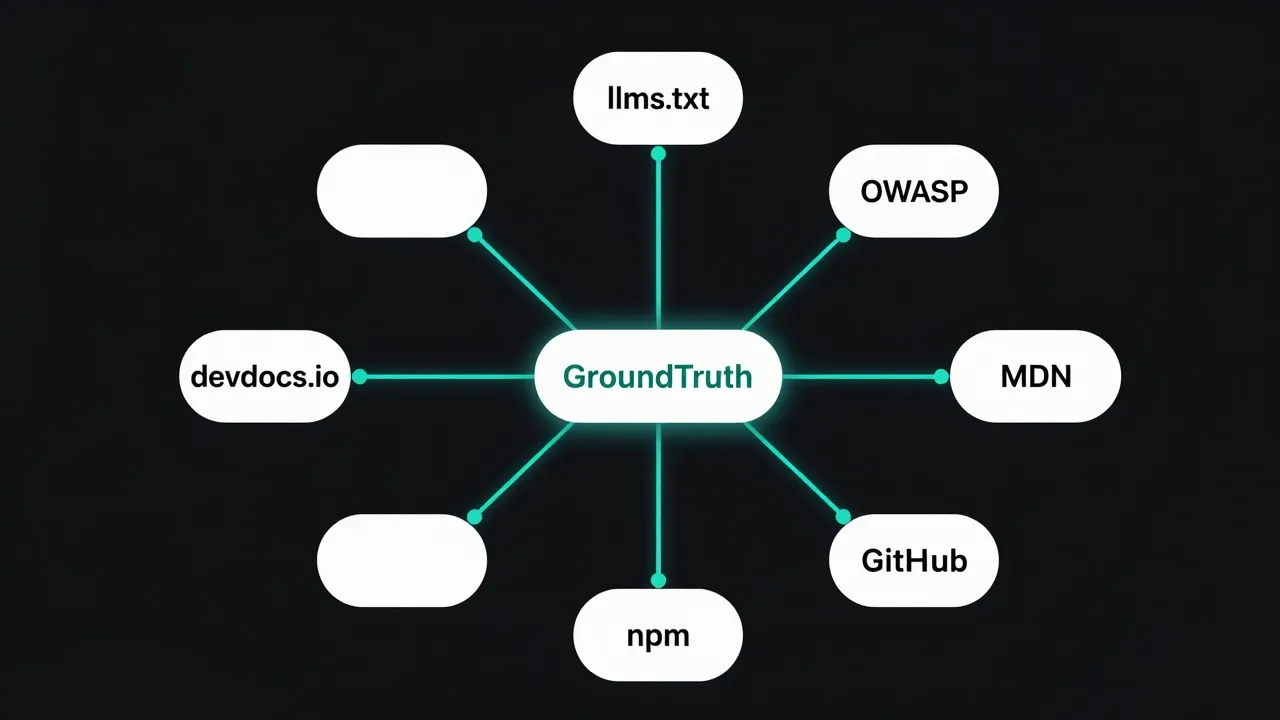
For every library docs request, GroundTruth tries sources in this order and stops at the first one that returns useful content:
llms.txt/llms-full.txt— context files published by the project maintainer specifically for LLM consumption. More reliable than scraping the docs site.- Jina Reader (
r.jina.ai) — converts the official docs page to clean markdown. Handles JS-rendered sites that would return nothing via a plain fetch. - GitHub README / releases — latest release notes and README from the project repository.
- npm / PyPI metadata — fallback for packages outside the curated registry.
Library coverage — 363+ libraries
Every major ecosystem. If a library publishes an llms.txt, it's probably in here.
| Ecosystem | Libraries |
|---|---|
| React / Next.js | React, Next.js, shadcn/ui, Radix UI, Tailwind CSS, Headless UI, Ariakit, Zag.js, Panda CSS |
| State management | Zustand, Jotai, TanStack Query, SWR, Redux Toolkit, Valtio, MobX, XState, Pinia |
| Backend (Node.js) | Express, Fastify, Hono, NestJS, Elysia, Nitro, tRPC |
| Backend (Python) | FastAPI, Django, Flask, Pydantic |
| Backend (Go) | Gin, Fiber, GORM, chi |
| Backend (Rust) | Axum, Actix Web, sqlx, Tokio |
| Database / ORM | Prisma, Drizzle, Kysely, TypeORM, Mongoose, Knex, Supabase, Neon, Turso, Electric SQL |
| Vector databases | Pinecone, Qdrant |
| AI / ML (JS) | Vercel AI SDK, Anthropic SDK, OpenAI SDK, LangChain.js, LlamaIndex.TS, Transformers.js, Ollama, assistant-ui |
| AI / ML (Python) | LangChain, LlamaIndex, CrewAI, LangGraph, HuggingFace Transformers |
| Testing | Vitest, Playwright, Jest, Testing Library, Cypress, MSW |
| Auth | Clerk, NextAuth, Better Auth, Lucia, Passport.js |
| Validation | Zod, Yup, Valibot, Effect |
| Rich text | Tiptap, Lexical, CodeMirror, Slate.js |
| Content | MDX, unified, Contentlayer, Fumadocs, gray-matter |
| CMS | Payload CMS, Strapi, Contentful |
| Resend, Nodemailer | |
| Payments | Stripe |
| Mobile | Expo, React Native, React Navigation, NativeWind, Reanimated, MMKV, FlashList, Skia, Moti |
| Build tools | Vite, Turbopack, SWC, Rollup, Webpack, Biome, ESLint, Prettier, Turborepo, Nx |
| Runtime | Node.js, Bun, Deno |
| Cloud | Vercel, Cloudflare Workers, AWS SDK, Firebase |
| HTTP clients | Axios, ky |
| Real-time | Socket.IO, PartyKit |
| Observability | OpenTelemetry, Sentry, Pino |
| GraphQL clients | Apollo Client, urql |
| HTTP utils | clsx, tailwind-merge |
vs. Context7
Context7 is solid. Here's why I reach for this instead.
| GroundTruth | Context7 | |
|---|---|---|
| Hosting | Self-hosted | Cloud |
| Rate limits | None | Yes |
| Source priority | llms.txt → Jina → GitHub | Doc page embeddings |
| Code audit | Yes — 100+ patterns, 18 categories, file:line, live fixes | No |
| Freeform search | Yes — OWASP, MDN, AI docs, web standards | Library docs only |
| Changelog lookup | Yes — GitHub Releases, CHANGELOG.md, docs site | No |
| Browser compatibility | Yes — MDN + caniuse.com | No |
| Library comparison | Yes — 2–3 libraries side-by-side, any criteria | No |
| Libraries | 363+ curated + npm/PyPI fallback | ~130 |
| Python / Rust / Go | Yes | Limited |
| API key required | No | No |
The two tools approach the same problem from different angles. Context7 embeds doc pages and retrieves them by semantic similarity. GroundTruth fetches from the source at query time and prioritizes llms.txt files — content the maintainers specifically wrote for LLM consumption. Neither is universally better, but when you hit a rate limit at 11pm debugging a production issue, "self-hosted with no quota" stops being a nice-to-have.
Tests
565 tests across 19 files. Every audit pattern has a test. Every manifest parser has a test. If a pattern ships without a test, the CI pipeline says no before any human has to.
npm test                # run all tests
npm run test:coverage   # with V8 coverage report
npm run typecheck       # TypeScript strict check (no emit)
| File | Coverage |
|---|---|
src/sources/registry.test.ts | LIBRARY_REGISTRY integrity, lookupById, lookupByAlias, fuzzy search |
src/tools/audit.test.ts | buildCommentMap, all 100+ patterns — Python, security, TypeScript, React, Node |
src/tools/auto-scan.test.ts | All 8 manifest parsers using temp directories (package.json, requirements.txt, pyproject.toml, Cargo.toml, go.mod, pom.xml, composer.json, build.gradle) |
src/utils/extract.test.ts | Topic relevance ranking, truncation, document order preservation |
src/utils/sanitize.test.ts | Prompt injection stripping, <script>/<style> removal, navigation link cleanup |
Tests run in CI on every push and pull request to main. See .github/workflows/ci.yml.
Requirements
- Node.js 20+
- Claude Code, Cursor, VS Code (MCP extension), or Claude Desktop
That's it. No Docker. No config files. No environment variables unless you want the GitHub token.
Contributing
The library registry lives in src/sources/registry.ts. Adding a library is a PR with id, name, docsUrl, and llmsTxtUrl if the project publishes one. If you've been frustrated by a library not being covered, that's the fix — it takes about five minutes.
Issues and requests: github.com/rm-rf-prod/GroundTruth-MCP/issues
Star history
License
Elastic License 2.0 — free to use, free to self-host, free to build on. The one thing you can't do is turn it into a managed service and sell it. Fair enough.