YantrikDB
A memory database that forgets, consolidates, and detects contradictions.
Vector databases store memories. They don't manage them. After 10,000 memories, recall quality degrades because there's no consolidation, no forgetting, no conflict resolution. Your AI agent just gets noisier.
YantrikDB is different. It's a cognitive memory engine — embed it, run it as a server, or connect via MCP. It thinks about what it stores.




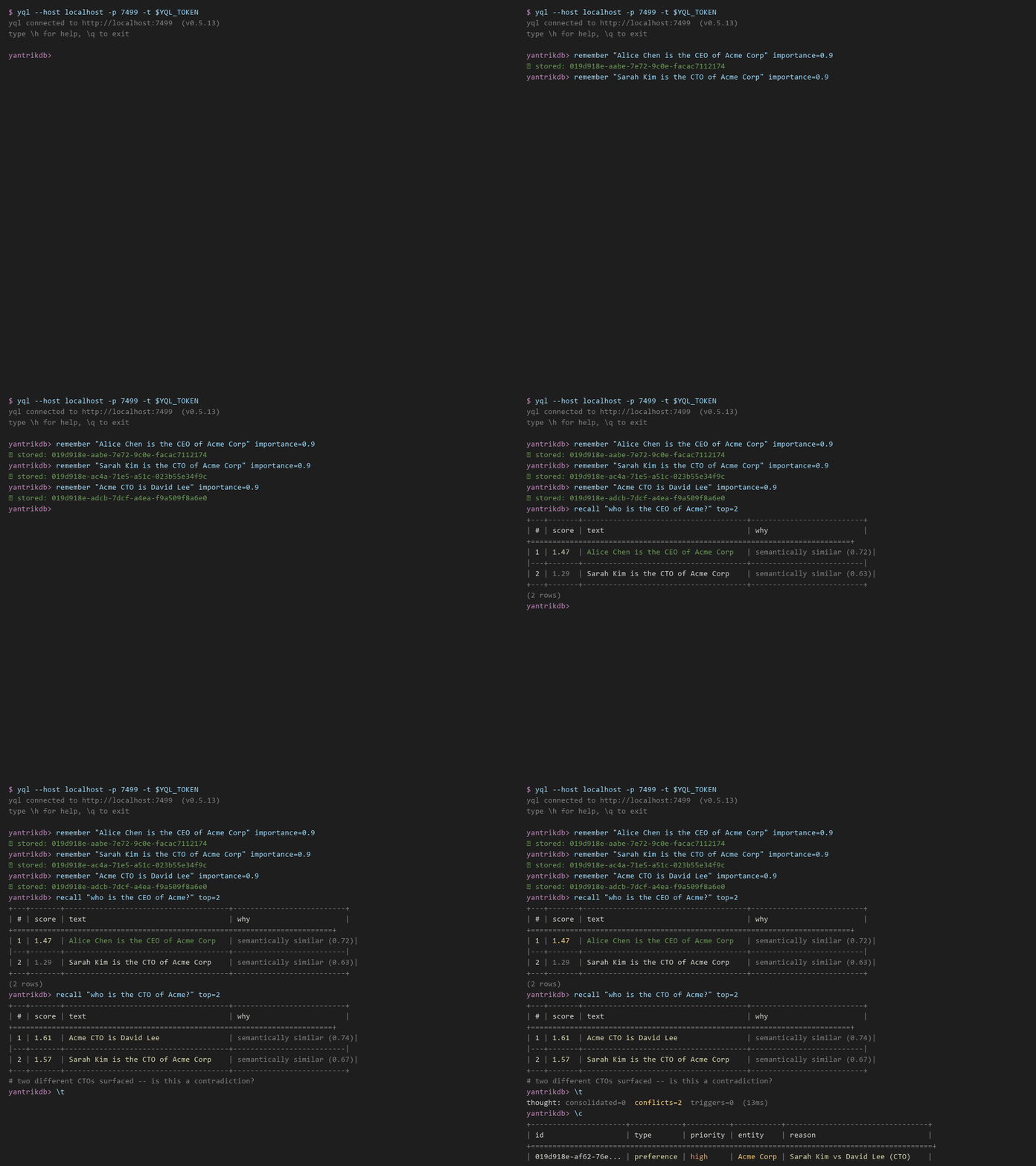
Three things no other database does
1. It forgets
db.record("read the SLA doc by Friday", importance=0.4, half_life=86400)  # 1 day
# 24 hours later, this memory's relevance score has decayed
# 7 days later, recall stops surfacing it unless explicitly queried
2. It consolidates
# 20 similar memories about the same meeting
for note in meeting_notes:
    db.record(note, namespace="standup-2026-04-12")

db.think()
# → {"consolidation_count": 5}  # collapsed 20 fragments into 5 canonical memories
3. It detects contradictions
db.record("CEO is Alice")
db.record("CEO is Bob")  # added later in another conversation

db.think()
# → {"conflicts_found": 1, "conflicts": [{"memory_a": "CEO is Alice",
#                                         "memory_b": "CEO is Bob",
#                                         "type": "factual_contradiction"}]}
Plus: temporal decay with configurable half-life, entity graph with relationship edges, personality derivation from memory patterns, session-aware context surfacing, multi-signal scoring (recency × importance × similarity × graph proximity).
Three ways to use it
As a network server
docker run -p 7438:7438 ghcr.io/yantrikos/yantrikdb:latest
curl -X POST http://localhost:7438/v1/remember -d '{"text":"hello"}'
Single Rust binary. HTTP + binary wire protocol. 2-voter + 1-witness HA cluster via Docker Compose or Kubernetes. Per-tenant quotas, Prometheus metrics, AES-256-GCM at-rest encryption, runtime deadlock detection. See docker-compose.cluster.yml and k8s manifests.
As an MCP server (Claude Code, Cursor, Windsurf)
pip install yantrikdb-mcp
Add to your MCP client config — the agent auto-recalls context, auto-remembers decisions, auto-detects contradictions. No prompting needed. See yantrikdb-mcp.
As an embedded library (Python or Rust)
pip install yantrikdb
# or
cargo add yantrikdb
import yantrikdb
db = yantrikdb.YantrikDB("memory.db", embedding_dim=384)
db.set_embedder(SentenceTransformer("all-MiniLM-L6-v2"))
db.record("Alice leads engineering", importance=0.8)
db.recall("who leads the team?", top_k=3)
db.think()  # consolidate, detect conflicts, derive personality
Performance
Live numbers from a 2-core LXC cluster with 1689 memories:
| Operation | Latency |
|---|---|
| Recall p50 | 112ms (most is query embedding ~100ms) |
| Recall p99 | 190ms |
| Batch write | 76 writes/sec |
| Engine lock acquire | <0.1ms |
| Deep health probe | <1ms |
For pre-computed embeddings (skip query-time embedding), recall p50 drops to ~5ms.
Status
v0.5.11 — hardened alpha. The embeddable engine has been used in production by the YantrikOS ecosystem since early 2026. The network server is newer — running live on a 3-node Proxmox cluster with multiple tenants for the past few weeks.
A 42-task hardening sprint just completed across 8 epics:
parking_lotmutexes everywhere with runtime deadlock detection (caught a self-deadlock that would have taken hours to find with std::sync)- Per-handler Prometheus metrics, structured JSON logging, deep health checks
- Chaos-tested failover (leader kill, network partition, kill-9 mid-write)
- Per-tenant quotas, load shedding, control plane replication
- 1178 core tests + chaos harness + cargo-fuzz + CRDT property tests
- 5 operational runbooks, watchdog with auto-restart
Read the maturity notes: https://yantrikdb.com/server/quickstart/#maturity
The Problem
Current AI memory is:
Store everything → Embed → Retrieve top-k → Inject into context → Hope it helps.
That's not memory. That's a search engine with extra steps.
Real memory is hierarchical, compressed, contextual, self-updating, emotionally weighted, time-aware, and predictive. YantrikDB is built for that.
Why Not Existing Solutions?
| Solution | What it does | What it lacks |
|---|---|---|
| Vector DBs (Pinecone, Weaviate) | Nearest-neighbor lookup | No decay, no causality, no self-organization |
| Knowledge Graphs (Neo4j) | Structured relations | Poor for fuzzy memory, not adaptive |
| Memory Frameworks (LangChain, Mem0) | Retrieval wrappers | Not a memory architecture — just middleware |
| File-based (CLAUDE.md, memory files) | Dump everything into context | O(n) token cost, no relevance filtering |
Benchmark: Selective Recall vs. File-Based Memory
| Memories | File-Based | YantrikDB | Token Savings | Precision |
|---|---|---|---|---|
| 100 | 1,770 tokens | 69 tokens | 96% | 66% |
| 500 | 9,807 tokens | 72 tokens | 99.3% | 77% |
| 1,000 | 19,988 tokens | 72 tokens | 99.6% | 84% |
| 5,000 | 101,739 tokens | 53 tokens | 99.9% | 88% |
At 500 memories, file-based exceeds 32K context windows. At 5,000, it doesn't fit in any context window — not even 200K. YantrikDB stays at ~70 tokens per query. Precision improves with more data — the opposite of context stuffing.
Architecture
Design Principles
- Embedded, not client-server — single file, no server process (like SQLite)
- Local-first, sync-native — works offline, syncs when connected
- Cognitive operations, not SQL —
record(),recall(),relate(), notSELECT - Living system, not passive store — does work between conversations
- Thread-safe —
Send + Syncwith internal Mutex/RwLock, safe for concurrent access
Five Indexes, One Engine
┌──────────────────────────────────────────────────────┐
│                   YantrikDB Engine                    │
│                                                      │
│  ┌──────────┬──────────┬──────────┬──────────┐       │
│  │  Vector  │  Graph   │ Temporal │  Decay   │       │
│  │  (HNSW)  │(Entities)│ (Events) │  (Heap)  │       │
│  └──────────┴──────────┴──────────┴──────────┘       │
│  ┌──────────┐                                        │
│  │ Key-Value│  WAL + Replication Log (CRDT)          │
│  └──────────┘                                        │
└──────────────────────────────────────────────────────┘
- Vector Index (HNSW) — semantic similarity search across memories
- Graph Index — entity relationships, profile aggregation, bridge detection
- Temporal Index — time-aware queries ("what happened Tuesday", "upcoming deadlines")
- Decay Heap — importance scores that degrade over time, like human memory
- Key-Value Store — fast facts, session state, scoring weights
Memory Types (Tulving's Taxonomy)
| Type | What it stores | Example |
|---|---|---|
| Semantic | Facts, knowledge | "User is a software engineer at Meta" |
| Episodic | Events with context | "Had a rough day at work on Feb 20" |
| Procedural | Strategies, what worked | "Deploy with blue-green, not rolling update" |
All memories carry importance, valence (emotional tone), domain, source, certainty, and timestamps — used in a multi-signal scoring function that goes far beyond cosine similarity.
Key Capabilities
Relevance-Conditioned Scoring
Not just vector similarity. Every recall combines:
- Semantic similarity (HNSW) — what's topically related
- Temporal decay — recent memories score higher
- Importance weighting — critical decisions beat trivia
- Graph proximity — entity relationships boost connected memories
- Retrieval feedback — learns from past recall quality
Weights are tuned automatically from usage patterns.
Conflict Detection & Resolution
When memories contradict, YantrikDB doesn't guess — it creates a conflict segment:
"works at Google" (recorded Jan 15) vs. "works at Meta" (recorded Mar 1)
→ Conflict: identity_fact, priority: high, strategy: ask_user
Resolution is conversational: the AI asks naturally, not programmatically.
Semantic Consolidation
After many conversations, memories pile up. think() runs:
- Consolidation — merge similar memories, extract patterns
- Conflict scan — find contradictions across the knowledge base
- Pattern mining — cross-domain discovery ("work stress correlates with health entries")
- Trigger evaluation — proactive insights worth surfacing
Proactive Triggers
The engine generates triggers when it detects something worth reaching out about:
- Memory conflicts needing resolution
- Approaching deadlines (temporal awareness)
- Patterns detected across domains
- High-importance memories about to decay
- Goal tracking ("how's the marathon training?")
Every trigger is grounded in real memory data — not engagement farming.
Multi-Device Sync (CRDT)
Local-first with append-only replication log:
- CRDT merging — graph edges, memories, and metadata merge without conflicts
- Vector indexes rebuild locally — raw memories sync, each device rebuilds HNSW
- Forget propagation — tombstones ensure forgotten memories stay forgotten
- Conflict detection — contradictions across devices are flagged for resolution
Sessions & Temporal Awareness
sid = db.session_start("default", "claude-code")
db.record("decided to use PostgreSQL")  # auto-linked to session
db.record("Alice suggested Redis for caching")
db.session_end(sid)
# → computes: memory_count, avg_valence, topics, duration

db.stale(days=14)    # high-importance memories not accessed recently
db.upcoming(days=7)  # memories with approaching deadlines
Full API
| Operation | Methods |
|---|---|
| Core | record, record_batch, recall, recall_with_response, recall_refine, forget, correct |
| Knowledge Graph | relate, get_edges, search_entities, entity_profile, relationship_depth, link_memory_entity |
| Cognition | think, get_patterns, scan_conflicts, resolve_conflict, derive_personality |
| Triggers | get_pending_triggers, acknowledge_trigger, deliver_trigger, act_on_trigger, dismiss_trigger |
| Sessions | session_start, session_end, session_history, active_session, session_abandon_stale |
| Temporal | stale, upcoming |
| Procedural | record_procedural, surface_procedural, reinforce_procedural |
| Lifecycle | archive, hydrate, decay, evict, list_memories, stats |
| Sync | extract_ops_since, apply_ops, get_peer_watermark, set_peer_watermark |
| Maintenance | rebuild_vec_index, rebuild_graph_index, learned_weights |
Technical Decisions
| Decision | Choice | Rationale |
|---|---|---|
| Core language | Rust | Memory safety, no GC, ideal for embedded engines |
| Architecture | Embedded (like SQLite) | No server overhead, sub-ms reads, single-tenant |
| Bindings | Python (PyO3), TypeScript | Agent/AI layer integration |
| Storage | Single file per user | Portable, backupable, no infrastructure |
| Sync | CRDTs + append-only log | Conflict-free for most operations, deterministic |
| Thread safety | Mutex/RwLock, Send+Sync | Safe concurrent access from multiple threads |
| Query interface | Cognitive operations API | Not SQL — designed for how agents think |
Ecosystem
| Package | What | Install |
|---|---|---|
| yantrikdb | Rust engine | cargo add yantrikdb |
| yantrikdb | Python bindings (PyO3) | pip install yantrikdb |
| yantrikdb-mcp | MCP server for AI agents | pip install yantrikdb-mcp |
Roadmap
- V0 — Embedded engine, core memory model (record, recall, relate, consolidate, decay)
- V1 — Replication log, CRDT-based sync between devices
- V2 — Conflict resolution with human-in-the-loop
- V3 — Proactive cognition loop, pattern detection, trigger system
- V4 — Sessions, temporal awareness, cross-domain pattern mining, entity profiles
- V5 — Multi-agent shared memory, federated learning across users
Research & Publications
- U.S. Patent Application 19/573,392 (March 2026): "Cognitive Memory Database System with Relevance-Conditioned Scoring and Autonomous Knowledge Management"
- Zenodo: YantrikDB: A Cognitive Memory Engine for Persistent AI Systems
Author
Pranab Sarkar — ORCID · LinkedIn · developer@pranab.co.in
License
AGPL-3.0. See LICENSE for the full text.
The MCP server is MIT-licensed — using the engine via the MCP server does not trigger AGPL obligations on your code.