YouTube MCP (youtube_mcp)



A Model Context Protocol (MCP) server that provides production-grade YouTube inventory tools (channel resolution, channel videos, channel playlists, playlist videos) designed to be safe-by-default, quota-aware, and AI-friendly.
Repository: https://github.com/glonorce/youtube_mcp PyPI: https://pypi.org/project/glonorce-youtube-mcp/
Naming note:
- Repo name:
youtube_mcp- Python package / import name:
youtube_mcp- MCP entry module:
python -m youtube_mcp.server
Prerequisites (PATH)
Make sure these commands work in your terminal (they must be on PATH):
python --versionpython -m pip --versionpipx --version(only if you use the pipx-based MCP config)
✅ What is PATH?
PATH is the list of folders that your OS searches when you run a command like python or pipx.
- If a command is not on PATH, you'll see errors like:
- Windows:
executable file not found in %PATH% - PowerShell:
... is not recognized as the name of a cmdlet
- Windows:
Quick checks (Windows):
where python
where pipx
$env:Path
On Windows:
- install Python from https://www.python.org/downloads/
- during installation, check "Add Python to PATH"
Install pipx (only if you use the pipx-based MCP config):
python -m pip install --user pipx
python -m pipx ensurepath
Notes:
- After
pipx ensurepath, restart your terminal/IDE sopipxis available onPATH. - Verify with:
pipx --version
✨ Available on PyPI
pip install glonorce-youtube-mcp

# run
youtube_mcp
Screenshots
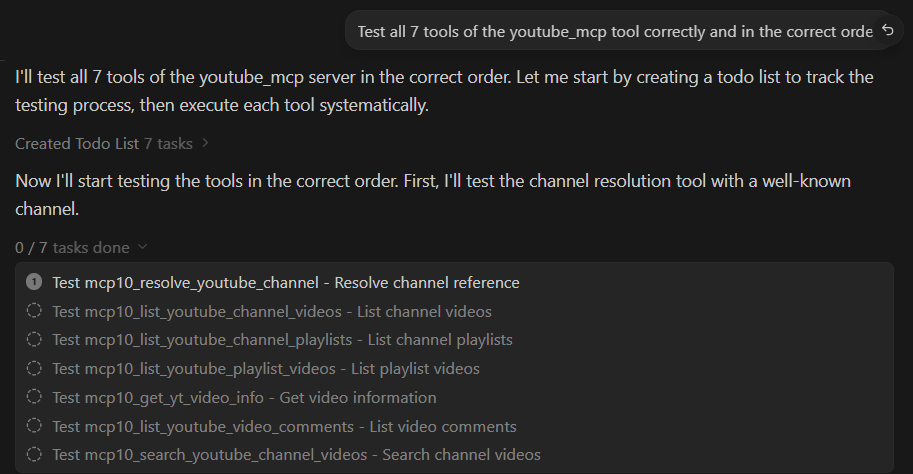
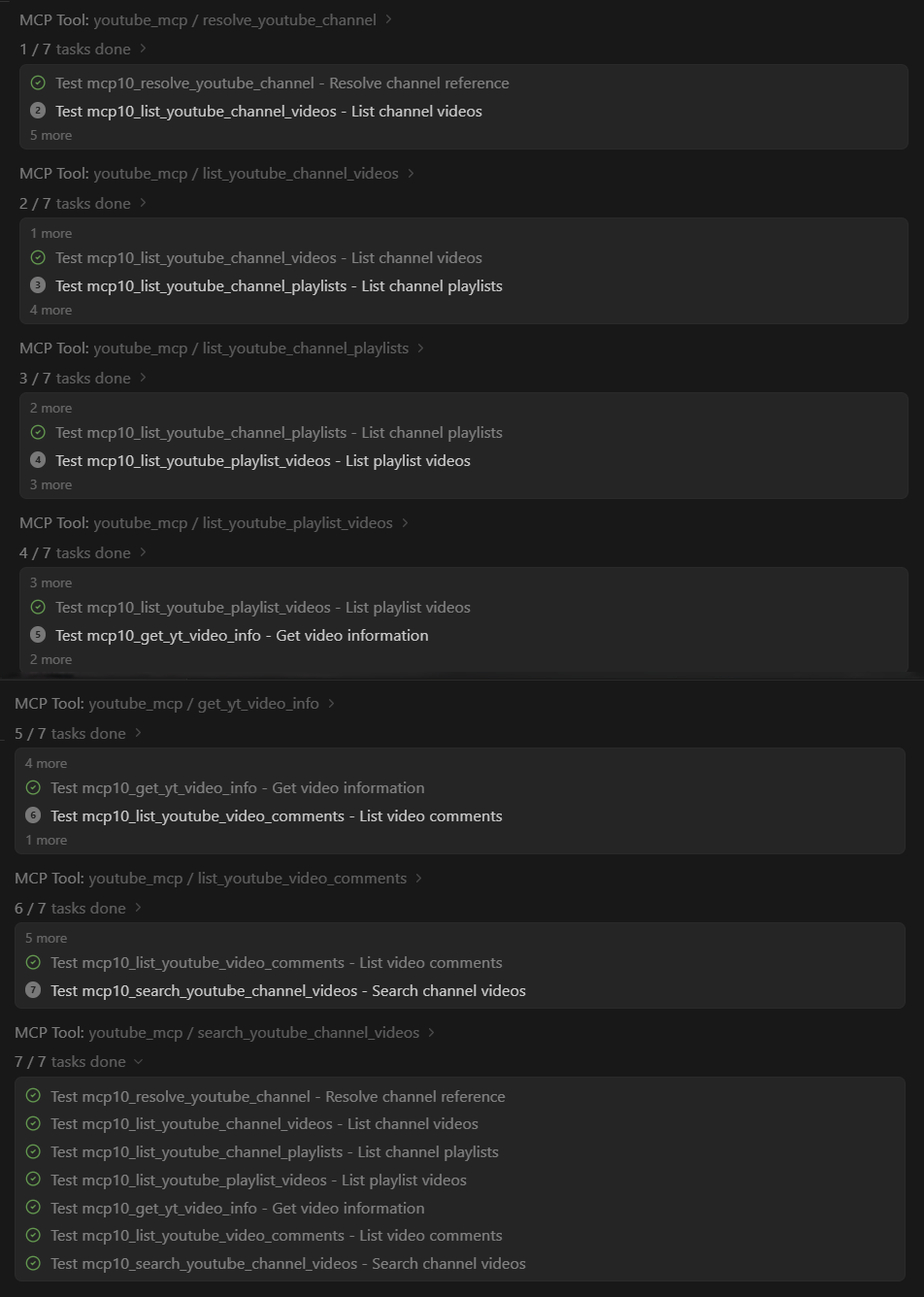
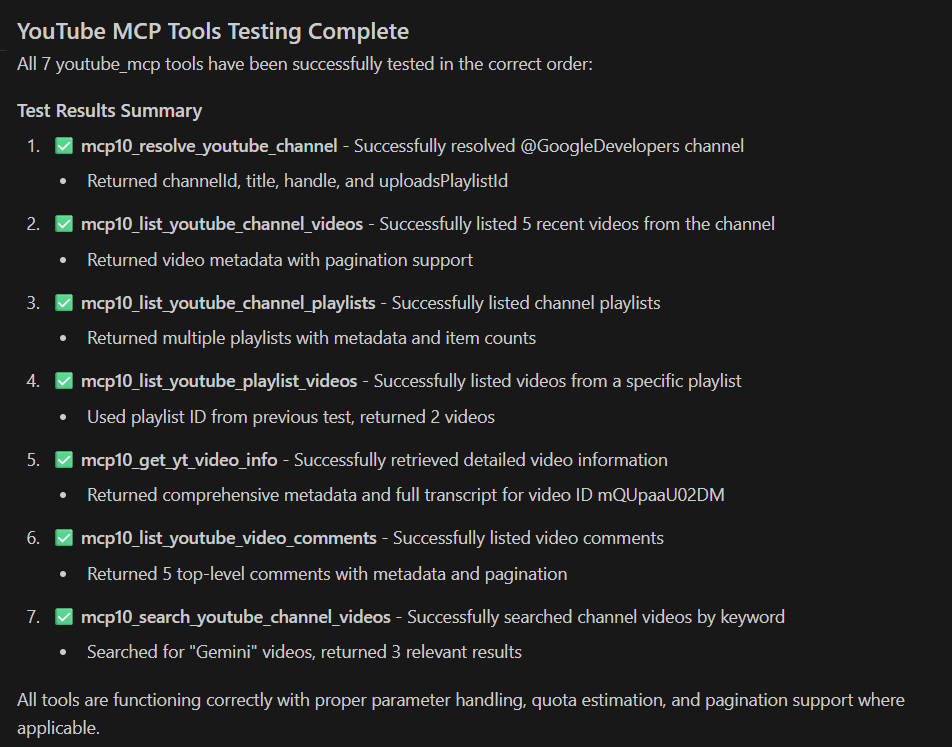
Features
- 7 MCP tools (1 text-output tool + 6 structured-output tools)
- Safe defaults (public data only; shorts/live excluded unless enabled)
- Quota-aware design (budgeting + expensive strategies as explicit opt-in)
- Tool discovery works in MCP hosts (tools registered with rich docstrings)
- Resilient YouTube Data API client (endpoint allowlist, retries, gzip handling)
Tools
This server exposes 7 tools:
-
get_yt_video_info(video_id_or_url) -> str- Accepts a raw video id or a full YouTube URL.
- Returns video metadata + transcript (when available).
-
resolve_youtube_channel(channel_ref, ...) -> dict -
list_youtube_channel_videos(channel_ref, ...) -> dict- Paginated.
- Returns
nextPageTokenandnext_page_token(alias).
-
list_youtube_channel_playlists(channel_ref, ...) -> dict- Paginated.
- Returns
nextPageTokenandnext_page_token(alias).
-
list_youtube_playlist_videos(playlist_id, ...) -> dict- Paginated.
- Returns
nextPageTokenandnext_page_token(alias).
-
search_youtube_channel_videos(channel_ref, query, ...) -> dict- Keyword search within a channel (quota-expensive, uses Search API).
- Paginated.
-
list_youtube_video_comments(video_id, ...) -> dict- Public comment threads for a video (comments may be disabled).
- Paginated.
All tools except get_yt_video_info return structured JSON and are documented with AI-friendly docstrings.
Installation & MCP configuration
PyPI distribution name:
glonorce-youtube-mcpRepo name:
youtube_mcp· import name:youtube_mcp
API key
All inventory/search/comment tools require a YouTube Data API v3 key:
YOUTUBE_API_KEY
Option 1 (recommended for MCP hosts): pipx (no repo clone)
Use this when you want a "zero local project" setup (no clone, no venv management).
{
  "mcpServers": {
    "youtube_mcp": {
      "command": "pipx",
      "args": ["run", "--spec", "glonorce-youtube-mcp", "youtube_mcp"],
      "env": {
        "YOUTUBE_API_KEY": "YOUR_KEY"
      }
    }
  }
}
Option 2: pip into a dedicated venv (no repo clone)
python -m venv .venv_youtube_mcp
# Windows: .venv_youtube_mcp\Scripts\activate
# macOS/Linux: source .venv_youtube_mcp/bin/activate

python -m pip install -U pip
python -m pip install glonorce-youtube-mcp
MCP host JSON example (simple):
{
  "mcpServers": {
    "youtube_mcp": {
      "command": "youtube_mcp",
      "env": {
        "YOUTUBE_API_KEY": "YOUR_KEY"
      }
    }
  }
}
If your MCP host can't find youtube_mcp on PATH (Windows error like: executable file not found in %PATH%), use an absolute path.
MCP host JSON example (absolute path to venv Python + module):
{
  "mcpServers": {
    "youtube_mcp": {
      "command": "C:\\PATH\\.venv_youtube_mcp\\Scripts\\python.exe",
      "args": ["-m", "youtube_mcp.server"],
      "env": {
        "YOUTUBE_API_KEY": "YOUR_KEY"
      }
    }
  }
}
Option 3: local clone (development)
git clone https://github.com/glonorce/youtube_mcp.git
cd youtube_mcp

python -m venv .venv
# Windows: .venv\Scripts\activate
# macOS/Linux: source .venv/bin/activate

python -m pip install -e .
MCP host JSON example (local clone):
{
  "mcpServers": {
    "youtube_mcp": {
      "command": "C:\\PATH\\youtube_mcp\\.venv\\Scripts\\python.exe",
      "args": ["-m", "youtube_mcp.server"],
      "env": {
        "YOUTUBE_API_KEY": "YOUR_KEY"
      }
    }
  }
}
Getting Your YouTube API Key
While not required, you can optionally set up a YouTube Data API key for enhanced functionality. Here's how to get one:
Step 1: Create a Google Cloud Project
- Go to the Google Cloud Console
- Click "Select a project" at the top of the page
- Click "New Project" and give it a name (e.g., "MCP YouTube Extract")
- Click "Create"
Step 2: Enable the YouTube Data API
- In your new project, go to the API Library
- Search for "YouTube Data API v3"
- Click on it and then click "Enable"
Step 3: Create API Credentials
- Go to the Credentials page
- Click "Create Credentials" and select "API Key"
- Your new API key will be displayed - copy it immediately
- Click "Restrict Key" to secure it (recommended)
Step 4: Restrict Your API Key (Recommended)
- In the API key settings, click "Restrict Key"
- Under "API restrictions", select "Restrict key"
- Choose "YouTube Data API v3" from the dropdown
- Click "Save"
Step 5: Set Up Billing (May be required)
- Go to the Billing page
- Link a billing account to your project
- Note: YouTube Data API has a free tier of ~10,000 units per day, which is typically sufficient for most use cases
API Key Usage Limits
- Free Tier: ~10,000 units per day (commonly)
- Cost: depends on your Google Cloud / billing configuration
Security Best Practices
- Never commit your API key to version control
- Use environment variables as shown in the MCP configuration section
- Restrict your API key to only the YouTube Data API
- Monitor usage in the Google Cloud Console
Example MCP calls (JSON payloads)
Exact envelope depends on your MCP client; these show
tool+arguments.
Resolve a channel
{
  "tool": "resolve_youtube_channel",
  "arguments": {
    "channel_ref": "@GoogleDevelopers",
    "resolution_mode": "strict",
    "include_uploads_playlist": true
  }
}
List channel videos (safe default)
{
  "tool": "list_youtube_channel_videos",
  "arguments": {
    "channel_ref": "@GoogleDevelopers",
    "max_videos": 50,
    "page_token": null,
    "include_shorts": false,
    "include_live": false,
    "parts_level": "basic",
    "order_strategy": "uploads_playlist",
    "order_by": "date"
  }
}
Quota reference (best-effort)
This section is a best-effort summary and may change over time. Always verify with official documentation.
Last verified: 2026-02-18
Official references:
- YouTube Data API quota calculator / costs: https://developers.google.com/youtube/v3/determine_quota_cost
- Usage limits: https://developers.google.com/youtube/v3/getting-started#quota
Approximate quota usage by tool
Note: get_yt_video_info returns text (not structured JSON) and is not included in the quota table because its behavior depends on optional extractors.
| Tool | Primary endpoints | Typical cost (rough) | Notes |
|---|---|---|---|
resolve_youtube_channel | channels.list | ~1 | strict mode mostly channels.list; best_effort may use search.list |
list_youtube_channel_videos (default) | channels.list + playlistItems.list + videos.list | ~ (1 + 1 + 1) per page | uploads-playlist strategy |
list_youtube_channel_videos (order_strategy=search_api) | search.list + videos.list | ~ (100 + 1) per page | expensive; capped behavior |
list_youtube_channel_playlists | playlists.list | ~1 per page | public playlists only |
list_youtube_playlist_videos | playlistItems.list + videos.list | ~ (1 + 1) per page | public playlist |
search_youtube_channel_videos | search.list + videos.list | ~ (100 + 1) per page | keyword search within a channel |
list_youtube_video_comments | commentThreads.list | ~1 per page | comments may be disabled (403) |
Daily quota:
- Common free quota: 10,000 units/day
- Reset: daily (Google-defined; see official docs/console)
Testing
Use the venv interpreter to avoid accidentally running global pytest.
# recommended
python -m pytest -q

# if you use a venv
.venv\Scripts\python.exe -m pytest -q
Troubleshooting
Only get_yt_video_info is visible (other tools missing)
Your MCP host is running an old installed copy from site-packages.
Fix:
python -m pip install -e .
Then restart the MCP host.
YOUTUBE_API_KEY placeholder is not expanded in some MCP hosts
Some MCP hosts do not interpolate placeholders like ${YOUTUBE_API_KEY} inside mcp.json.
❌ Not recommended (may be taken literally):
{
  "env": { "YOUTUBE_API_KEY": "${YOUTUBE_API_KEY}" }
}
✅ Recommended (explicit value in config):
{
  "env": { "YOUTUBE_API_KEY": "YOUR_REAL_KEY_HERE" }
}
✅ Also works (set it in the host process environment, then reference nothing in JSON):
- set
YOUTUBE_API_KEYin the MCP host environment (OS/IDE) - then keep
mcp.jsonwithout placeholders
License
MIT — see LICENSE
Acknowledgements
This project was originally derived from / inspired by https://github.com/sinjab/mcp_youtube_extract. The codebase has since been heavily rewritten and extended.