Annota — AI-Powered Paper Annotation Assistant
Turn your PDF library into an intelligent research assistant.
AI reads your papers, highlights key findings, explains formulas, and writes structured notes — all saved back to your reference manager.



Features · Quick Start · Usage Examples · Screenshots · Roadmap
What Can It Do?
| You say... | AI does... |
|---|---|
| "高亮摘要中的发现结果" (Highlight findings in the abstract) | Reads the abstract, identifies findings, highlights them in green |
| "解释第3页的公式" (Explain the formulas on page 3) | Extracts the formula, adds an explanation as a note annotation |
| "写一份结构化阅读笔记" (Write a structured reading note) | Generates a note with contributions, methods, results, limitations — saved to your library |
| "以 MICRO 审稿人视角审阅" (Review as a MICRO reviewer) | Produces a structured review with scores and actionable feedback |
AI reads the paper → understands content → creates precise annotations
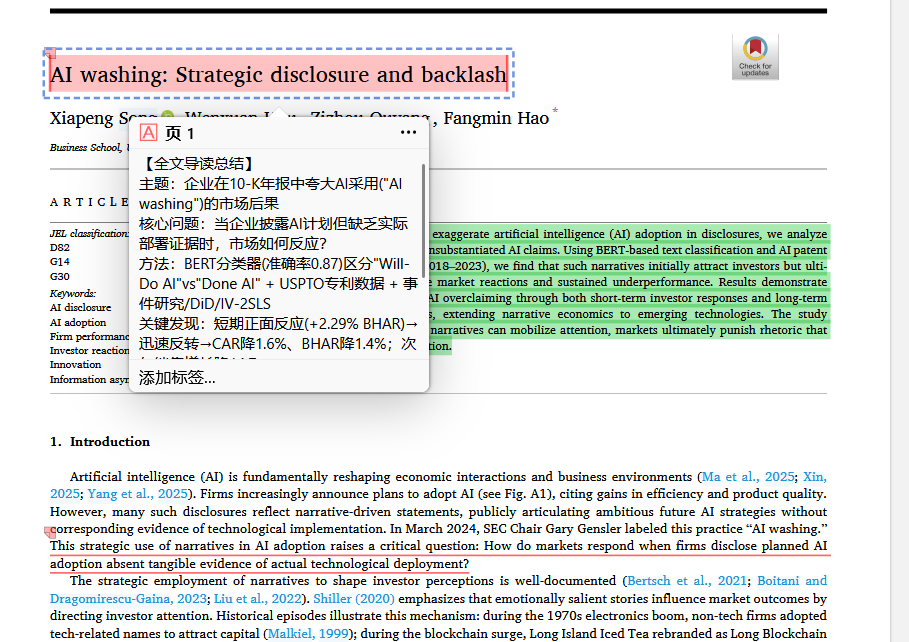
AI generates a structured reading summary with key findings, methods, and conclusions
✨ Features
9 MCP Tools
| Tool | What it does |
|---|---|
search_zotero_items | Search by title / author / key |
list_zotero_items | Browse recent items |
get_item_metadata | Get authors, year, venue, DOI |
get_pdf_text_bulk | Extract full text (no coords, fast) |
get_pdf_layout_text | Extract text + precise coordinates |
list_annotations | View existing annotations |
create_pdf_annotation | Create highlight / underline |
batch_annotate | Create multiple annotations at once |
add_child_note | Add a note to any item |
3 Claude Code Skills (Slash Commands)
| Command | Function |
|---|---|
/annota-annotate | Smart annotation with semantic color coding |
/annota-summarize | Structured reading notes saved to your library |
/annota-review | Simulated peer review with scoring rubric |
Smart Design
- Two-phase workflow — Reads full text first (cheap), then only gets coordinates for target sentences (precise). Reduces context usage by 63–80%.
- Auto-skip references — Detects "References" section and skips it. A 21-page paper extracts only 13 pages.
- Batch annotations — Creates 10 highlights in 1 API call instead of 10.
- Friendly errors — Write failures return helpful messages instead of crashing.
🚀 Quick Start (3 Minutes)
Step 1: Clone & Install
git clone https://github.com/dengls24/annota.git
cd annota

python -m venv .venv
# Windows:
.venv\Scripts\activate
# Linux/Mac:
# source .venv/bin/activate

pip install pymupdf mcp
Step 2: Configure Claude Code
Add to ~/.claude.json (or via Claude Code Settings > MCP Servers):
{
  "mcpServers": {
    "annota": {
      "command": "YOUR_PATH/annota/.venv/Scripts/python.exe",
      "args": ["YOUR_PATH/annota/annota/server.py"],
      "env": {
        "ZOTERO_DATA_DIR": "YOUR_ZOTERO_DATA_DIR"
      }
    }
  }
}
Finding your Zotero data directory: Zotero → Edit → Settings → Advanced → Files and Folders → Data Directory Location
Step 3: Use It
Just talk to Claude naturally:
# Chinese: 把这篇论文摘要中的发现结果用绿色标出来
# English: Highlight the findings in this paper's abstract in green
"E:\papers\my-paper.pdf"
Or use slash commands:
/annota-annotate "path/to/paper.pdf" highlight experimental results
/annota-summarize "path/to/paper.pdf"
/annota-review "path/to/paper.pdf" ISCA
(Optional) Install Skills Globally
# Make skills available in all projects
cp -r .claude/skills/ ~/.claude/skills/
📖 Usage Examples
Example 1: Highlight Key Findings
Input:
把这篇论文摘要中的发现结果用绿色标出来
(Highlight the findings in this paper's abstract in green)
"E:\Zotero\storage\ABCD1234\Song et al. - 2025 - AI washing.pdf"
Result:
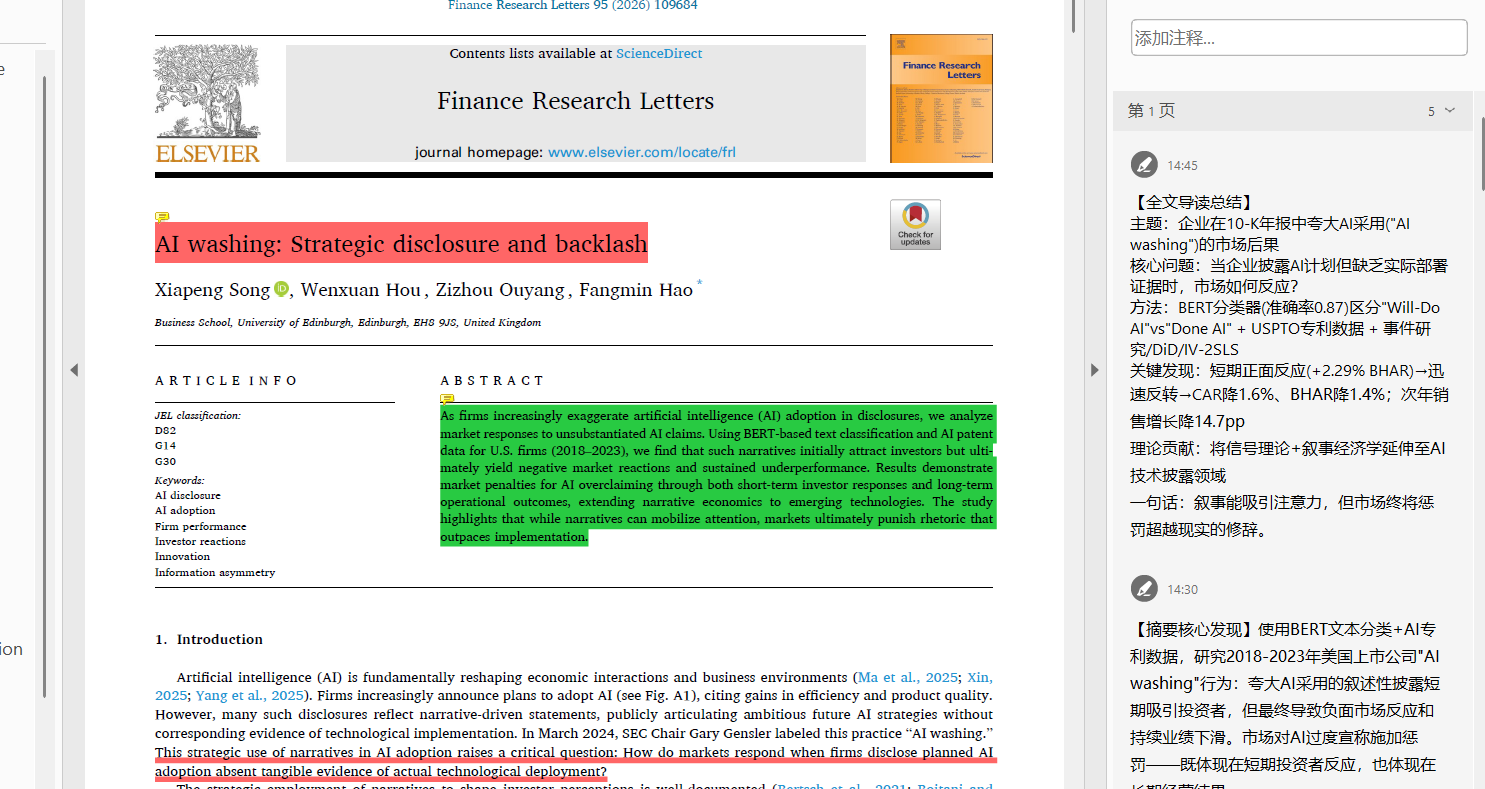
AI identifies findings in the abstract and highlights them in green
Example 2: Annotate Hypotheses & Theories
Input:
标注论文中的假设(H1, H2),并用中文解释每个假设的理论基础
(Annotate the hypotheses (H1, H2) and explain the theoretical basis of each in Chinese)
Result:
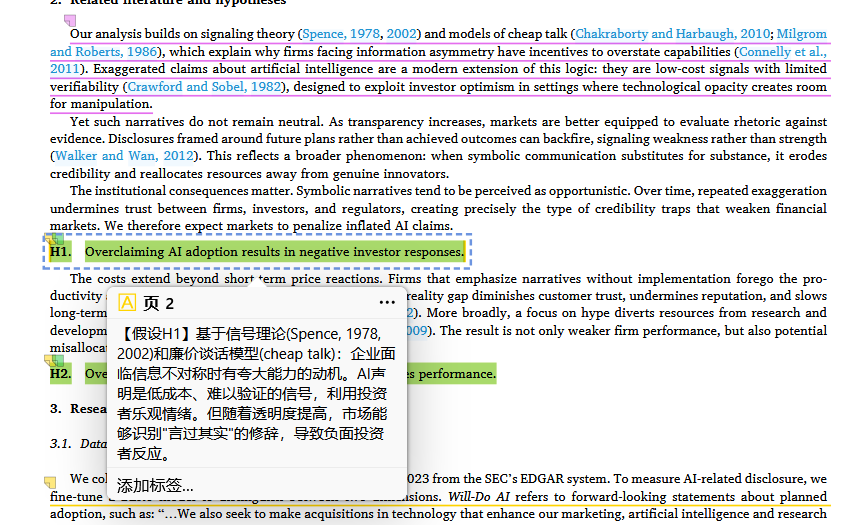
Hypotheses highlighted in yellow, with Chinese explanation notes for the underlying theory
Example 3: Explain Formulas
Input:
解释论文中的核心公式,添加中文注释
(Explain the key formulas in this paper, add Chinese annotations)
Result:
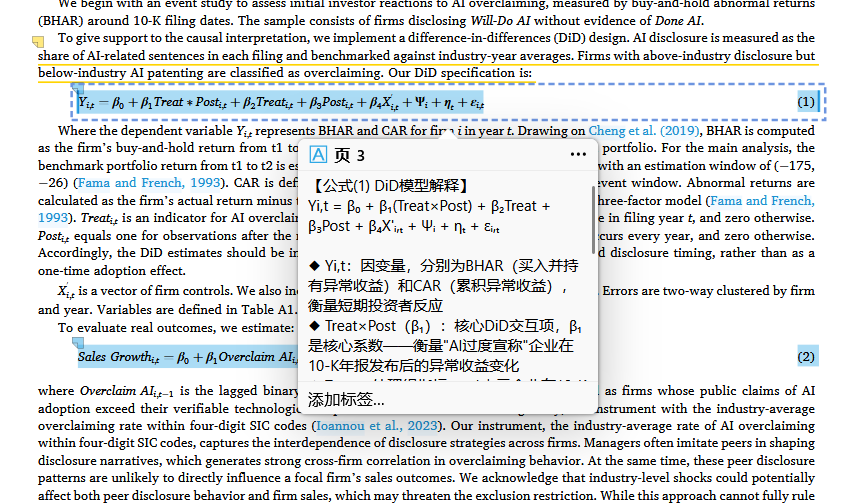
DID model formula annotated with variable explanations in Chinese
Example 4: Policy Implications & Conclusion Notes
Input:
标注结论部分的政策启示,添加中文总结笔记
(Highlight policy implications in the conclusion, add a Chinese summary note)
Result:
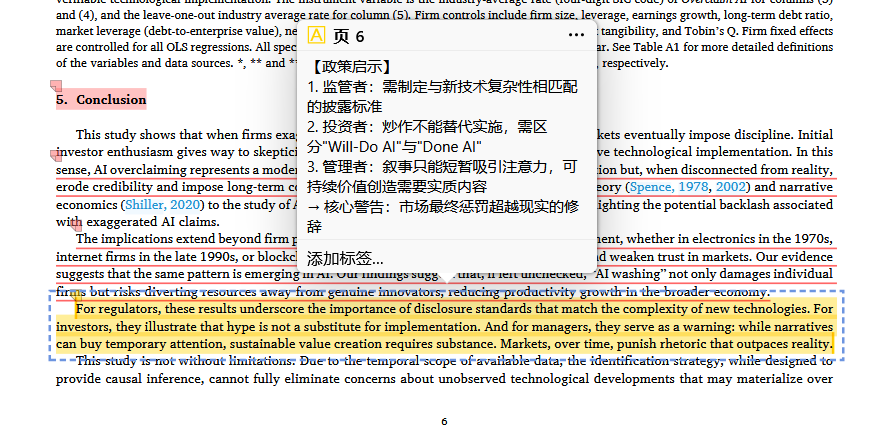
Conclusion highlighted with a structured policy implications note
Example 5: Full Paper Reading Notes
Input:
/annota-summarize "path/to/paper.pdf"
Result:
AI generates a complete reading summary: topic, research question, method, key findings, and implications
Example 6: Detailed Paragraph-by-Paragraph Notes
Input:
逐段阅读这篇论文,为每个重要段落添加中文批注
(Read this paper paragraph by paragraph, add Chinese annotations to each important section)
Result:
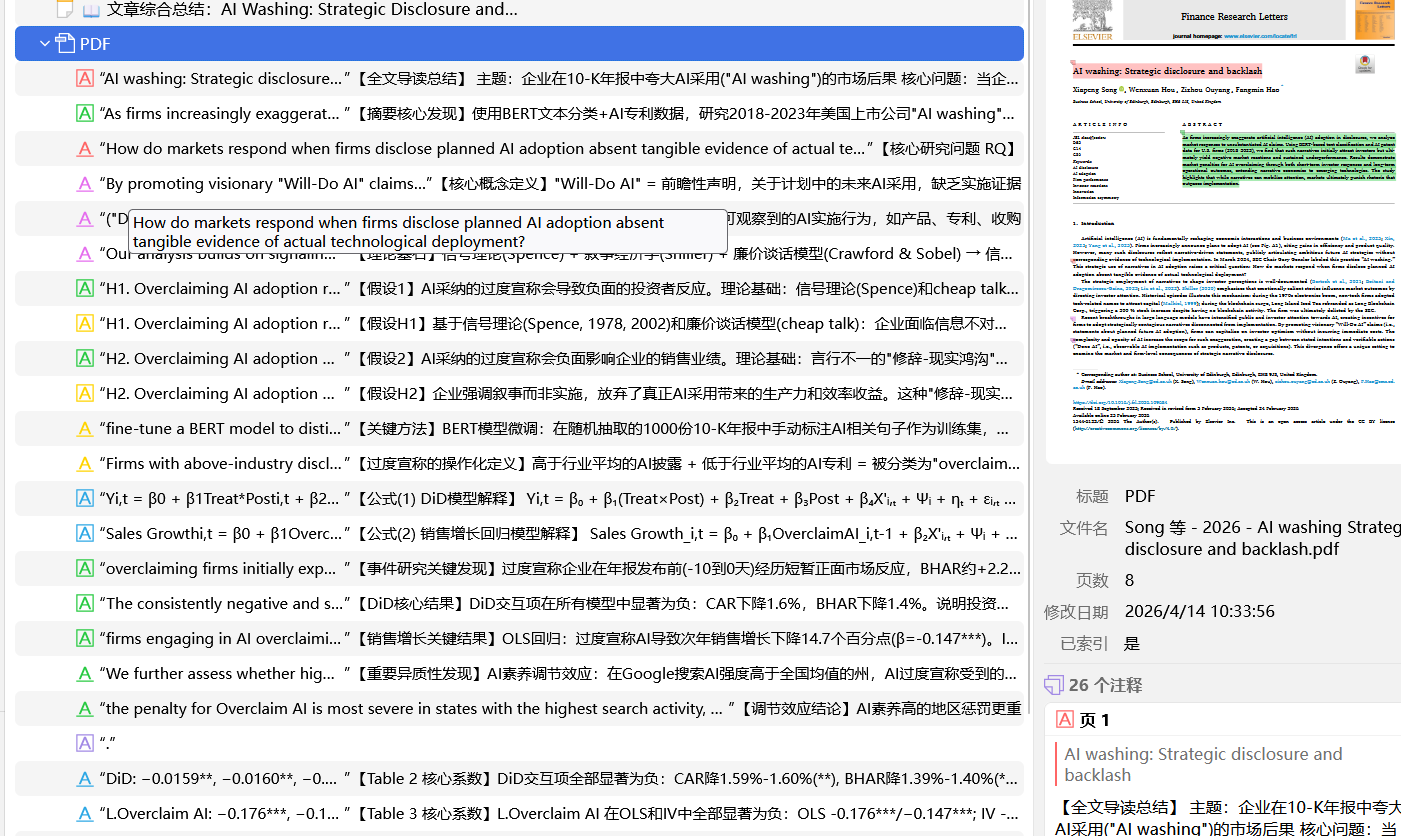
Each important paragraph gets a Chinese annotation explaining the content
Example 7: The AI Workflow in Action
Here's what Claude Code looks like when processing a paper:
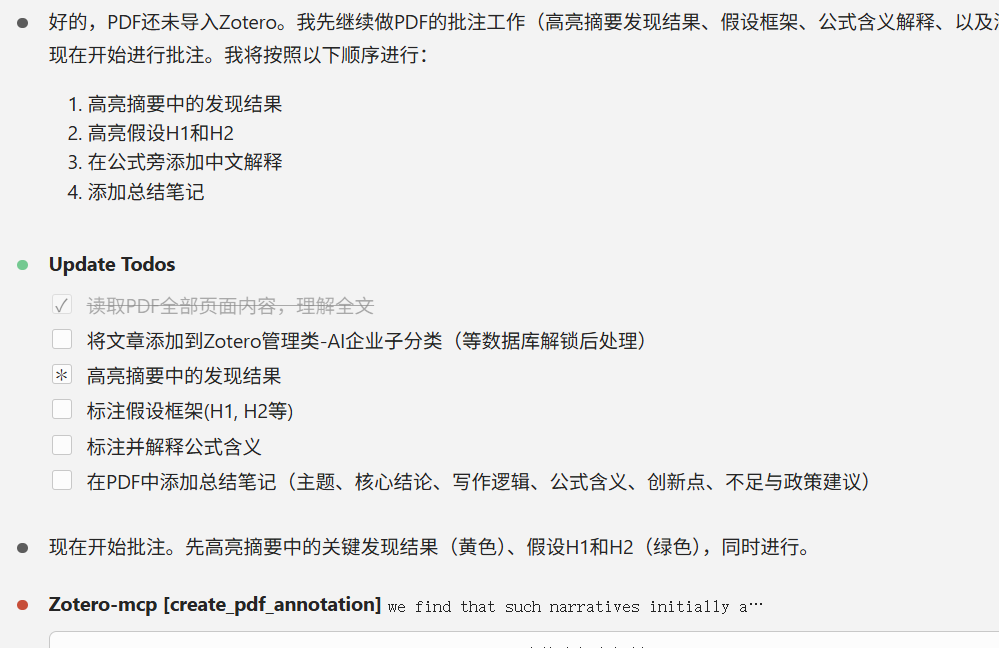
Claude creates a task list, reads the PDF, and calls MCP tools to create annotations step by step
🎨 Color Convention
| Color | Code | Use for |
|---|---|---|
| 🟡 Yellow | #ffd400 | Default / general highlights |
| 🟢 Green | #28CA42 | Results, findings, data |
| 🔵 Blue | #2EA8E5 | Methods, definitions, algorithms |
| 🔴 Red | #ff6666 | Limitations, issues, problems |
| 🟣 Purple | #a28ae5 | Contributions, novelty |
⚡ How It Handles Large PDFs
For papers >10 pages, a two-phase workflow avoids context overflow:
Phase 1 — Understand (lightweight)
  get_pdf_text_bulk(pdf, skip_refs=True)
  → Full text without coordinates
  → AI identifies which sentences to annotate

Phase 2 — Annotate (precise)
  get_pdf_layout_text(pdf, target_page_only)
  → Coordinates for 1–2 target pages
  batch_annotate(pdf, all_annotations)
  → Write everything in one call
Real-world performance:
| Paper | Pages | Old approach | New approach | Savings |
|---|---|---|---|---|
| Conference paper | 2 pages | 41 KB coords | 15 KB text | 63% |
| Journal article | 21 pages | 21 pages extracted | 13 pages (refs skipped at p.13) | 38% |
| Survey paper | 19 pages | 19 pages extracted | 10 pages (refs skipped at p.10) | 47% |
📁 Project Structure
annota/
├── annota/                        # MCP Server (Python)
│   ├── server.py                  # 9 tool registrations
│   ├── zotero_db.py               # SQLite read/write layer
│   ├── pdf_tools.py               # PyMuPDF text extraction
│   └── config.py                  # Constants & configuration
├── .claude/skills/                # Claude Code Skills
│   ├── annota-annotate/SKILL.md   # /annota-annotate
│   ├── annota-summarize/SKILL.md  # /annota-summarize
│   └── annota-review/SKILL.md     # /annota-review
├── docs/                          # Design documents
│   ├── annota-guide.md            # Usage guide (CN)
│   ├── large-pdf-design.md        # Large PDF handling design
│   ├── dev-notes.md               # Pitfalls & solutions
│   └── commercial-plan.md         # Commercialization plan
├── assets/                        # Screenshots
└── README.md
⚠️ Known Limitations & Disclaimer
Database Direct Access: Annota writes annotations directly to the Zotero SQLite database, which bypasses Zotero's internal consistency mechanisms. This is a design choice to enable fully offline, local-first annotation workflows without depending on external services. Users are responsible for their own database — please back up your
zotero.sqlitebefore use. We plan to migrate to the official Zotero Web API / Local API in future versions.
| Limitation | Workaround | Planned Fix |
|---|---|---|
| Direct SQLite write (not officially supported) | Back up your database before use | Migrate to Zotero Local API / Web API |
| Write ops need Zotero closed | Close Zotero before annotating | Local API bridge |
| References detection is heuristic | Pass skip_refs=False if needed | Improve heuristics |
| Tested on Windows only | Should work on Linux/Mac | Cross-platform testing |
🗺 Roadmap
- Zotero Local API / Web API — Migrate from direct SQLite to official API for safer writes
- More skills —
/compare-papers,/extract-tables,/literature-map - Prompt template marketplace — Share and reuse annotation rules
- Team features — Shared annotation standards for lab groups
- Multi-backend — Support Adobe Acrobat, Endnote, and other PDF tools
🤝 Contributing
Issues and PRs are welcome! If you have ideas for new skills or tools, please open an issue.
📄 License
MIT — Use it freely for research and commercial projects.
Built with MCP + Claude Code
If this project helps your research, consider giving it a ⭐